ChemistryUnit 28 min read
Ionic Equilibrium: Acids, Bases, Salts, pH, Buffers & Solubility
Unit 2 of Chemistry explains how ions behave in solution, covering acid-base theories (Arrhenius, Brønsted-Lowry, Lewis), pH calculations, hydrolysis, buffer solutions, and solubility product principles with real-world applications.
What is Ionic Equilibrium?
Ionic equilibrium refers to the dynamic balance between ions in a solution. When a substance dissolves in water, it breaks into ions (charged particles). These ions move freely, but their concentrations remain constant over time—this is called equilibrium.
Example: When sodium chloride (NaCl) dissolves in water:
NaCl (s) ⇌ Na⁺ (aq) + Cl⁻ (aq)
Here, the forward and backward reactions happen at the same rate, so the concentrations of Na⁺ and Cl⁻ stay the same.
1. Acids and Bases: Definitions and Theories
A. Arrhenius Theory (Oldest Definition)
- Acid: A substance that releases H⁺ ions in water. Example: HCl → H⁺ + Cl⁻
- Base: A substance that releases OH⁻ ions in water. Example: NaOH → Na⁺ + OH⁻
Limitation: Only works for aqueous solutions.
B. Brønsted-Lowry Theory (More General)
- Acid: A proton (H⁺) donor.
- Base: A proton (H⁺) acceptor.
Example:
HCl + H₂O ⇌ H₃O⁺ + Cl⁻
Here, HCl donates H⁺ → acid, and H₂O accepts H⁺ → base.
C. Lewis Theory (Most General)
- Acid: An electron pair acceptor (e.g., BF₃).
- Base: An electron pair donor (e.g., NH₃).
Example:
BF₃ + NH₃ → BF₃:NH₃
BF₃ accepts electrons → Lewis acid, NH₃ donates electrons → Lewis base.
2. Strength of Acids and Bases
A. Strong vs. Weak Acids/Bases
| Type | Definition | Example | Dissociation |
|---|---|---|---|
| Strong Acid | Fully dissociates in water | HCl, HNO₃, H₂SO₄ | HCl → H⁺ + Cl⁻ (100%) |
| Weak Acid | Partially dissociates | CH₃COOH, H₂CO₃ | CH₃COOH ⇌ CH₃COO⁻ + H⁺ (partial) |
| Strong Base | Fully dissociates | NaOH, KOH | NaOH → Na⁺ + OH⁻ (100%) |
| Weak Base | Partially reacts with water | NH₃, CH₃NH₂ | NH₃ + H₂O ⇌ NH₄⁺ + OH⁻ (partial) |
B. Ionization Constant (Ka and Kb)
- Ka (Acid Dissociation Constant):
For a weak acid HA:
Example: For acetic acid (CH₃COOH), Ka = 1.8 × 10⁻⁵.HA ⇌ H⁺ + A⁻ Ka = [H⁺][A⁻] / [HA]
- Kb (Base Dissociation Constant):
For a weak base B:
Example: For ammonia (NH₃), Kb = 1.8 × 10⁻⁵.B + H₂O ⇌ BH⁺ + OH⁻ Kb = [BH⁺][OH⁻] / [B]
Note: Strong acids/bases have very large Ka/Kb (almost complete dissociation).
3. pH Scale and Hydrogen Ion Concentration
- pH = -log[H⁺]
- pH < 7: Acidic (e.g., lemon juice, pH ≈ 2)
- pH = 7: Neutral (pure water)
- pH > 7: Basic (e.g., soap, pH ≈ 10)
Example Calculation: If [H⁺] = 1 × 10⁻³ M, then:
pH = -log(1 × 10⁻³) = 3
Relationship between pH and pOH:
pH + pOH = 14
Example: If pH = 5, then pOH = 9.
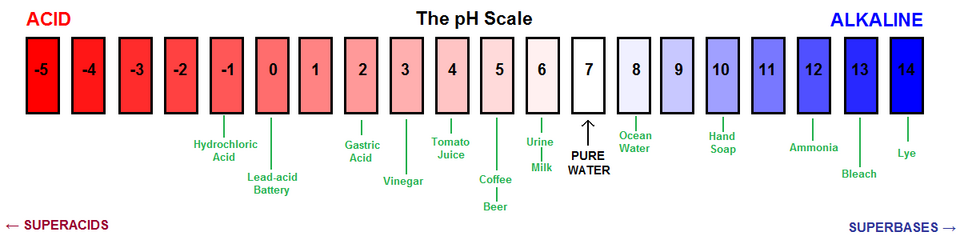 A labelled pH scale from 0 to 14 with examples (lemon, water, soap) (Image: Piercetheorganist at English Wikipedia, Public domain, via Wikimedia Commons)
4. Hydrolysis of Salts
When salts dissolve in water, their ions can react with water (hydrolysis), changing the pH.
A. Cations from Weak Bases + Anions from Strong Acids → Acidic Solution
Example: NH₄Cl (from NH₄⁺ and Cl⁻)
NH₄⁺ + H₂O ⇌ NH₃ + H₃O⁺ (acidic)
B. Cations from Strong Bases + Anions from Weak Acids → Basic Solution
Example: CH₃COONa (from CH₃COO⁻ and Na⁺)
CH₃COO⁻ + H₂O ⇌ CH₃COOH + OH⁻ (basic)
C. Both Ions Hydrolyze → pH Depends on Ka/Kb
Example: CH₃COONH₄
- CH₃COO⁻ hydrolyzes to OH⁻ (basic)
- NH₄⁺ hydrolyzes to H⁺ (acidic)
- Net pH depends on Ka/Kb values.
5. Buffer Solutions
A buffer resists changes in pH when small amounts of acid or base are added.
How Buffers Work
- Made from a weak acid + its conjugate base (or weak base + its conjugate acid).
- Example: CH₃COOH + CH₃COONa
Buffer Capacity
- Henderson-Hasselbalch Equation:
Example: For a buffer with pKa = 4.75 and [A⁻]/[HA] = 1:pH = pKa + log([A⁻]/[HA])pH = 4.75 + log(1) = 4.75
Applications of Buffers
- Biological: Blood (pH ≈ 7.4, buffered by H₂CO₃/HCO₃⁻)
- Industrial: Soap, food preservation
6. Solubility Product (Ksp)
When a sparingly soluble salt dissolves, it reaches equilibrium:
AgCl (s) ⇌ Ag⁺ (aq) + Cl⁻ (aq)
Solubility Product Constant (Ksp):
Ksp = [Ag⁺][Cl⁻]
Example: For AgCl, Ksp = 1.8 × 10⁻¹⁰.
Factors Affecting Solubility
- Temperature: Most solids become more soluble with heat.
- Common Ion Effect: Adding a common ion decreases solubility. Example: Adding NaCl to AgCl solution shifts equilibrium left → less AgCl dissolves.
Solubility vs. Ksp
| Salt | Ksp | Solubility (mol/L) |
|---|---|---|
| AgCl | 1.8 × 10⁻¹⁰ | 1.3 × 10⁻⁵ |
| CaF₂ | 3.9 × 10⁻¹¹ | 2.0 × 10⁻⁴ |
Exam Tip: How to Score Full Marks in NEB Exams
Memorize Key Formulas:
- pH = -log[H⁺]
- Ka = [H⁺][A⁻]/[HA]
- Ksp = [cation][anion]
- Henderson-Hasselbalch: pH = pKa + log([A⁻]/[HA])
Practice pH Calculations:
- Always convert [H⁺] to pH and vice versa.
- Example: If [OH⁻] = 1 × 10⁻², find pH.
- pOH = -log(1 × 10⁻²) = 2
- pH = 14 - pOH = 12
Understand Buffer Problems:
- Identify weak acid/conjugate base pairs.
- Use Henderson-Hasselbalch for pH calculations.
Solubility Questions:
- Always write the dissociation equation first.
- Use ICE (Initial-Change-Equilibrium) tables for Ksp problems.
Common Mistakes to Avoid:
- Forgetting units (always use M for molarity).
- Ignoring activity coefficients in simple problems.
- Misapplying Ksp for miscible vs. insoluble salts.
NEB Board-Style Questions (Solved Examples)
Question 1: pH Calculation
A solution has [H⁺] = 5 × 10⁻⁴ M. Calculate its pH and classify it as acidic or basic. Solution:
pH = -log(5 × 10⁻⁴) = -[log(5) + log(10⁻⁴)] = -[0.7 - 4] = 3.3
Since pH < 7 → acidic.
Question 2: Buffer pH
A buffer is made with 0.1 M CH₃COOH (Ka = 1.8 × 10⁻⁵) and 0.2 M CH₃COONa. Calculate its pH. Solution: Using Henderson-Hasselbalch:
pH = pKa + log([A⁻]/[HA]) = -log(1.8 × 10⁻⁵) + log(0.2/0.1)
pH = 4.75 + log(2) = 4.75 + 0.30 = 5.05
Question 3: Solubility Product
The Ksp of Ag₂CrO₄ is 1.1 × 10⁻¹². Calculate its solubility in mol/L. Solution:
Ag₂CrO₄ ⇌ 2Ag⁺ + CrO₄²⁻
Let s = solubility.
Ksp = [2s]² [s] = 4s³ = 1.1 × 10⁻¹²
s³ = 2.75 × 10⁻¹³ → s = 1.4 × 10⁻⁴ mol/L
Summary Table: Key Concepts
| Topic | Key Idea | Formula/Example |
|---|---|---|
| Acid-Base Theories | Brønsted-Lowry is most general | HCl donates H⁺ → acid |
| pH Scale | pH = -log[H⁺] | [H⁺] = 10⁻³ → pH = 3 |
| Buffers | Resist pH change | pH = pKa + log([A⁻]/[HA]) |
| Hydrolysis | Salts affect pH | NH₄Cl → acidic, CH₃COONa → basic |
| Solubility (Ksp) | Equilibrium for insoluble salts | AgCl ⇌ Ag⁺ + Cl⁻, Ksp = [Ag⁺][Cl⁻] |
Final Note: Ionic equilibrium is everywhere—from stomach acid (HCl) to blood buffers (HCO₃⁻/CO₂). Master the definitions, formulas, and problem-solving steps, and you’ll ace NEB exams!
Based on the NEB +2 Science syllabus for Chemistry (Chem), unit 2.
Discussion
Loading…