EnglishUnit 79 min read
Democracy & Human Rights: Types, Rights, Challenges
Unit 7 of English explores democracy’s principles, types (direct/indirect), human rights (civil, political, economic), and their global challenges, with NEB-style exercises and writing tasks.
TAKEAWAYS:
- Democracy is a system where power comes from the people, either directly or through elected representatives.
- Human rights include civil (freedom of speech), political (right to vote), and economic (right to work) rights.
- Challenges to democracy include corruption, lack of education, and human rights violations.
- Writing tasks in this unit focus on essays, letters, and reports on democracy and human rights issues.
- NEB exams test comprehension, critical thinking, and application of concepts through short answers and essays.
What is Democracy?
Democracy is a system of government where power belongs to the people. The word comes from Greek: demos (people) + kratos (power). In democracy, citizens have the right to choose their leaders through free and fair elections.
Types of Democracy
There are two main types:
Direct Democracy
- Citizens vote directly on laws and policies.
- Example: Ancient Athens (Greece) where citizens gathered to decide on issues.
- Pros: People have direct control.
- Cons: Difficult to manage in large countries.
Indirect (Representative) Democracy
- Citizens elect representatives (e.g., MPs, presidents) to make decisions.
- Example: Nepal, India, the USA.
- Pros: Efficient for large populations.
- Cons: Representatives may not always act in the people’s best interest.
Key Features of Democracy
- Free and Fair Elections: Everyone has the right to vote.
- Rule of Law: Laws apply to all, including leaders.
- Fundamental Rights: Freedom of speech, religion, and press.
- Separation of Powers: Government divided into branches (executive, legislative, judiciary).
Human Rights
Human rights are basic rights that every person is entitled to simply because they are human. They include:
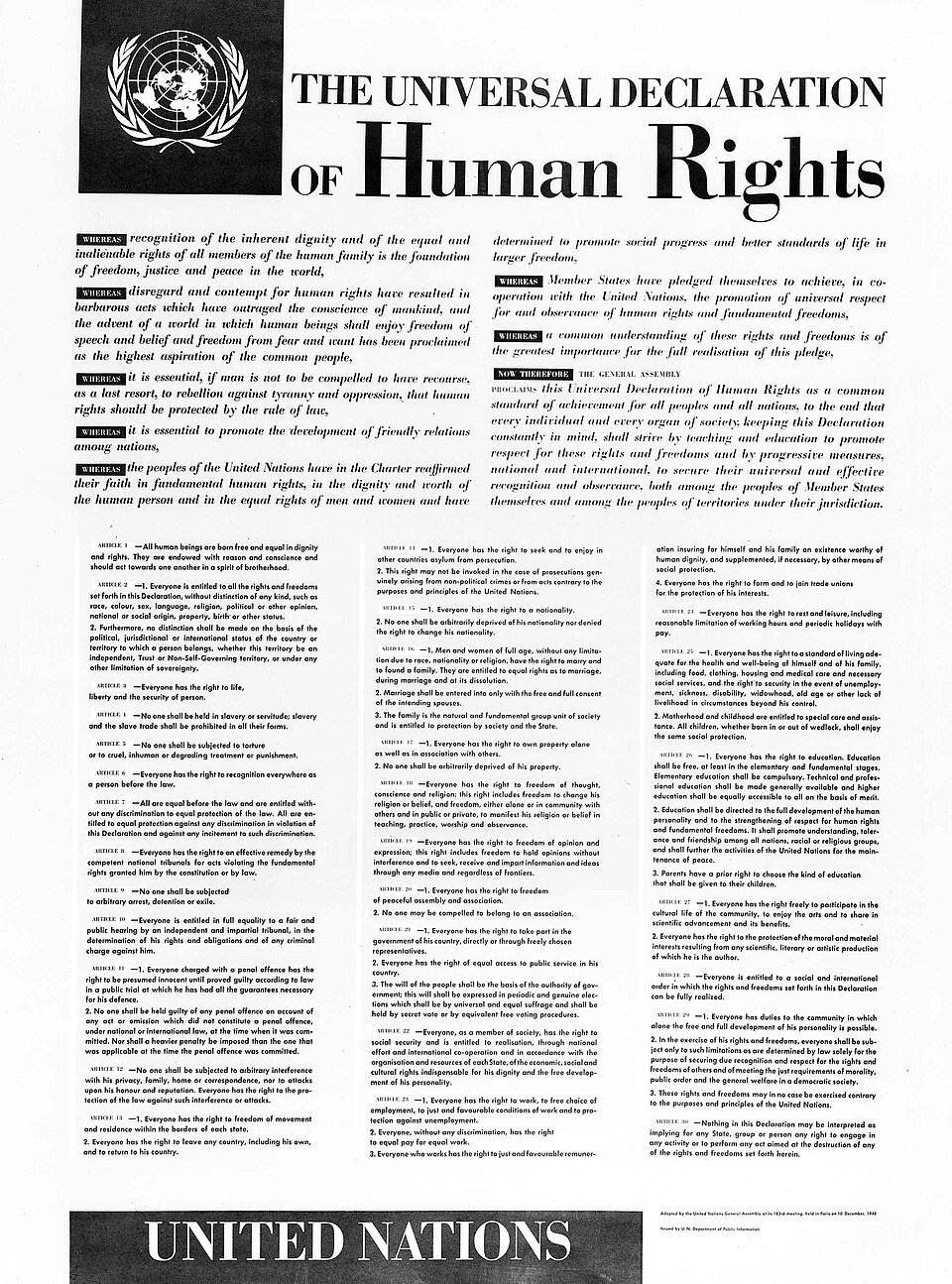 The first page of the UN’s Universal Declaration of Human Rights (UDHR), adopted in 1948, listing 30 fundamental rights. (Image: UN, Public domain, via Wikimedia Commons)
Types of Human Rights
| Category | Examples |
|---|---|
| Civil Rights | Freedom of speech, religion, movement, and equality before the law. |
| Political Rights | Right to vote, participate in government, and freedom from torture. |
| Economic Rights | Right to work, fair wages, and social security. |
| Social Rights | Right to education, healthcare, and a clean environment. |
Universal Declaration of Human Rights (UDHR)
- Adopted by the UN in 1948.
- Lists 30 rights, including:
- Right to life, liberty, and security.
- Freedom from slavery and torture.
- Right to education and healthcare.
Challenges to Democracy and Human Rights
Despite progress, democracy and human rights face challenges:
Corruption
- Leaders misuse power for personal gain.
- Example: Bribery in elections or government contracts.
Lack of Education
- Illiterate citizens may not understand their rights or vote wisely.
Violence and Conflict
- Wars and political instability disrupt democracy.
- Example: Military coups overthrowing elected governments.
Human Rights Violations
- Discrimination, censorship, and oppression.
- Example: Restrictions on freedom of speech in some countries.
Democracy and Human Rights in Nepal
Nepal is a democratic country with:
- A constitution guaranteeing fundamental rights.
- Free elections (last held in 2022).
- Challenges:
- Political instability (frequent government changes).
- Caste-based discrimination.
- Media censorship in some cases.
Writing Tasks: Essays, Letters, and Reports
NEB exams test your ability to write about democracy and human rights. Here are two common formats:
1. Formal Letter (Complaint About Human Rights Violation)
Sample 1: Complaint to a Human Rights Organization
[Your Name]
[Your Address]
[Date]

The Chairperson,
Human Rights Watch Nepal
Kathmandu

Subject: Complaint Regarding Police Brutality

Dear Sir/Madam,

I am writing to report a serious violation of human rights that occurred on [date] in [location]. A group of police officers unlawfully detained and beat [name], a local resident, without any valid reason. This incident violates Article 10 of the Universal Declaration of Human Rights, which guarantees protection from torture and cruel treatment.

I request your immediate intervention to investigate this matter and ensure justice for the victim. Please take necessary actions to prevent such abuses in the future.

Thank you for your attention.

Yours sincerely,
[Your Name]
Explanation of Parts:
- Sender’s Address: Your contact details.
- Date: When the letter was written.
- Recipient’s Address: Organization you are writing to.
- Subject: Brief summary of the complaint.
- Body:
- Introduction (what happened).
- Details (who, when, where, how).
- Request for action.
- Closing: Polite sign-off.
2. Essay: "Democracy is the Best Form of Government"
Sample Essay (NEB Style)
Democracy is widely considered the best form of government because it ensures people’s participation in decision-making. Unlike dictatorships or monarchies, democracy allows citizens to choose their leaders through free and fair elections. This system protects individual rights, such as freedom of speech and religion, which are often suppressed in authoritarian regimes.

One key advantage of democracy is accountability. Elected leaders must answer to the people, reducing corruption and misuse of power. For example, in Nepal, the constitution guarantees fundamental rights, and citizens can protest or vote out leaders who fail them. Additionally, democracy promotes peace and stability because conflicts are resolved through dialogue rather than force.

However, democracy faces challenges like illiteracy and corruption. In some countries, elections are rigged, and leaders ignore public demands. Despite these issues, democracy remains the fairest system because it values human dignity and equality.

In conclusion, democracy is the best form of government because it empowers people, protects rights, and fosters development. While imperfect, it is the foundation of a just society.
Structure of an Essay:
- Introduction: State the topic and your main argument.
- Body Paragraphs:
- Point 1: Advantage of democracy (e.g., free elections).
- Point 2: How it protects rights.
- Counterpoint: Challenges (e.g., corruption).
- Conclusion: Summarize your argument and reinforce your stance.
NEB-Style Questions and Answers
Short Answer Questions
Define democracy.
- Democracy is a system of government where power belongs to the people, who exercise it either directly or through elected representatives.
List two civil rights.
- Freedom of speech and freedom of religion.
What is the Universal Declaration of Human Rights?
- It is a UN document adopted in 1948 that lists 30 fundamental human rights.
Name one challenge to democracy in Nepal.
- Political instability or corruption.
What is the difference between direct and indirect democracy? |
Direct Democracy Indirect Democracy Citizens vote directly. Citizens elect representatives. Example: Ancient Athens. Example: Nepal, USA.
Long Answer Questions
Explain the importance of human rights in a democratic society.
- Human rights are essential in democracy because they ensure fairness and equality. Rights like freedom of speech allow citizens to criticize leaders, while political rights (e.g., voting) give people control over their government. Economic rights (e.g., education, healthcare) help citizens contribute to society. Without these rights, democracy cannot function properly, as people would be oppressed or excluded. For example, if a government censors the media, citizens cannot hold leaders accountable, leading to corruption.
Write a letter to the Prime Minister complaining about a human rights violation in your community. (Use the sample format above, adjusting details for your local context.)
Discuss the challenges to democracy in Nepal and suggest solutions.
- Challenges:
- Corruption: Leaders take bribes, distorting fair elections.
- Lack of education: Many citizens cannot read or understand their rights.
- Political instability: Frequent government changes disrupt development.
- Solutions:
- Strengthen anti-corruption laws and enforce them strictly.
- Improve education to empower citizens.
- Encourage political parties to work together for stability.
- Challenges:
Exam Tip
For Short Answers:
- Keep responses concise (2–3 sentences).
- Use bullet points if allowed.
- Define terms clearly (e.g., "Democracy is a government by the people...").
For Essays:
- Follow the Introduction-Body-Conclusion structure.
- Use examples (e.g., Nepal, UDHR) to support points.
- Balance advantages and disadvantages where asked.
For Letters/Reports:
- Use formal language (e.g., "Dear Sir/Madam," "I request...").
- Include specific details (dates, names, locations).
- End with a clear request for action.
Vocabulary Boost:
- Learn key terms: suffrage (right to vote), censorship, constitutional, pluralism (multiple political parties).
Practice Now!
- Write a 100-word paragraph on: "How can social media help or harm democracy?"
- Draft a formal letter to a newspaper editor about a human rights issue in your area.
Based on the NEB +2 Science syllabus for English (Eng), unit 7.
Discussion
Loading…