Life Skill EducationUnit 911 min read
Environment & Sustainable Development: Ecosystems, Pollution, Green Living
Unit 9 of Life Skill Education explores how humans interact with nature—what ecosystems need to survive, how pollution harms them, and how we can live sustainably. Learn about biodiversity, waste management, climate change, and simple actions everyone can take to protect our planet.
TAKEAWAYS:
- Ecosystems are like living communities where plants, animals, and microbes depend on each other for survival.
- Pollution (air, water, soil) disrupts nature and harms human health—we must reduce, reuse, and recycle to fight it.
- Sustainable development means meeting our needs today without ruining the future for tomorrow’s generations.
- Climate change is caused by human activities (like burning fossil fuels) and affects weather patterns, agriculture, and wildlife.
- Small daily choices (e.g., saving energy, planting trees) can create big environmental impacts over time.
- Laws and global agreements (like the Paris Agreement) help countries work together to protect the environment.
What is an Ecosystem?
An ecosystem is a natural unit made up of living things (plants, animals, microbes) and their physical environment (air, water, soil). Everything in an ecosystem is connected. For example, trees provide oxygen and shelter for animals, while animals help spread seeds and pollinate plants.
How does an ecosystem work?
- Producers (plants) make their own food using sunlight (photosynthesis).
- Consumers (animals) eat plants or other animals for energy.
- Decomposers (fungi, bacteria) break down dead matter, returning nutrients to the soil.
Example: In a forest ecosystem, trees (producers) give food to deer (herbivores). Eagles (carnivores) eat deer, and when plants/animals die, fungi (decomposers) break them down, enriching the soil for new plants.
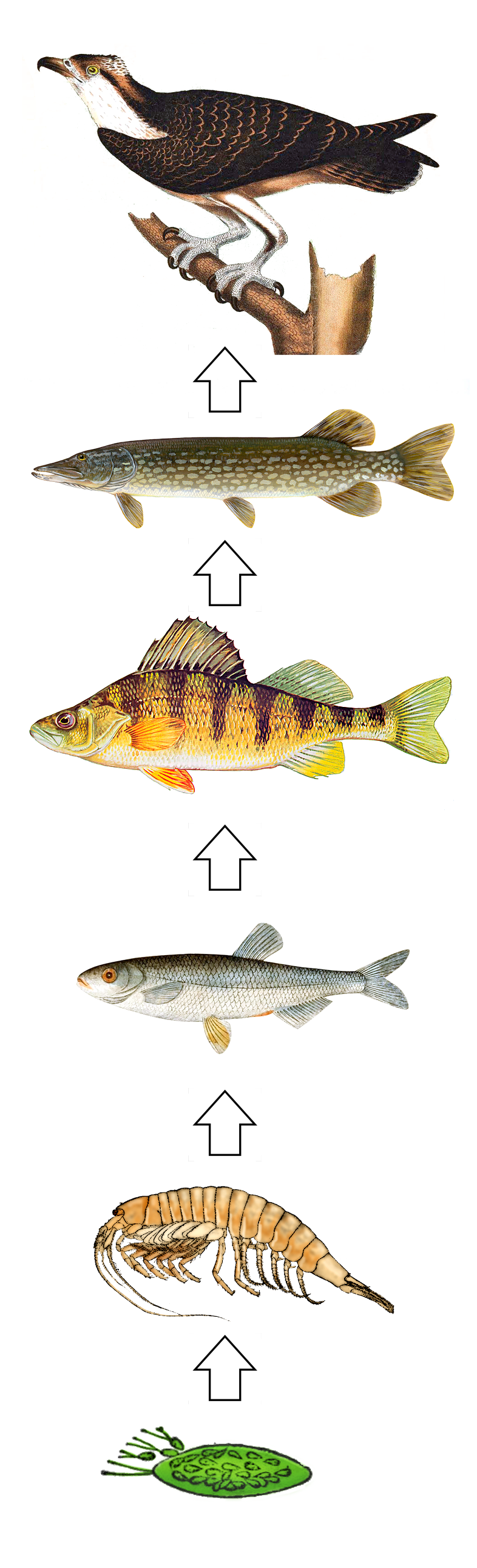 A simple food chain showing producers, consumers, and decomposers in a forest ecosystem. (Image: Composition by Amada44, Public domain, via Wikimedia Commons)
Types of Ecosystems
Ecosystems can be terrestrial (land-based) or aquatic (water-based). Each has unique features:
| Type | Examples | Key Features |
|---|---|---|
| Terrestrial | Forests, grasslands, deserts | Varied climates, diverse plant/animal life |
| Aquatic | Lakes, rivers, oceans | Water-based life, limited sunlight in deep zones |
Why are ecosystems important?
- Provide clean air, water, and food.
- Help regulate climate (e.g., forests absorb CO₂).
- Support medicine and tourism (e.g., rainforests have healing plants).
Threats to Ecosystems:
- Deforestation (cutting down forests for farming or cities).
- Pollution (chemicals, plastics, waste).
- Climate change (rising temperatures, extreme weather).
Environmental Pollution: Causes and Effects
Pollution is the introduction of harmful substances into the environment. It can be:
- Air pollution (smoke, car fumes).
- Water pollution (chemicals, plastic waste).
- Soil pollution (pesticides, industrial waste).
Causes of Pollution:
| Type | Causes | Effects |
|---|---|---|
| Air | Vehicles, factories, burning trash | Respiratory diseases, global warming |
| Water | Sewage, oil spills, plastic | Poisoning fish, spreading diseases |
| Soil | Pesticides, industrial waste | Reduced crop growth, soil infertility |
Example: Factories release sulfur dioxide into the air, which mixes with water vapor to form acid rain. This harms forests, lakes, and buildings.
Sustainable Development: Balancing Needs and Nature
What is sustainable development? It means meeting our current needs without harming future generations. It includes:
- Economic growth (jobs, businesses).
- Social development (education, healthcare).
- Environmental protection (clean air, forests, wildlife).
Three Pillars of Sustainability:
How can we achieve sustainability?
- Reduce, Reuse, Recycle (3R):
- Reduce waste (e.g., use reusable bags).
- Reuse items (e.g., old jars for storage).
- Recycle paper, plastic, metal.
- Use renewable energy (solar, wind power).
- Protect forests and wildlife.
- Conserve water and energy.
Example: A school can go green by:
- Installing solar panels for electricity.
- Starting a recycling program.
- Planting trees to reduce carbon dioxide.
Climate Change: Causes and Solutions
What is climate change? It is the long-term change in Earth’s weather patterns, mostly caused by greenhouse gases (like CO₂) trapping heat in the atmosphere.
Causes:
- Burning fossil fuels (coal, oil, gas) for energy.
- Deforestation (fewer trees = more CO₂).
- Industrial activities (factories release pollutants).
Effects of Climate Change:
- Rising temperatures (heatwaves, melting ice).
- Extreme weather (floods, droughts, storms).
- Rising sea levels (threatens coastal areas).
- Loss of biodiversity (animals/plants can’t adapt).
Solutions:
| Action | How It Helps |
|---|---|
| Plant trees | Absorbs CO₂, cools the planet |
| Use public transport | Reduces car emissions |
| Save energy at home | Less electricity = fewer power plant emissions |
| Eat less meat | Livestock farming produces methane (a greenhouse gas) |
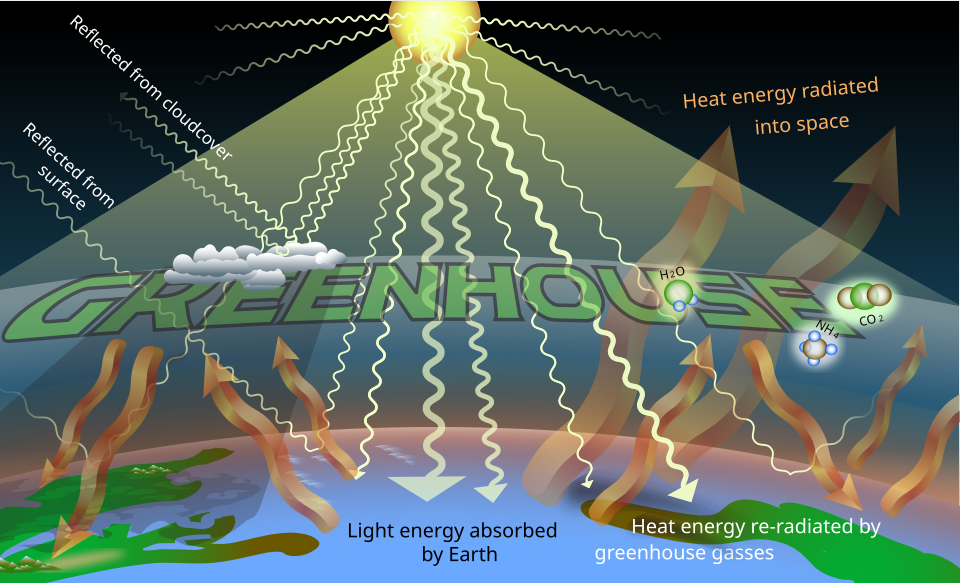 A simple illustration showing how greenhouse gases trap heat in the atmosphere. (Image: A loose necktie, CC BY-SA 4.0, via Wikimedia Commons)
Environmental Laws and Global Agreements
Governments and organizations work together to protect the environment through laws and treaties:
National Laws (Nepal):
- Environment Protection Act (1993) – Bans pollution, protects forests.
- Local rules – Some cities ban plastic bags.
Global Agreements:
- Paris Agreement (2015) – Countries promise to reduce greenhouse gas emissions.
- Montreal Protocol – Protects the ozone layer by phasing out harmful chemicals.
Why are these important?
- They set rules for industries and individuals.
- They encourage cooperation between countries.
- They help monitor progress in protecting the environment.
Example: Nepal has banned single-use plastics in some areas to reduce pollution.
How You Can Help the Environment
Even small actions make a difference! Here’s what you can do:
| At Home | At School | In Your Community |
|---|---|---|
| Turn off lights when not in use | Start a recycling club | Clean up local parks |
| Use cloth bags instead of plastic | Organize tree-planting drives | Support local environmental groups |
| Save water (e.g., shorter showers) | Teach others about sustainability | Advocate for clean energy policies |
Example: If every student in Nepal planted one tree per year, we could add millions of trees to absorb CO₂!
Exam Tip: How to Score Full Marks in NEB Exams
The NEB exam on this topic usually tests:
- Definitions (e.g., "What is an ecosystem?").
- Causes and effects (e.g., "Explain how deforestation harms the environment").
- Solutions (e.g., "Suggest three ways to reduce pollution").
- Diagrams (e.g., draw a food chain or greenhouse effect).
- Short/long answers (e.g., "Describe sustainable development in 10 points").
How to Prepare: ✅ Memorize key terms (e.g., biodiversity, greenhouse effect, 3R). ✅ Practice diagrams (food chains, pollution sources). ✅ Write short/long answers (use bullet points for clarity). ✅ Relate to Nepal (e.g., "How does plastic pollution affect Kathmandu?"). ✅ Revise case studies (e.g., effects of climate change on agriculture).
Sample NEB-Style Questions & Answers:
Q1: Define ecosystem. Give two examples. Answer: An ecosystem is a community of living organisms (plants, animals, microbes) interacting with their physical environment (air, water, soil). Examples:
- A forest with trees, deer, and fungi.
- A pond with fish, algae, and frogs.
Q2: What are the three R’s of waste management? Explain one in detail. Answer: The three R’s are:
- Reduce – Cut down on waste (e.g., buy only what you need).
- Reuse – Use items again (e.g., glass jars for storage).
- Recycle – Turn waste into new materials (e.g., paper into cardboard). Explanation of Recycle: Recycling means processing waste (like plastic bottles) to make new products. This saves energy, reduces pollution, and protects natural resources.
Q3: How does deforestation affect climate change? (5 points) Answer:
- Less CO₂ absorption – Trees absorb CO₂; cutting them increases greenhouse gases.
- More methane release – Dead trees rot, releasing methane (a potent greenhouse gas).
- Disrupted water cycle – Fewer trees = less rainfall, leading to droughts.
- Loss of biodiversity – Animals lose habitats, affecting food chains.
- Increased heat – Forests reflect less sunlight; bare land absorbs more heat.
Q4: Draw a labeled diagram of the greenhouse effect. Answer: (Draw this in your exam:)
Sun’s rays → Earth’s surface → Heat trapped by greenhouse gases (CO₂, methane) → Warmer atmosphere
Labels:
- Sunlight entering the atmosphere.
- Earth’s surface absorbing heat.
- Greenhouse gases (CO₂, methane) trapping heat.
- Result: Global warming.
Final Advice:
- Read the question carefully – Underline key words (e.g., "define," "explain," "compare").
- Use diagrams – They help explain complex ideas (e.g., food chains, pollution sources).
- Be concise – NEB exams reward clear, point-wise answers.
- Relate to Nepal – Use local examples (e.g., plastic pollution in rivers, deforestation in Chitwan).
Good luck! 🌱🌍 You’ve got this!
Based on the NEB +2 Science syllabus for Life Skill Education (LSE), unit 9.
Discussion
Loading…