PhysicsUnit 1410 min read
Diffraction: Slits, Gratings, and Wave Patterns
Unit 14 of Physics explores how waves bend around obstacles and spread through openings, revealing the wave nature of light and sound—key to understanding diffraction patterns, resolving power, and real-world applications like CDs and X-rays.
TAKEAWAYS:
- Diffraction is bending of waves around edges or through openings, strongest when the obstacle size is comparable to the wavelength.
- Single-slit diffraction creates a central bright fringe flanked by dimmer fringes, with intensity following .
- Double-slit interference + diffraction combines bright/dark fringes from both effects, altering the envelope of the pattern.
- Diffraction gratings produce sharp, well-separated spectra by dividing light into many coherent sources.
- Resolving power () determines how well a grating can distinguish close wavelengths, critical for spectroscopy.
- Applications range from CDs (microscopic pits) to X-ray crystallography (atomic-scale diffraction).
1. What is Diffraction?
Diffraction is the bending of waves when they encounter an obstacle or pass through an opening. It occurs for all waves—sound, light, water—but is most noticeable when the obstacle size (a) is comparable to the wavelength (λ).
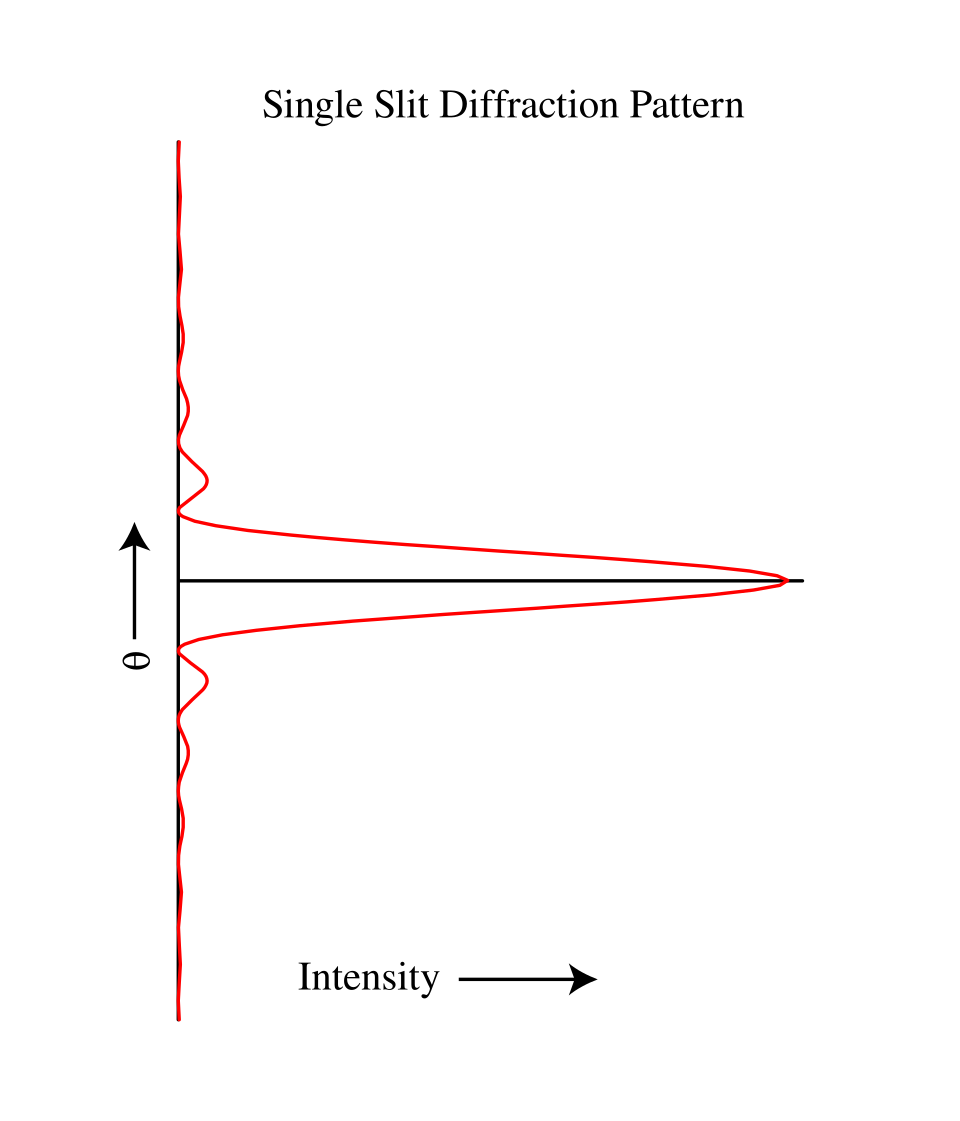 Light waves bending around the edges of a single slit (width a) (Image: Single-slit-diffraction-graph.svg: Nmurdoch derivative work:, Public domain, via Wikimedia Commons)
Why does diffraction happen?
When a wavefront meets an edge, the Huygens’ principle says each point on the wavefront acts as a new source of wavelets. These wavelets interfere constructively/destructively, creating a new wavefront that bends around the edge.
Key observation:
- Small opening → wide diffraction (e.g., sound through a doorway).
- Large opening → negligible diffraction (e.g., light through a window).
2. Single-Slit Diffraction
When light passes through a single narrow slit, it spreads out, creating a central bright fringe with side fringes of decreasing intensity.
Pattern Explanation
- Central maximum: Brightest fringe (constructive interference at θ = 0).
- Minima: Occur where the path difference causes destructive interference.
For a slit width a, the condition for dark fringes is:
where:
- = angle from the central axis,
- = wavelength of light,
- = order of the minimum.
Intensity Distribution
The intensity of the diffracted light varies as:
- β = 0 → (central maximum).
- β = π, 2π, ... → (minima).
Worked Example
A monochromatic light of wavelength passes through a slit of width . Find the angular position of the first minimum.
Solution: Using for :
Answer: The first minimum occurs at 30° from the central axis.
3. Double-Slit Diffraction + Interference
When light passes through two narrow slits, the pattern combines:
- Interference fringes (from double-slit interference).
- Diffraction envelope (from single-slit diffraction).
Resulting Pattern
- Bright fringes from interference are modulated by the diffraction envelope.
- The central maximum is the brightest, and side maxima become weaker.
Key Differences from Pure Interference
| Feature | Double-Slit Interference | Double-Slit + Diffraction |
|---|---|---|
| Fringe sharpness | Sharp, equally spaced | Envelope reduces intensity |
| Central maximum | Brightest | Still brightest |
| Higher-order fringes | Visible | Fainter or absent |
4. Diffraction Gratings
A diffraction grating is a series of equally spaced slits (or grooves) that separates light into its component wavelengths.
How It Works
- Light incident on the grating diffracts from each slit.
- The path difference between adjacent slits causes constructive interference at specific angles:
where:
- = slit separation (grating spacing),
- = angle of the -th maximum,
- = order of the spectrum.
Advantages Over Prisms
| Feature | Diffraction Grating | Prism |
|---|---|---|
| Dispersion | Linear with wavelength | Non-linear |
| Resolving power | Very high (thousands) | Lower |
| Efficiency | High for normal incidence | Lower for UV/IR |
| Size | Compact | Bulky |
Worked Example
A grating has 600 lines/mm. Calculate the angle for the second-order maximum for light of wavelength .
Solution:
- Grating spacing .
- For :
Answer: The second-order maximum appears at 44.7°.
5. Resolving Power of a Grating
The resolving power (R) measures how well a grating can distinguish two close wavelengths: where:
- = order of the spectrum,
- = total number of slits.
Example
A grating has 5000 slits and is used in the 3rd order. What is its resolving power for ?
Solution: If is the smallest distinguishable wavelength difference:
Answer: The grating can resolve wavelengths differing by 0.033 nm.
6. Applications of Diffraction
| Application | Explanation |
|---|---|
| CDs/DVDs | Microscopic pits act as diffraction gratings to read data. |
| X-ray crystallography | X-rays diffract from atomic planes, revealing molecular structures. |
| Spectroscopy | Gratings separate light into spectra for chemical analysis. |
| Optical instruments | Telescopes and microscopes use diffraction limits to define resolution. |
| Wireless communication | Antenna arrays use diffraction to direct signals. |
7. NEB Exam-Style Questions
Short Answer (2 marks)
Why does the central maximum in single-slit diffraction remain the brightest? Answer: Because all wavelets from the slit interfere constructively at θ = 0, while other angles have partial cancellation.*
How does increasing the slit width affect the diffraction pattern? Answer: The pattern narrows (minima move closer to the central axis) because .*
Long Answer (5 marks)
- Derive the condition for the -th minimum in single-slit diffraction. A slit of width is illuminated by light of wavelength . Calculate the angular position of the first minimum.
Answer:
- Condition: .
- For , .
- .*
Numerical (3 marks)
- A diffraction grating has 500 lines/cm. Light of wavelength falls on it. Find the angle for the first-order maximum.
Answer:
- .
- .
- .*
Exam Tip
Memorize key formulas:
- Single-slit minima: .
- Grating maxima: .
- Resolving power: .
Draw diagrams:
- Always sketch the diffraction pattern (central maximum + side minima).
- Label angles and slit widths clearly.
Unit consistency:
- Convert all units to meters (m) or nanometers (nm) before calculations.
Common mistakes:
- Confusing slit width (a) with grating spacing (d).
- Forgetting that starts from 0 for the central maximum in gratings.
Application questions:
- Expect questions on CDs, X-rays, or spectroscopy. Relate theory to real-world examples.
Final Note: Diffraction is a wave phenomenon, so it proves light behaves as a wave. Master the geometry of patterns and formulas—they are the core of exam questions!
Based on the NEB +2 Science syllabus for Physics (Phy), unit 14.
Discussion
Loading…