PhysicsUnit 138 min read
Interference: Superposition, Path Difference, Young’s Double Slit, Thin Films
Unit 13 of Physics explains how waves combine to create interference patterns—constructive and destructive—using Young’s double-slit experiment, thin films, and real-world applications like soap bubbles and CDs.
What is Interference?
Interference is a phenomenon where two or more waves superpose (overlap) to produce a new wave pattern. This happens because waves are disturbances in a medium (like water, air, or light) that carry energy but not matter.
Key Idea: Superposition Principle
When two waves meet at a point, the resultant displacement is the sum of their individual displacements. This is called the superposition principle.
Explanation:
- If two waves are in phase (peaks align), they add up → constructive interference (larger amplitude).
- If they are out of phase (peak of one meets trough of another), they cancel out → destructive interference (zero amplitude).
Types of Interference
There are two main types of interference:
| Type | Condition | Effect | Example |
|---|---|---|---|
| Constructive | Path difference = | Amplitude increases | Loud sound from two speakers |
| Destructive | Path difference = | Amplitude decreases (or cancels) | Noise-cancelling headphones |
Where:
- (integer)
- = wavelength of the wave
Young’s Double-Slit Experiment
This is the most famous experiment to prove the wave nature of light. Thomas Young performed it in 1801.
Setup:
- A monochromatic light source (single wavelength, e.g., laser or sodium lamp) shines on a screen with two narrow slits (S₁ and S₂).
- Light passing through the slits acts as two coherent sources (same frequency, constant phase difference).
- A detector screen shows an interference pattern (bright and dark fringes).
flowchart TD
    A["Monochromatic Light Source"] --> B["Slit Screen (S₀)"]
    B --> C["Two Slits (S₁, S₂)"]
    C --> D["Detector Screen"]
    D --> E["Interference Pattern\n(Bright & Dark Fringes)"]
Why Does This Happen?
- Light from S₁ and S₂ travels different distances to reach a point P on the screen.
- The path difference () determines whether waves arrive in phase (bright fringe) or out of phase (dark fringe).
Formula for Fringe Width ():
The distance between two consecutive bright (or dark) fringes is given by: Where:
- = wavelength of light
- = distance between slits and screen
- = distance between the two slits
Worked Example:
A laser of wavelength is used in Young’s double-slit experiment. The slits are separated by , and the screen is placed away. Find the fringe width ().
Solution:
- Convert all units to meters:
- Plug into the formula: Answer: The fringe width is 1.2 mm.
Interference in Thin Films
Thin films (like soap bubbles, oil slicks, or CDs) produce colorful patterns due to interference. This happens because light reflects off the top and bottom surfaces of the film.
Conditions for Bright and Dark Fringes:
- Reflection from a denser medium (e.g., air to water) causes a phase change of (or ).
- Reflection from a rarer medium (e.g., water to air) causes no phase change.
| Case | Path Difference | Condition for Bright Fringe | Condition for Dark Fringe |
|---|---|---|---|
| Thin Film in Air | (extra distance) | ||
| With Phase Change |
Where:
- = thickness of the film
Worked Example:
A soap bubble has a thickness of . Light of wavelength is incident normally. Will there be a bright or dark fringe reflected?
Solution:
- Since light reflects off the top surface (air to soap) and the bottom surface (soap to air), there is no net phase change (both reflections cause a phase change, but they cancel out).
- The path difference is .
- Compare with :
- → This matches the condition for a bright fringe ().
Answer: A bright fringe is observed.
Applications of Interference
Interference is used in many real-life applications:
| Application | How It Works | Example |
|---|---|---|
| Optical Coatings | Thin films (like on glasses) reduce reflections by destructive interference. | Anti-reflective coatings on cameras |
| CD/DVDs | Pits and lands create interference patterns to read data. | Digital storage |
| Newton’s Rings | Air film between a lens and glass plate creates concentric rings. | Testing surface flatness |
| Noise-Cancelling Headphones | Destructive interference cancels out unwanted sound waves. | Reducing engine noise |
| Holography | Laser light interference creates 3D images. | Security tags, art |
Common Mistakes to Avoid
- Forgetting phase changes in thin films (e.g., reflection from denser medium adds ).
- Mixing up constructive and destructive conditions (remember vs. ).
- Incorrect unit conversions (always convert nm to m or mm to m).
- Assuming all interference is visible (e.g., sound waves interfere but we don’t "see" it like light).
NEB Board-Style Questions
Short Answer (2 marks)
- Define coherent sources and give one example.
- Why do soap bubbles show different colors?
- What is the condition for destructive interference in Young’s double-slit experiment?
Long Answer (5 marks)
- Explain Young’s double-slit experiment with a neat diagram. Derive the formula for fringe width.
- A thin film of oil () floats on water (). Light of wavelength is incident normally. If the film appears bright, what is the minimum thickness of the film?
Practical/Numerical (3 marks)
- In a Young’s double-slit experiment, the distance between slits is , and the screen is away. If the fringe width is , find the wavelength of light used.
- A soap bubble has a thickness of . For light of wavelength , will the reflected light be bright or dark? Justify.
Exam Tip
What NEB Expects:
- Diagrams are mandatory for Young’s double-slit and thin-film interference. Label all parts clearly.
- Derive formulas (e.g., fringe width) step-by-step. Don’t just write the final answer.
- Phase changes are often tested in thin-film questions. Always mention whether reflection causes a phase shift.
- Units matter! Always convert to meters (or consistent units) before plugging into formulas.
- Real-world applications (like anti-reflective coatings or CDs) may be asked in descriptive questions. Know at least 2-3 examples.
Quick Revision Checklist:
✅ Can you draw Young’s double-slit setup? ✅ Do you remember the conditions for bright/dark fringes in thin films? ✅ Can you solve for fringe width given ? ✅ Do you know why soap bubbles are colorful?
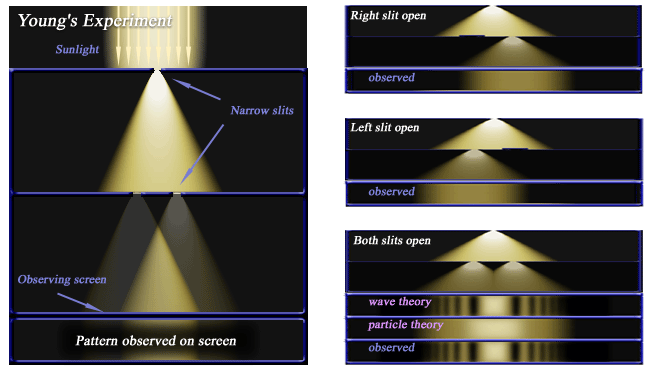 A labelled diagram of Young’s double-slit experiment showing light source, slits, and interference pattern. (Image: CC BY-SA 3.0, via Wikimedia Commons)
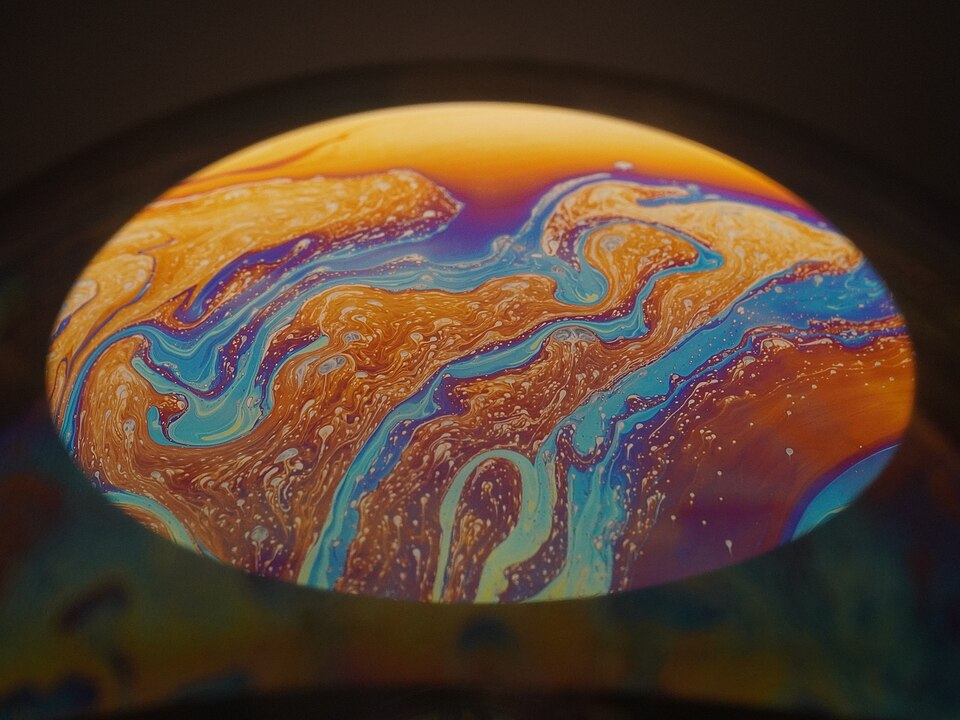 A photo of a soap bubble showing rainbow colors due to thin-film interference. (Image: Pksois23, CC BY-SA 4.0, via Wikimedia Commons)
Based on the NEB +2 Science syllabus for Physics (Phy), unit 13.
Discussion
Loading…