PhysicsUnit 98 min read
Mechanical Waves: Types, Properties & Equations
Unit 9 of Physics explores mechanical waves—how they travel, their energy, and key formulas like wave speed, frequency, and amplitude, with real-world examples and NEB-style problems.
What Are Mechanical Waves?
Mechanical waves are disturbances that travel through a medium (solid, liquid, or gas) by transferring energy, not matter. They require a medium to propagate. Examples include:
- Sound waves (travel through air, water, or solids).
- Waves on a string (like a guitar string).
- Water ripples (created by dropping a stone).
Key Features of Mechanical Waves
graph TD
    A["Mechanical Waves"] --> B["Need a Medium"]
    A --> C["Transfer Energy, Not Matter"]
    A --> D["Types: Transverse & Longitudinal"]
    A --> E["Described by: Wavelength, Frequency, Amplitude, Speed"]
Visual:
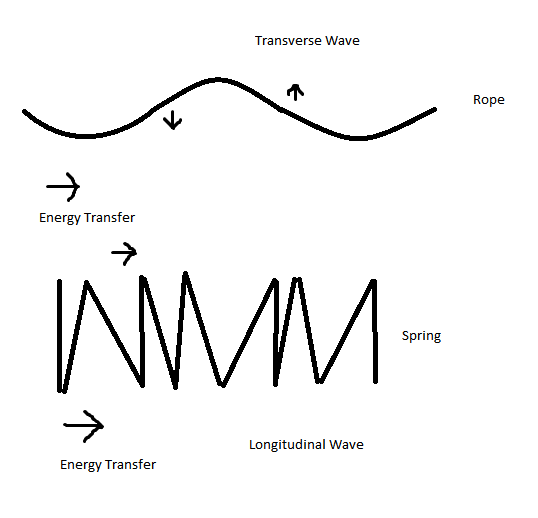
Types of Mechanical Waves
1. Transverse Waves
- Particles move perpendicular to the wave direction.
- Example: Waves on a string, light waves (though light is an electromagnetic wave, not mechanical).
- Crest: Highest point.
- Trough: Lowest point.
2. Longitudinal Waves
- Particles move parallel to the wave direction.
- Example: Sound waves, slinky waves.
- Compression: Region where particles are close.
- Rarefaction: Region where particles are far apart.
Comparison Table:
| Feature | Transverse Waves | Longitudinal Waves |
|---|---|---|
| Particle Motion | Perpendicular to wave | Parallel to wave |
| Example | Waves on a string | Sound waves |
| Polarization | Possible | Not possible |
Wave Properties
1. Wavelength (λ)
- Distance between two consecutive crests or troughs (for transverse waves).
- Distance between two compressions or rarefactions (for longitudinal waves).
- Unit: Meter (m).
2. Frequency (f)
- Number of waves passing a point per second.
- Unit: Hertz (Hz) = 1/s.
- Formula: , where = time period (time for one complete wave).
3. Amplitude (A)
- Maximum displacement from the equilibrium position.
- Determines the energy of the wave (higher amplitude = more energy).
4. Wave Speed (v)
- Distance traveled by a wave per unit time.
- Formula: (speed = frequency × wavelength).
- Unit: m/s.
Visual:
Wave Speed in Different Media
The speed of a wave depends on the medium:
- String Waves:
- , where:
- = tension in the string (N).
- = linear mass density (kg/m).
- , where:
- Sound Waves in Air:
- m/s (where = temperature in °C).
- At 20°C, m/s.
- Water Waves:
- Depends on depth and gravity.
Example 1: Calculating Wave Speed on a String A string has a tension of 10 N and a linear mass density of 0.01 kg/m. Find the wave speed. Solution:
Energy and Power of Waves
- Energy (E): Proportional to the square of the amplitude ().
- Power (P): Energy transmitted per unit time.
- For a wave on a string: , where .
Example 2: Comparing Energy If a wave’s amplitude doubles, how does its energy change? Solution: Since , doubling increases by times.
Superposition and Interference
When two waves meet, they superpose (combine). The result depends on their phases:
- Constructive Interference: Waves in phase → larger amplitude.
- Destructive Interference: Waves out of phase → cancel out (if amplitudes are equal).
Visual:

Standing Waves
Occur when two waves of the same frequency, amplitude, and wavelength travel in opposite directions and interfere.
- Nodes: Points with zero amplitude (no movement).
- Antinodes: Points with maximum amplitude.
- Fundamental Frequency (f₁): Lowest frequency for standing waves.
- For a string fixed at both ends: , where = length of the string.
Example 3: Standing Waves on a String A string of length 1 m has a wave speed of 200 m/s. Find the fundamental frequency. Solution:
Doppler Effect (Brief Introduction)
- Change in frequency (and wavelength) due to the relative motion of the source and observer.
- Formula:
- If the observer moves: .
- If the source moves: .
- = wave speed, = observer speed, = source speed.
- Use + when moving toward each other, – when moving apart.
Example 4: Doppler Effect A train blows a whistle of frequency 500 Hz while moving at 20 m/s toward a stationary observer. Speed of sound = 340 m/s. Find the observed frequency. Solution:
Applications of Mechanical Waves
- Music Instruments: Strings (guitar), air columns (flute), and membranes (drums) produce standing waves.
- Medical Imaging: Ultrasound uses high-frequency sound waves to create images.
- Seismology: Studying earthquake waves (P-waves = longitudinal, S-waves = transverse).
- Communication: Radio waves (though electromagnetic, the concept applies to signal transmission).
Exam Tip
Memorize Key Formulas:
- (for strings)
- (fundamental frequency)
- Doppler effect formulas.
Understand Concepts, Not Just Formulas:
- Know the difference between transverse and longitudinal waves.
- Visualize standing waves (nodes and antinodes).
Practice Problems:
- NEB often asks for calculations involving wave speed, frequency, or Doppler effect.
- Draw diagrams for standing waves and interference.
Common Mistakes to Avoid:
- Confusing frequency and period ().
- Forgetting units (Hz for frequency, m/s for speed).
- Misapplying Doppler effect signs (+ or –).
NEB-Style Questions
Short Answer (5 marks)
Define wavelength and frequency. A wave has a speed of 200 m/s and a frequency of 50 Hz. Calculate its wavelength. Answer:
- Wavelength () = distance between two consecutive crests.
- Frequency () = number of waves per second.
- .
Differentiate between transverse and longitudinal waves with examples. Answer:
Feature Transverse Waves Longitudinal Waves Particle Motion Perpendicular Parallel Example Waves on a string Sound waves
Long Answer (10 marks)
Explain the formation of standing waves in a string fixed at both ends. Derive the expression for the fundamental frequency. Answer:
- Standing waves form when two identical waves travel in opposite directions and interfere.
- Nodes (no displacement) and antinodes (maximum displacement) are created.
- For a string of length , the fundamental frequency is: where is the wave speed.
A source emits sound waves of frequency 440 Hz. An observer moves toward the source at 10 m/s. If the speed of sound is 340 m/s, calculate the observed frequency. Answer:
Final Note: Mechanical waves are everywhere—from music to earthquakes! Master the formulas, draw diagrams, and practice calculations to score well in NEB exams. 🚀
Based on the NEB +2 Science syllabus for Physics (Phy), unit 9.
Discussion
Loading…