PhysicsUnit 107 min read
Waves in Pipes and Strings: Standing Waves, Harmonics, and Resonance
Unit 10 of Physics explores how waves behave in pipes (open/closed) and strings, covering standing waves, harmonics, resonance, and key formulas like \(v = f\lambda\) and \(fn = \frac{nv}{2L}\). Learn to solve problems using boundary conditions and derive wave equations.
Introduction to Waves in Pipes and Strings
Waves can travel through different mediums, such as air (in pipes) and strings. When waves are confined in these mediums, they create standing waves—waves that appear stationary due to interference between incident and reflected waves. This unit focuses on how waves behave in strings (like guitar strings) and pipes (like organ pipes), and how they produce different harmonics and resonance.
1. Waves in Strings
When a string is plucked or struck, it vibrates and produces waves. The speed of a wave in a string depends on:
- Tension (T): The force stretching the string (measured in Newtons, N).
- Linear mass density (μ): The mass per unit length of the string (kg/m).
The wave speed in a string is given by:
Standing Waves in Strings
When both ends of a string are fixed, only certain wavelengths (and frequencies) can produce standing waves. These are called harmonics or overtones.
Fundamental Frequency (1st Harmonic): The longest possible wavelength that fits in the string length .
Higher Harmonics (nth Harmonic): For the nth harmonic, the wavelength is: where
Visualizing Standing Waves in a String
graph LR
    A["Fundamental (n=1)"] -->|"λ=2L"| B["One loop"]
    C["1st Overtone (n=2)"] -->|"λ=L"| D["Two loops"]
    E["2nd Overtone (n=3)"] -->|"λ=2L/3"| F["Three loops"]
Key Idea: The number of loops = harmonic number .
Worked Example 1: Finding Frequency of a Guitar String
A guitar string has a length , tension , and linear mass density . Find the fundamental frequency.
Solution:
- Calculate wave speed:
- Fundamental frequency:
2. Waves in Pipes (Organ Pipes)
Pipes produce sound when air columns inside them vibrate. There are two types:
- Open Pipes: Both ends are open (e.g., flute).
- Closed Pipes: One end is closed (e.g., clarinet).
Standing Waves in Open Pipes
- Both ends are antnodes (maximum displacement).
- Only odd harmonics are present (1st, 3rd, 5th, ...).
- Wavelengths:
Standing Waves in Closed Pipes
- One end is a node, the other is an antinode.
- Only odd harmonics are present (1st, 3rd, 5th, ...).
- Wavelengths:
Comparison Table: Open vs. Closed Pipes
| Feature | Open Pipe | Closed Pipe |
|---|---|---|
| End Conditions | Both ends antinodes | One node, one antinode |
| Harmonics | All harmonics (n=1,2,3,...) | Only odd harmonics (n=1,3,5,...) |
| Fundamental Freq. | ||
| Example | Flute, recorder | Clarinet, organ pipe |
Worked Example 2: Finding Length of an Organ Pipe
A closed organ pipe produces a fundamental frequency of 256 Hz. If the speed of sound is , find the length of the pipe.
Solution:
3. Resonance in Pipes and Strings
Resonance occurs when an external force matches the natural frequency of the system, causing large amplitude vibrations.
- In strings, resonance is achieved by plucking at the correct frequency.
- In pipes, resonance is achieved by blowing air at the correct frequency.
Example: A guitar string resonates when another string of the same length is plucked nearby.
4. Applications of Waves in Pipes and Strings
| Application | How It Works |
|---|---|
| Musical Instruments | Strings (guitar, violin) and pipes (flute, organ) produce specific frequencies. |
| Speakers | Use vibrating membranes (like strings) to produce sound waves. |
| Ultrasound Machines | Use standing waves in pipes to create high-frequency sound for medical imaging. |
| Wireless Communication | Antennas (like open pipes) resonate at specific frequencies to transmit signals. |
Exam Tip: How to Score Full Marks
Memorize Key Formulas:
- Wave speed in string:
- Harmonics in strings:
- Harmonics in open pipes:
- Harmonics in closed pipes:
Draw Standing Wave Diagrams:
- Label nodes and antinodes correctly.
- Show the correct number of loops for each harmonic.
Solve Numerical Problems Step-by-Step:
- Always write down given values and units.
- Substitute correctly into formulas.
Distinguish Between Open and Closed Pipes:
- Open pipes have all harmonics; closed pipes have only odd harmonics.
Practice NEB-Style Questions:
- Questions often ask for:
- Fundamental frequency.
- Length of pipe/string given frequency.
- Harmonic numbers from diagrams.
- Questions often ask for:
NEB Board-Style Questions (Practice)
Short Answer Questions
- Why does a closed pipe produce only odd harmonics?
- How does increasing tension in a string affect its fundamental frequency?
- Draw the first three harmonics of an open pipe.
Long Answer Questions
- A string of length 1 m is fixed at both ends. If the speed of the wave is 200 m/s, find:
- The fundamental frequency.
- The frequencies of the 2nd and 3rd harmonics.
- An open pipe and a closed pipe have the same fundamental frequency. If the length of the open pipe is 0.5 m, find the length of the closed pipe. (Assume speed of sound = 340 m/s.)
Diagram-Based Questions
- The diagram below shows a standing wave in a string. If the length of the string is 1.2 m and the wave speed is 150 m/s, find:
- The harmonic number.
- The frequency of the wave.
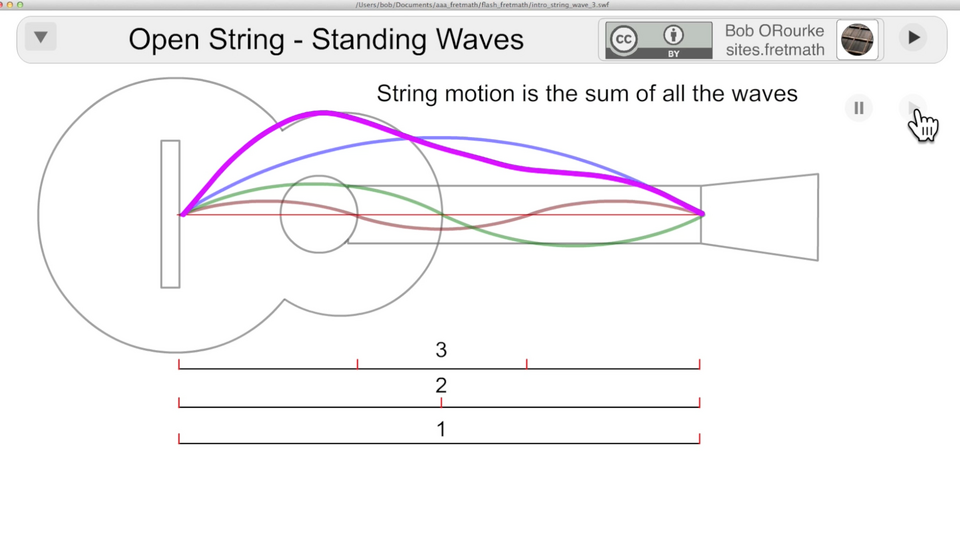 A string with 3 loops (antinodes at both ends) (Image: BobORourke, CC BY 4.0, via Wikimedia Commons)
---
**Final Note**: Always visualize standing waves and label nodes/antinodes. Practice drawing diagrams—they help a lot in exams!
Based on the NEB +2 Science syllabus for Physics (Phy), unit 10.
Discussion
Loading…