PhysicsUnit 210 min read
Periodic Motion: SHM, Pendulums, Springs & Waves
Unit 2 of Physics covers simple harmonic motion (SHM), its equations, energy, pendulums, springs, and damping—explaining how oscillatory systems work in nature, machines, and waves with clear examples and NEB-style questions.
TAKEAWAYS:
- SHM is a special kind of periodic motion where acceleration is proportional to displacement and directed toward equilibrium.
- Amplitude, period, and frequency define the size and speed of oscillations.
- Energy in SHM is conserved and switches between kinetic and potential forms.
- Pendulums and springs follow SHM under ideal conditions, but real systems have damping and resonance.
- Damped oscillations lose energy over time, while forced oscillations can be amplified near resonance.
- NEB exams test definitions, equations, graphs, and real-world applications (e.g., clocks, bridges, musical instruments).
What is Periodic Motion?
Periodic motion is any motion that repeats itself at regular time intervals. Examples include:
- A swinging pendulum (clock).
- A vibrating guitar string.
- The Earth’s orbit around the Sun.
- A bouncing spring.
Key terms:
- Period (T): Time taken to complete one full cycle (unit: seconds).
- Frequency (f): Number of cycles per second (unit: Hertz, Hz). .
- Amplitude (A): Maximum displacement from equilibrium.
graph LR
    A["Periodic Motion"] --> B["Repeats at regular intervals"]
    A --> C["Examples: Pendulum, Spring, Waves"]
    B --> D["Period (T) = Time for one cycle"]
    B --> E["Frequency (f) = 1/T"]
Simple Harmonic Motion (SHM)
SHM is a special type of periodic motion where:
- The restoring force is directly proportional to displacement and acts toward equilibrium.
- The acceleration is constant in magnitude but changes direction.
Mathematical Definition: If is displacement from equilibrium, then: where:
- = spring constant (for springs) or (for pendulums).
- = angular frequency ().
Equation of SHM: where:
- = amplitude,
- = angular frequency,
- = phase angle.
Velocity and Acceleration in SHM
Differentiate to find velocity () and acceleration ():
Key Observations:
- Maximum velocity occurs at equilibrium (): .
- Maximum acceleration occurs at extreme positions (): .
Energy in SHM
Total energy () is constant and switches between:
- Kinetic Energy (KE): Maximum at equilibrium.
- Potential Energy (PE): Maximum at extreme positions.
At any point:
Graph of Energy vs. Displacement:
graph TD
    A["Total Energy (E)"] --> B["Constant"]
    B --> C["KE = 1/2 mω²(A² - x²)"]
    B --> D["PE = 1/2 kx²"]
    C --> E["Max at x=0"]
    D --> F["Max at x=±A"]
Examples of SHM
1. Mass-Spring System
A block attached to a spring oscillates when displaced.
- Restoring force: .
- Angular frequency: .
- Period: .
Example: A 2 kg mass is attached to a spring with . Find:
- Angular frequency ().
- Period ().
- Maximum velocity if amplitude is 0.1 m.
Solution:
- .
- .
- .
2. Simple Pendulum
A small mass (bob) suspended by a string/rod.
- Restoring force: (for small angles, in radians).
- Angular frequency: .
- Period: .
Example: A pendulum has length . Find its period.
Solution:
Note: For large angles, the period increases slightly (non-linear SHM).
Comparison: Spring vs. Pendulum
| Feature | Mass-Spring System | Simple Pendulum |
|---|---|---|
| Restoring Force | ||
| Angular Frequency | ||
| Period | ||
| Amplitude Effect | Independent of amplitude (ideal) | Depends on amplitude (non-linear for large ) |
| Applications | Seismometers, car suspensions | Clocks, metronomes |
Damped and Forced Oscillations
1. Damped Oscillations
Real systems lose energy due to friction/air resistance, causing oscillations to die out.
- Under-damped: Oscillations decrease slowly (e.g., swinging door).
- Over-damped: No oscillations (e.g., car shock absorbers).
- Critically damped: Fastest return to equilibrium without oscillation.
Equation of damped SHM: where:
- = damping coefficient,
- .
Example: A damped oscillator has and . Find the new angular frequency ().
Solution:
2. Forced Oscillations and Resonance
When an external periodic force is applied, the system oscillates at the driver’s frequency.
- Resonance: Occurs when the driver’s frequency matches the natural frequency ().
- Amplitude becomes very large (can cause damage).
- Example: Bridge collapse (Tacoma Narrows Bridge, 1940).
Applications of Resonance:
- Musical instruments (guitars, pianos).
- Radio tuning (LC circuits).
- MRI machines (nuclear magnetic resonance).
Graph of Amplitude vs. Frequency:
graph TD
    A["Amplitude"] --> B["Increases with frequency"]
    B --> C["Peaks at resonance (ω = ω₀)"]
    B --> D["Drops off at high/low frequencies"]
NEB-Style Questions and Solutions
Short Answer Questions
Define simple harmonic motion (SHM). Answer: SHM is a type of periodic motion where the restoring force is directly proportional to displacement and acts toward equilibrium.
What is the period of a simple pendulum? Derive it. Answer: For small angles, . Derivation:
- Restoring force: .
- Torque: .
- Angular acceleration: .
- Compare with SHM: , so .
- Period: .
Numerical Problems
A mass-spring system has and . If amplitude is 0.2 m, find: a) Angular frequency. b) Maximum velocity. c) Total energy.
Solution: a) . b) . c) .
Conceptual Questions
Why does a pendulum clock keep time accurately? Answer: The period of a simple pendulum () is independent of amplitude (for small angles) and depends only on length () and gravity (). Thus, it provides a consistent time interval.
What happens to the period of a spring-mass system if the mass is doubled? Answer: The period increases by a factor of , because .
Exam Tip: How to Score Full Marks
Understand Definitions:
- Know the difference between periodic motion, SHM, and damped/forced oscillations.
- Memorize key equations (e.g., for springs, for pendulums).
Graphs are Important:
- Draw displacement-time, velocity-time, and acceleration-time graphs for SHM.
- Label axes, amplitude, period, and equilibrium correctly.
Units Matter:
- Always include units (e.g., , , ).
- NEB deducts marks for missing units!
Real-World Applications:
- Relate SHM to clocks, seismometers, musical instruments, and resonance disasters (e.g., bridges).
- Example: "A metronome uses a pendulum because its period is independent of amplitude."
Damping and Resonance:
- Explain why damping reduces amplitude and how resonance causes large amplitudes.
- Example: "A radio tuner uses resonance to select specific frequencies."
Common Mistakes to Avoid:
- Assuming SHM for large angles (pendulum period changes).
- Forgetting the negative sign in .
- Mixing up angular frequency () and frequency ().
Summary Table for Quick Revision
| Concept | Key Equation | Example Application |
|---|---|---|
| Period (Spring) | Car suspension | |
| Period (Pendulum) | Clock pendulum | |
| Angular Frequency | Vibrating strings (guitar) | |
| Energy in SHM | Spring potential energy | |
| Damped Oscillation | Shock absorbers | |
| Resonance | Amplitude peaks at | Radio tuning, MRI machines |
Final Advice:
- Practice deriving equations (e.g., pendulum period).
- Solve numerical problems from past NEB papers.
- Visualize SHM using graphs and animations (YouTube helps!).
- Relate theory to real life—NEB loves applications!
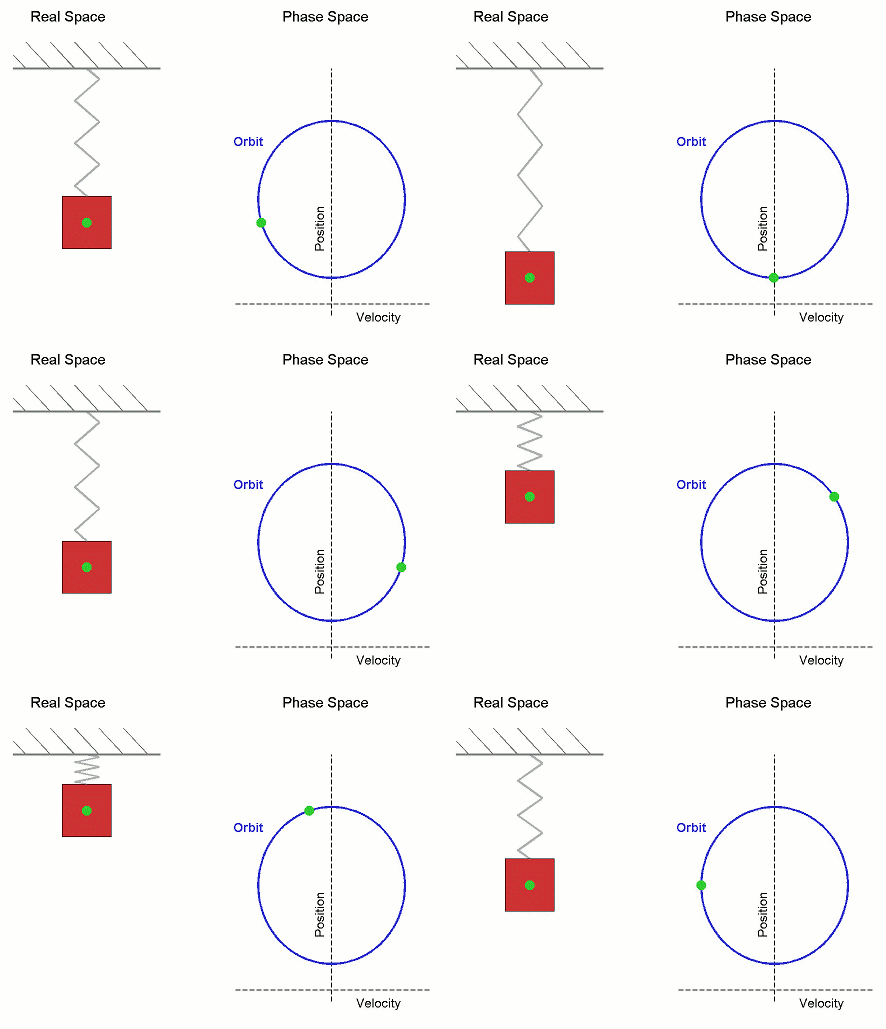 A block-spring system demonstrating SHM with displacement, velocity, and acceleration graphs. (Image: Mazemaster, Public domain, via Wikimedia Commons)
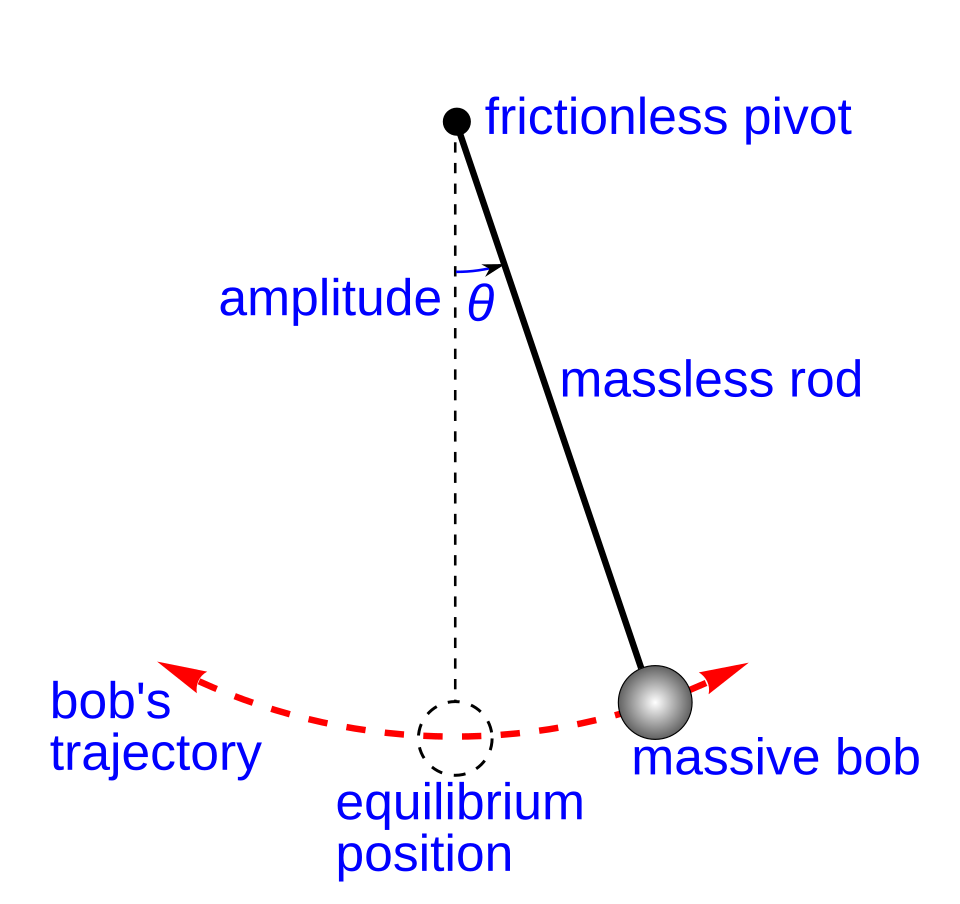 A pendulum bob swinging with small angles, showing restoring force and equilibrium. (Image: Chetvorno, Public domain, via Wikimedia Commons)
Based on the NEB +2 Science syllabus for Physics (Phy), unit 2.
Discussion
Loading…