PhysicsUnit 15 min read
Rotational Dynamics: Torque, Angular Momentum, Rolling Motion & Gyroscopes
Unit 1 of Physics: Rotational Dynamics explains how objects rotate around an axis, covering torque, angular momentum, rotational kinetic energy, rolling motion, and gyroscopic effects with clear examples and NEB-style questions.
What is Rotational Motion?
Rotational motion is the movement of an object around a fixed axis (like a spinning top or a rotating fan blade). Unlike linear motion, where objects move in a straight line, rotational motion involves circular paths.
Key Differences: Linear vs. Rotational Motion
mindmap
  root((Motion))
    Linear
      "Straight-line path"
      "Mass (m) and velocity (v)"
      "Force (F = ma)"
    Rotational
      "Circular path around axis"
      "Moment of inertia (I) and angular velocity (ω)"
      "Torque (τ = Iα)"
1. Moment of Inertia (I)
Moment of inertia is the rotational equivalent of mass. It measures an object’s resistance to rotational motion.
How to Calculate Moment of Inertia?
For different shapes, the moment of inertia depends on the axis of rotation:
| Shape | Axis | Moment of Inertia (I) |
|---|---|---|
| Point mass | Distance (r) from axis | |
| Rod (length L) | Through center | |
| Rod (length L) | End of rod | |
| Disk (radius R) | Through center | |
| Hollow cylinder | Through center |
Example: A rod of length 2 m and mass 5 kg rotates about its center. Find its moment of inertia. Solution:
2. Torque (τ)
Torque is the rotational equivalent of force. It causes angular acceleration.
How to Calculate Torque?
- Unit: Newton-meter (Nm)
- Direction: Given by the right-hand rule (clockwise = negative, counterclockwise = positive)
Example: A force of 10 N is applied at a distance of 0.5 m from the axis. Find the torque. Solution:
3. Angular Momentum (L)
Angular momentum is conserved in a closed system (like a spinning ice skater pulling in their arms).
How to Calculate Angular Momentum?
- Conservation Law: If no external torque acts, remains constant.
Example: A figure skater spins with and . If they pull in their arms and reduce to 1 kg·m², what is the new angular velocity? Solution: Since is conserved:
4. Rotational Kinetic Energy (KE)
Example: A disk of moment of inertia spins at 10 rad/s. Find its rotational KE. Solution:
5. Rolling Motion
When an object rolls without slipping, both translational and rotational motion occur.
Key Relationships
Condition for rolling without slipping: (where = linear velocity, = radius, = angular velocity)
Total kinetic energy of a rolling object:
Example: A solid sphere of radius 0.2 m rolls without slipping at 5 m/s. Find its angular velocity. Solution:
6. Gyroscopic Motion
A spinning object (like a gyroscope) resists changes in its orientation due to angular momentum conservation.
Applications of Gyroscopes
- Compasses (maintain direction)
- Airplanes & ships (stabilization)
- Smartphones (orientation sensors)
Exam Tip
- NEB-style questions often test:
- Calculating torque and moment of inertia.
- Applying conservation of angular momentum.
- Rolling motion problems (combining linear and rotational motion).
- Common mistakes:
- Forgetting to use the perpendicular distance in torque calculations.
- Misapplying the rolling condition .
- Key formulas to remember:
- (rotational equivalent of )
- (conserved in closed systems)
NEB Board-Style Questions
Short Answer Questions
- Define torque and write its formula.
- What is the moment of inertia of a rod rotating about its center?
- Explain why a spinning ice skater speeds up when pulling arms inward.
Long Answer Questions
- A disk of radius 0.1 m and mass 2 kg rotates at 10 rad/s. If a force of 5 N is applied tangentially, find:
- The torque acting on it.
- The new angular velocity after 2 seconds (assuming no friction).
- A solid cylinder rolls down an incline without slipping. Derive an expression for its acceleration.
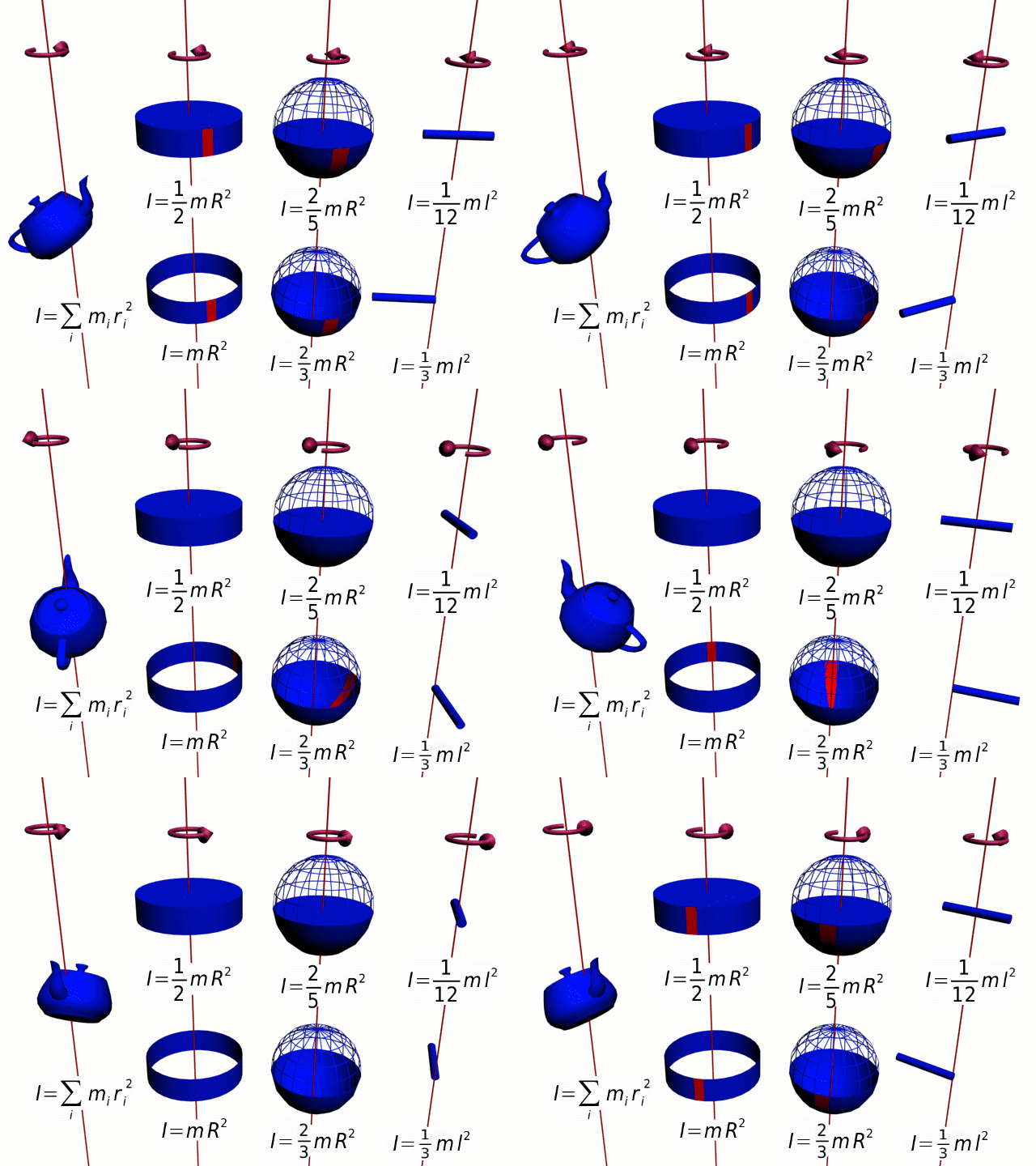 A table comparing I for different objects (Image: PanCiasteczko, Public domain, via Wikimedia Commons)
Based on the NEB +2 Science syllabus for Physics (Phy), unit 1.
Discussion
Loading…