PhysicsUnit 238 min read
Photons: Light as Particles, Photoelectric Effect, Einstein’s Explanation
Unit 23 of Physics explores photons as quanta of light, the photoelectric effect, and Einstein’s revolutionary theory that light behaves as both a wave and a particle. Learn how photons explain emission spectra, solar energy, and modern devices like solar cells.
What is a Photon?
A photon is the smallest possible packet (or "quantum") of light or electromagnetic radiation. It behaves like a particle but also has wave-like properties.
Key Properties of a Photon
mindmap
  root((Photon))
    Properties
      Mass: 0 (massless)
      Charge: 0 (neutral)
      Energy: E = hν (where h = Planck’s constant, ν = frequency)
      Momentum: p = h/λ (λ = wavelength)
    Behavior
      Particle-like: Discrete packets (e.g., photoelectric effect)
      Wave-like: Interference, diffraction
    Source
      Emitted by atoms when electrons jump energy levels
Why is this important?
- Photons explain why light can knock electrons out of metals (photoelectric effect).
- They help us understand how solar panels convert sunlight into electricity.
Photoelectric Effect: Light as a Particle
The photoelectric effect is when light shines on a metal surface and ejects electrons. This effect cannot be explained by the wave theory of light.
Observations of the Photoelectric Effect
- Threshold Frequency (ν₀): Light must have a minimum frequency to eject electrons. Below this frequency, no electrons are emitted, no matter how bright the light.
- Instantaneous Emission: Electrons are ejected immediately if the light frequency is above ν₀.
- Kinetic Energy of Electrons: The energy of ejected electrons depends on the light’s frequency, not its intensity.
Wave Theory Fails to Explain This!
- If light were purely a wave, brighter light (higher intensity) should always eject electrons, even at low frequencies.
- But experiments show that only light above a certain frequency works, regardless of brightness.
Einstein’s Explanation: Light as Packets of Energy (Photons)
Einstein proposed that light consists of tiny energy packets called photons. Each photon has energy: where:
- (Planck’s constant)
- = frequency of light
How Photons Explain the Photoelectric Effect
When a photon hits a metal surface:
- If work function (), the photon transfers its energy to an electron.
- The electron may escape if it has enough energy to overcome the metal’s binding energy.
- The maximum kinetic energy (KEₘₐₓ) of the ejected electron is:
- = minimum energy needed to remove an electron (work function of the metal).
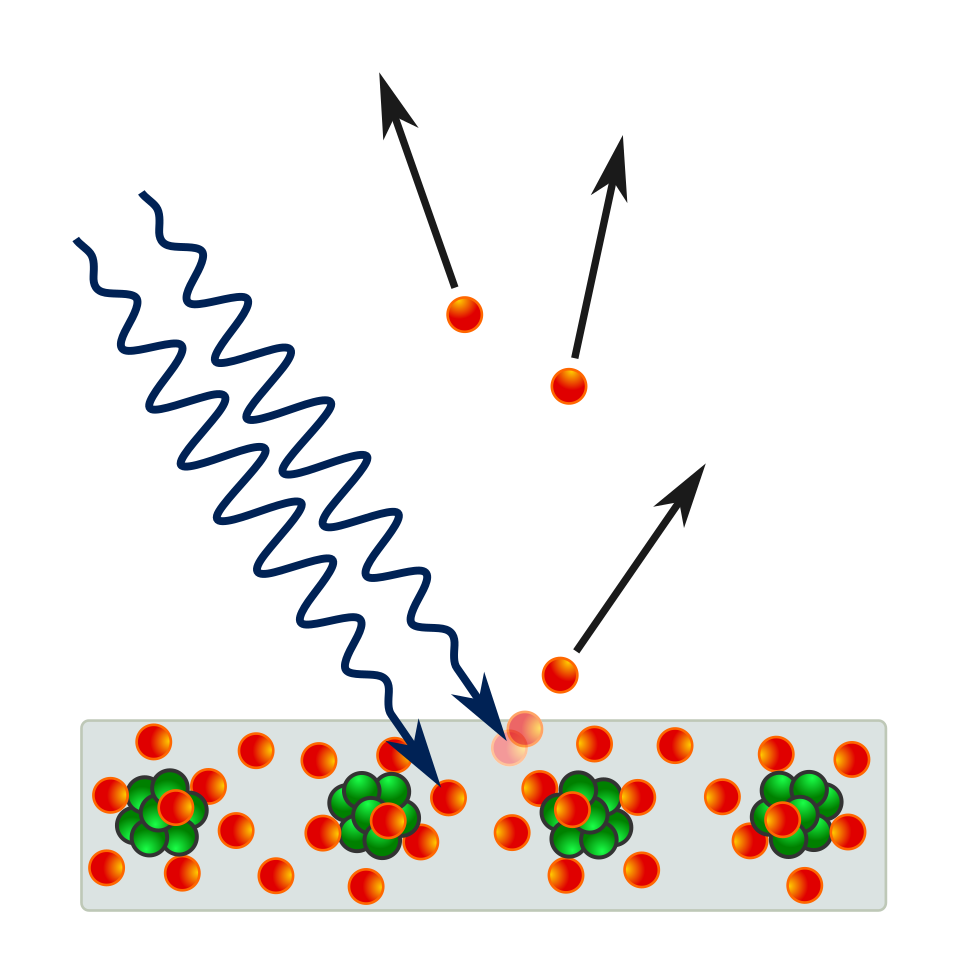 Photon hitting a metal surface and ejecting an electron (Image: Ponor, CC BY-SA 4.0, via Wikimedia Commons)
Worked Example: Calculating Maximum Kinetic Energy
Problem: Light of wavelength shines on sodium metal (work function ). What is the maximum kinetic energy of the ejected electrons?
Solution:
- Convert wavelength to frequency:
- Calculate photon energy: Convert to eV:
- Find :
Answer: The maximum kinetic energy of the ejected electrons is 0.82 eV.
Stopping Potential (V₀)
The stopping potential is the minimum voltage needed to stop the most energetic photoelectrons from reaching the anode.
From Einstein’s equation: where = charge of an electron ().
Example: If , then:
Applications of the Photoelectric Effect
| Application | How It Works | Example |
|---|---|---|
| Solar Cells | Photons knock electrons free, creating electric current. | Rooftop solar panels |
| Photocopiers & Scanners | Light reflects off a page, and sensors detect photons to create an image. | Office photocopier |
| Digital Cameras | Photons hit a sensor (CCD), creating an electric signal that forms an image. | Smartphone camera |
| Light Sensors | Photons trigger a current in sensors (e.g., street lights that turn on at dusk). | Automatic street lights |
Comparison: Wave Theory vs. Photon Theory
| Feature | Wave Theory (Classical) | Photon Theory (Quantum) |
|---|---|---|
| Nature of Light | Continuous wave (like ripples in water) | Discrete packets (photons) |
| Energy Dependence | Energy depends on intensity (brightness) | Energy depends on frequency (color) |
| Threshold Frequency | No threshold—bright enough light should always work | Must exceed a minimum frequency () |
| Instantaneous Effect | Delay expected (energy builds up) | Instant emission if |
| Explanation of KE | Cannot explain why KE depends on frequency | Explains |
Einstein’s Photoelectric Equation
The key equation linking photon energy, work function, and kinetic energy: or in terms of stopping potential:
Graphical Representation:
graph LR
  A["Photon Energy (hν)"] -->|"If hν > φ"| B["Electron Ejected"]
  B --> C["KE = hν - φ"]
  A -->|"If hν ≤ φ"| D["No Electron Ejected"]
NEB Board-Style Questions (Practice!)
Short Answer (5 marks)
- Explain why the photoelectric effect cannot be explained by the wave theory of light.
- Derive the expression for the maximum kinetic energy of photoelectrons.
- What is the stopping potential? How is it related to the maximum kinetic energy of photoelectrons?
Long Answer (10 marks)
- A metal surface has a work function of . When light of wavelength falls on it:
- Calculate the energy of the incident photons.
- Determine if photoelectrons will be emitted. If yes, calculate their maximum kinetic energy.
- Find the stopping potential required to stop the emitted electrons.
Numerical (5 marks)
- In an experiment, the stopping potential for a metal is found to be when illuminated by light of frequency . Calculate:
- The work function of the metal.
- The threshold wavelength for the metal.
Exam Tip: How to Score Full Marks
✅ Understand the photoelectric effect deeply—know why wave theory fails and how photon theory explains it. ✅ Memorize Einstein’s equation () and use it in calculations. ✅ Practice numerical problems—always convert units (e.g., nm to m, J to eV). ✅ Draw diagrams—label photon, metal surface, ejected electron, and stopping potential in your answers. ✅ Explain applications—mention solar cells, photocopiers, or digital cameras in descriptive answers. ✅ Watch for units—Planck’s constant () is in J·s, but work functions are often in eV. Convert carefully!
Final Note: Photons bridge the gap between light’s wave and particle nature. Master this topic, and you’ll ace questions on modern physics in your NEB exam! 🚀
Based on the NEB +2 Science syllabus for Physics (Phy), unit 23.
Discussion
Loading…