PhysicsUnit 265 min read
Radioactivity & Nuclear Reactions: Decay Types, Binding Energy, Fission & Fusion
Unit 26 of Physics explains radioactivity (alpha, beta, gamma decay), nuclear reactions (fission/fusion), binding energy, and applications like radiocarbon dating and nuclear power—with solved problems and NEB-style questions.
What is Radioactivity?
Radioactivity is the process by which unstable atomic nuclei lose energy by emitting radiation. This happens naturally in some elements (like uranium and radium) and can also be induced artificially.
Types of Radioactive Decay
There are three main types of radioactive decay:
Alpha (α) Decay
- An alpha particle (2 protons + 2 neutrons) is emitted.
- The atomic number decreases by 2, and the mass number decreases by 4.
- Example: Uranium-238 decays into Thorium-234.
Beta (β) Decay
- A beta particle (electron or positron) is emitted.
- The atomic number increases or decreases by 1, but the mass number stays the same.
- Example: Carbon-14 decays into Nitrogen-14.
Gamma (γ) Decay
- High-energy photons (gamma rays) are emitted.
- No change in atomic or mass number.
- Example: Cobalt-60 emits gamma rays while remaining Cobalt-60.
Comparison of Decay Types
| Type | Particle Emitted | Change in Atomic Number (Z) | Change in Mass Number (A) | Penetration Power |
|---|---|---|---|---|
| Alpha | Helium nucleus (α) | Decreases by 2 | Decreases by 4 | Low |
| Beta | Electron (β⁻) or Positron (β⁺) | Increases/decreases by 1 | No change | Medium |
| Gamma | Photon (γ) | No change | No change | High |
Nuclear Reactions
Nuclear reactions involve changes in the nucleus of an atom, leading to the formation of new elements.
Nuclear Fission
- A heavy nucleus (like Uranium-235) splits into smaller nuclei when struck by a neutron.
- Releases a large amount of energy.
- Example:
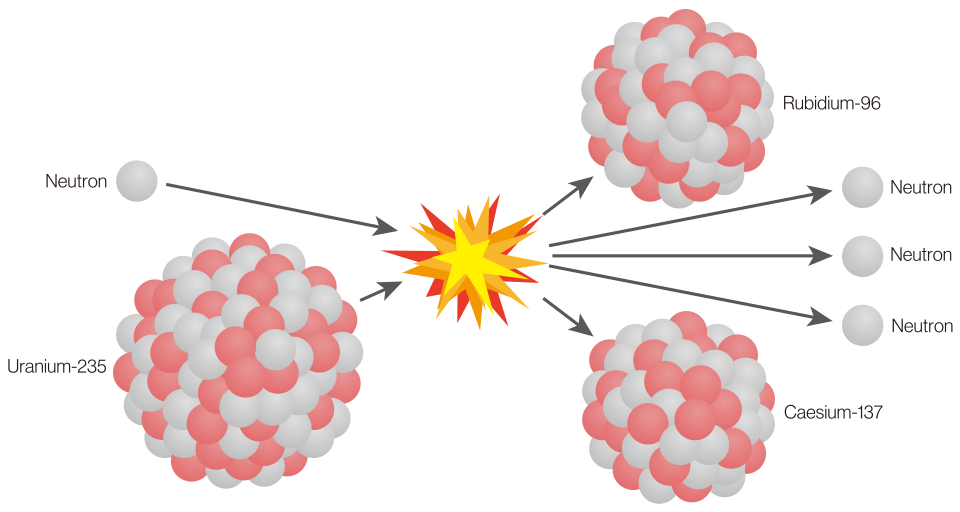 Fission of Uranium-235 (Image: Justinkunimune, CC0, via Wikimedia Commons)
n + U-235 → Ba-141 + Kr-92 + 3n + Energy
### Nuclear Fusion
- Two light nuclei (like Hydrogen isotopes) combine to form a heavier nucleus.
- Releases even more energy than fission.
- Example (in the Sun):
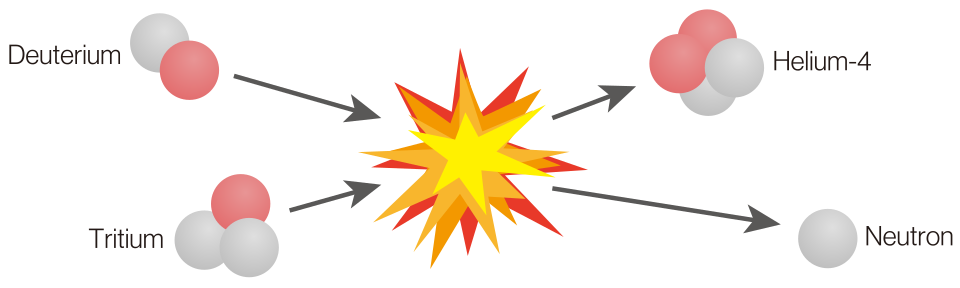 Fusion of Hydrogen to Helium (Image: Justinkunimune, CC0, via Wikimedia Commons)
4H-1 → He-4 + 2 positrons + Energy
---

## Binding Energy and Mass Defect
- **Binding Energy**: The energy required to break a nucleus into its individual protons and neutrons.
- **Mass Defect (Δm)**: The difference between the mass of the nucleus and the sum of the masses of its nucleons.
Binding Energy (E) = Δm × c² (Einstein’s equation)
- **Binding Energy per Nucleon**: Shows nuclear stability. Higher values mean more stable nuclei.
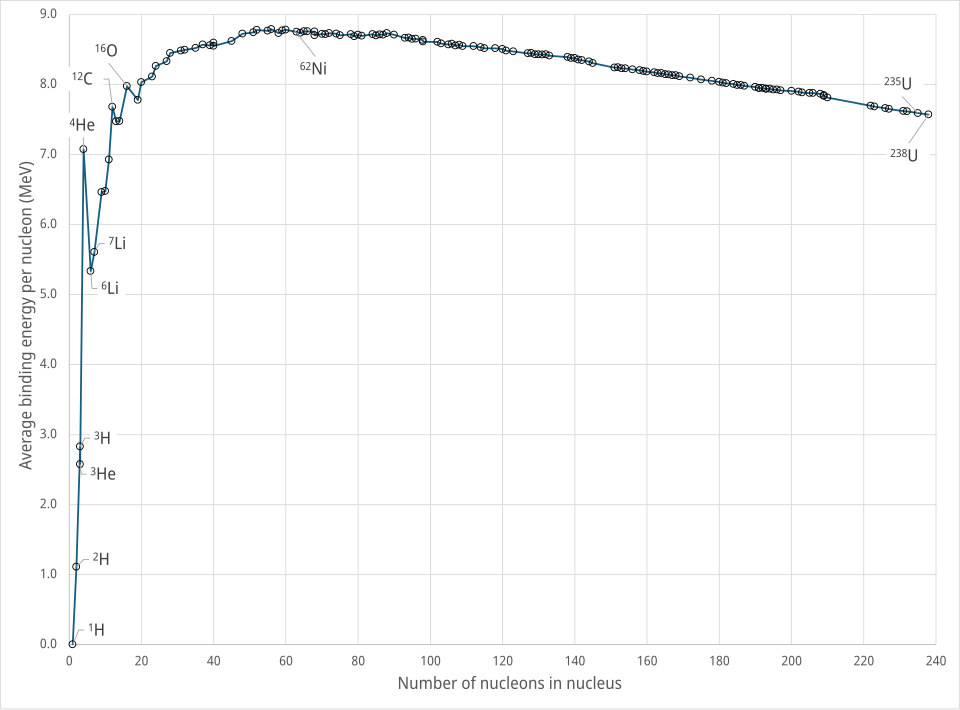 Binding energy per nucleon vs. mass number (Image: ScottMars, CC0, via Wikimedia Commons)
---

## Applications of Radioactivity
1. **Medical Uses**
 - **Cancer Treatment**: Cobalt-60 emits gamma rays to kill cancer cells.
 - **Diagnosis**: Technetium-99m is used in medical imaging.

2. **Archaeology (Radiocarbon Dating)**
 - Carbon-14 decays at a known rate, helping determine the age of fossils and artifacts.

3. **Nuclear Power**
 - Uranium-235 undergoes fission to produce electricity.

4. **Industrial Uses**
 - **Tracers**: Radioactive isotopes track fluid flow in pipes.
 - **Sterilization**: Gamma rays kill bacteria in medical supplies.

---

## Solved Example
**Problem**: A radioactive element decays from 100 mg to 25 mg in 10 days. What is its half-life?
**Solution**:
- Half-life (t₁/₂) is the time for half the substance to decay.
- After 10 days, the mass reduces to 25 mg (which is 1/4 of the original 100 mg).
- This means **two half-lives** have passed (since 100 → 50 → 25).
- Therefore, **half-life = 10 days / 2 = 5 days**.

---

## NEB-Style Questions
### Short Answer Questions
1. What is the difference between alpha and beta decay?
2. Why is nuclear fusion more energy-efficient than fission?
3. How is radiocarbon dating used to determine the age of fossils?

### Long Answer Questions
1. Explain the process of nuclear fission with an example. What are its advantages and disadvantages?
2. Describe the binding energy curve. How does it relate to nuclear stability?
3. A sample of Radium-226 decays to 1/16th of its original amount in 64 days. Calculate its half-life.

---

## Exam Tip
- **Memorize decay equations** (e.g., Uranium → Thorium + Alpha).
- **Understand half-life calculations**—practice problems with different time intervals.
- **Compare fission and fusion**—know their energy outputs and real-world applications.
- **Binding energy curve**: Recognize that iron-56 is the most stable nucleus.
- **Applications**: Link radioactivity to medical, archaeological, and industrial uses.

---
This note covers all key subtopics with visuals, examples, and NEB-style questions to help you score well!
Based on the NEB +2 Science syllabus for Physics (Phy), unit 26.
Discussion
Loading…