PhysicsUnit 2714 min read
Recent Trends in Physics: Nanotechnology, Superconductivity, Quantum Computing
Unit 27 of Physics explores cutting-edge advancements like nanotechnology, superconductivity, quantum computing, and their real-world applications, helping students understand how modern physics shapes technology and society.
Introduction
Physics is always evolving. New discoveries and technologies change how we live, work, and solve problems. This unit covers four major recent trends in physics:
- Nanotechnology – Science and technology at the atomic and molecular scale.
- Superconductivity – Materials that conduct electricity with zero resistance.
- Quantum Computing – Computers that use quantum bits (qubits) for ultra-fast calculations.
- Applications in Medicine, Energy, and Communication – How these trends impact daily life.
Let’s explore each one with real-world examples, diagrams, and NEB-style questions at the end.
1. Nanotechnology: The Science of the Tiny
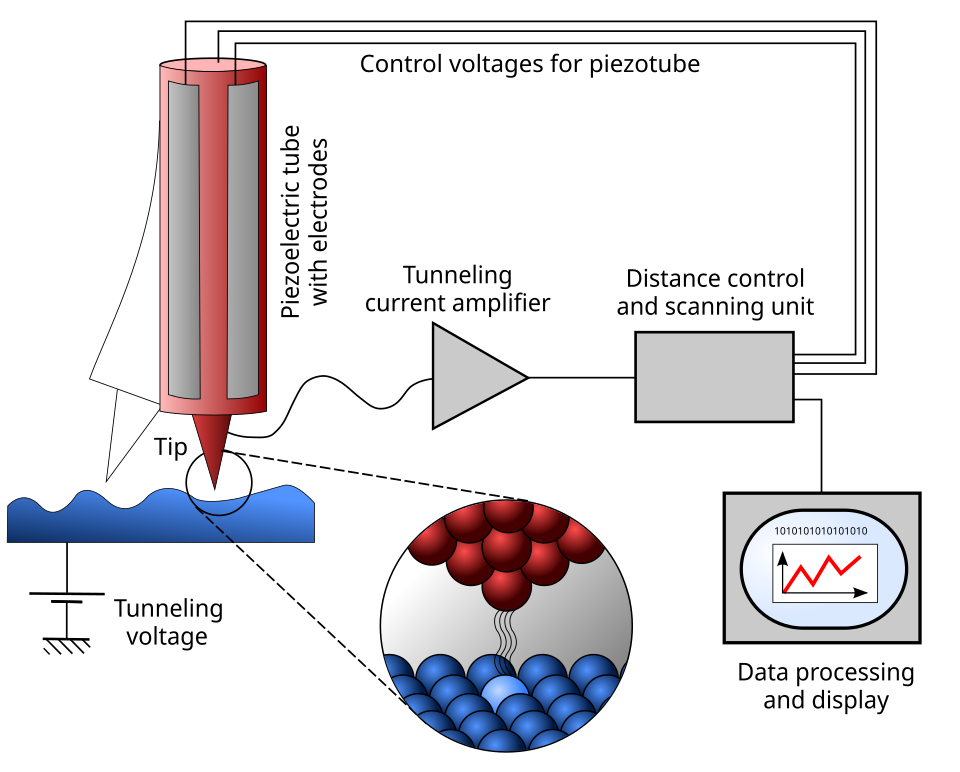 STM (Scanning Tunneling Microscope) used to visualize and manipulate atoms at nanoscale. (Image: Michael Schmid and Grzegorz Pietrzak, CC BY-SA 2.0 at, via Wikimedia Commons)
What is Nanotechnology?
- Nano means 1 billionth (10⁻⁹ meters).
- Nanotechnology works with atoms and molecules (1–100 nm in size).
- It involves designing, building, and using materials at the nanoscale to create new properties.
How Does It Work?
- At the nanoscale, materials behave differently (e.g., gold nanoparticles turn red, not gold).
- Scientists use scanning tunneling microscopes (STM) and atomic force microscopes (AFM) to see and manipulate atoms.
Applications of Nanotechnology
| Field | Application | Example |
|---|---|---|
| Medicine | Drug delivery, cancer treatment | Nanoparticles carry medicine directly to tumors. |
| Electronics | Faster, smaller chips | Quantum dots in TVs and solar panels. |
| Energy | Better batteries, solar cells | Nanomaterials increase solar efficiency. |
| Environment | Water purification, pollution control | Nanofilters remove heavy metals from water. |
Advantages & Disadvantages
✅ Pros:
- More efficient products (e.g., stronger materials, better medicines).
- Helps in cancer treatment (nanobots target only diseased cells).
- Reduces waste in electronics.
❌ Cons:
- Toxicity risks (some nanoparticles may harm health).
- High cost of production.
- Ethical concerns (e.g., military use of nanoweapons).
Example: Carbon Nanotubes
- Structure: Tiny tubes made of carbon atoms (like rolled graphene).
- Properties:
- 100x stronger than steel but lighter.
- Excellent conductors of electricity and heat.
- Uses:
- Sports equipment (lighter tennis rackets).
- Electronics (faster computer chips).
- Medicine (nanotube-based sensors detect diseases early).
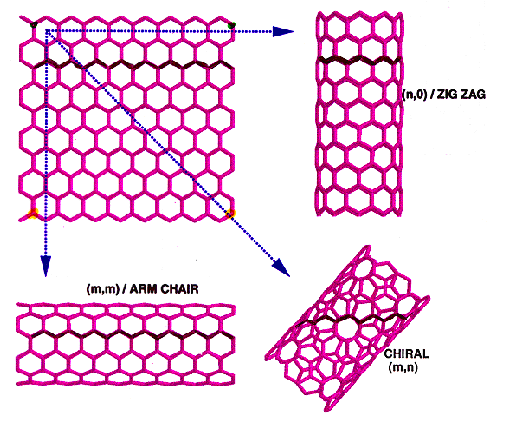 A rolled sheet of graphene forming a tiny tube, used in super-strong materials. (Image: Lesnar1234, CC0, via Wikimedia Commons)
2. Superconductivity: Zero Resistance, Infinite Possibilities
What is Superconductivity?
- A material loses all electrical resistance when cooled below a certain temperature (critical temperature, Tc).
- No energy loss → Electricity flows forever without heating.
How Does It Work?
- Conventional superconductors (e.g., mercury, lead) work at very low temperatures (near absolute zero, -273°C).
- High-temperature superconductors (e.g., ceramics) work at liquid nitrogen temperatures (-196°C).
- Meissner Effect: Superconductors repel magnetic fields (can float on magnets!).
Types of Superconductors
| Type | Example | Critical Temp (Tc) | Discovery Year |
|---|---|---|---|
| Type I | Mercury (Hg) | -269°C | 1911 |
| Type II | Niobium-Titanium | -253°C | 1960s |
| High-Tc (Ceramics) | YBCO (Yttrium) | -183°C | 1987 |
| Room-Temp (Future?) | Hydrogen sulfide | -70°C (theoretical) | 2020 |
Applications of Superconductivity
| Field | Application | Example |
|---|---|---|
| Energy | Lossless power transmission | Superconducting cables in cities. |
| Transport | Maglev trains (floating on magnets) | Japan’s SCMaglev (581 km/h). |
| Medicine | Stronger MRI machines | Superconducting magnets in hospitals. |
| Computers | Faster processors | Quantum computers use superconducting qubits. |
Challenges
❌ Extreme cooling required (most superconductors need -200°C). ❌ Brittleness (ceramic superconductors break easily). ❌ High cost of production.
Example: Maglev Trains
- Use superconducting magnets to levitate (float) above tracks.
- No friction → speeds over 500 km/h (faster than planes in some cases!).
- Japan’s SCMaglev connects Tokyo to Osaka in 40 minutes (vs. 2.5 hours by bullet train).
3. Quantum Computing: The Future of Computers
What is Quantum Computing?
- Normal computers use bits (0 or 1).
- Quantum computers use qubits (can be 0, 1, or both at once due to superposition).
- Entanglement allows qubits to be instantly connected, even far apart.
How Does It Work?
- Superposition: A qubit can be in multiple states at once (like a spinning coin).
- Entanglement: Qubits are linked—changing one affects another instantly (Einstein called this "spooky action at a distance").
- Quantum Gates: Perform operations on qubits (like logic gates in normal computers).
Advantages Over Normal Computers
✅ Exponential speed for certain problems (e.g., cracking codes, drug discovery). ✅ Simulates complex molecules (helps in medicine and chemistry). ✅ Optimizes systems (e.g., traffic, finance, AI).
Challenges
❌ Extremely sensitive to noise and temperature (requires near absolute zero). ❌ Error-prone (qubits lose coherence quickly). ❌ Expensive to build and maintain.
Example: Shor’s Algorithm (Breaking Codes)
- A quantum algorithm that factors large numbers much faster than normal computers.
- Threat to cybersecurity (can break RSA encryption).
- Opportunity for quantum-safe cryptography.
Current Quantum Computers (2024)
| Company | Computer Name | Qubits (2024) | Temperature Needed |
|---|---|---|---|
| IBM | IBM Quantum Eagle | 1,121 | Near absolute zero |
| Sycamore | 72 | -273°C | |
| China | Jiuzhang | Photonic (100+) | Room temperature (partially) |
4. Applications in Medicine, Energy, and Communication
A. Medicine: Nanobots and Early Disease Detection
- Nanobots (tiny robots) can deliver drugs directly to cancer cells.
- Nanosensors detect diseases (e.g., diabetes, heart attacks) years before symptoms appear.
- 3D-printed organs using nanotechnology for transplants.
B. Energy: Cleaner and More Efficient
- Superconducting wind turbines → No energy loss in transmission.
- Nanomaterial solar panels → Cheaper and more efficient than silicon panels.
- Fusion reactors (future) → Unlimited clean energy (like the Sun).
C. Communication: Faster Internet and 6G
- Quantum internet → Unhackable communication (using quantum entanglement).
- Nanotube-based transistors → Faster smartphones and computers.
- 5G/6G networks use nanotechnology for smaller, more powerful antennas.
Exam Tip: How to Score Full Marks in NEB Physics (Unit 27)
NEB exams test concepts, applications, and problem-solving. Here’s how to maximize your score:
1. Understand Key Definitions
- Nanotechnology: "Science of manipulating matter at the atomic and molecular scale (1–100 nm)."
- Superconductivity: "A state where a material has zero electrical resistance below a critical temperature."
- Qubit: "A quantum bit that can exist in superposition (0, 1, or both)."
2. Compare Technologies (Tables Help!)
NEB loves comparison tables. Example:
| Property | Normal Computer | Quantum Computer |
|---|---|---|
| Basic Unit | Bit (0 or 1) | Qubit (0, 1, or both) |
| Speed | Fast for simple tasks | Exponentially faster for complex problems |
| Error Rate | Low | High (needs error correction) |
| Temperature | Room temp | Near absolute zero |
3. Explain Applications with Real Examples
- Nanotechnology: "Carbon nanotubes are used in tennis rackets because they are 100x stronger than steel but lighter."
- Superconductivity: "Maglev trains in Japan use superconducting magnets to float and reach 581 km/h."
- Quantum Computing: "Google’s Sycamore solved a problem in 200 seconds that would take a supercomputer 10,000 years."
4. Solve Numerical Problems (If Any)
- Example: If a superconducting cable has zero resistance, how much energy is lost in transmitting 1000 kWh over 100 km? Answer: Zero energy loss (since resistance = 0).
5. Common Mistakes to Avoid
❌ Mixing up nanotechnology with nanoscale biology (e.g., viruses are not nanotechnology). ❌ Saying superconductors work at room temperature (only high-Tc ones work at -196°C). ❌ Assuming quantum computers replace normal computers (they are specialized tools).
NEB-Style Questions & Solutions
Short Answer Questions (2 marks each)
What is nanotechnology? Give one application in medicine. Answer: Nanotechnology is the science of manipulating matter at the atomic and molecular scale (1–100 nm). Application: Nanoparticles are used in targeted drug delivery for cancer treatment.
Define superconductivity. Why are most superconductors cooled? Answer: Superconductivity is a state where a material has zero electrical resistance below a critical temperature. Reason: Most superconductors lose their properties at higher temperatures, so they must be cooled to near absolute zero to maintain superconductivity.
How does a quantum computer differ from a normal computer? Answer:
Feature Normal Computer Quantum Computer Basic Unit Bit (0 or 1) Qubit (0, 1, or both) Processing Sequential Parallel (superposition)
Long Answer Questions (5 marks)
Explain the working principle of a maglev train. Why is superconductivity important for it? Answer:
- Working Principle:
- Superconducting magnets are placed on the train and track.
- Meissner Effect causes the train to float above the track (repels magnetic field).
- No friction → Train moves smoothly at high speeds (500+ km/h).
- Importance of Superconductivity:
- Zero resistance → Magnets stay strong without energy loss.
- Strong magnetic fields → Lifts the train higher for stability.
- Efficiency → Less power needed compared to normal magnets.
- Working Principle:
Describe two applications of nanotechnology in everyday life. How does it benefit society? Answer:
- Application 1: Sunscreen Lotions
- Nanoparticles (ZnO/TiO₂) block UV rays without leaving a white film.
- Benefit: More comfortable and effective sun protection.
- Application 2: Stain-Resistant Clothes
- Nanocoating makes fabrics repel water and stains.
- Benefit: Clothes stay cleaner for longer, reducing laundry needs.
- Societal Benefits:
- Healthier lives (better medicines, pollution control).
- Sustainability (energy-efficient materials).
- Economic growth (new industries, jobs).
- Application 1: Sunscreen Lotions
Problem-Solving (3 marks)
- A superconducting cable carries 100 A of current with zero resistance. Calculate the power loss if the cable were normal copper with resistance 0.1 Ω.
Solution:
- Power loss (P) = I²R
- For superconductor (R = 0 Ω): W (no loss)
- For copper (R = 0.1 Ω): W
- Conclusion: Superconductors save huge energy by eliminating resistance.
Summary Table: Recent Trends in Physics
| Trend | Key Idea | Real-World Impact | Future Potential |
|---|---|---|---|
| Nanotechnology | Manipulating atoms (1–100 nm) | Medicine, electronics, energy | Nanobots for surgery, self-healing materials |
| Superconductivity | Zero resistance at low temps | Maglev trains, MRI machines | Room-temperature superconductors, lossless power grids |
| Quantum Computing | Qubits (0, 1, or both) | Breaking codes, drug discovery | Unhackable internet, AI revolution |
Final Advice for NEB Exam
✅ Memorize definitions (but understand them, don’t just cram). ✅ Draw diagrams (e.g., carbon nanotube, maglev train, quantum gates). ✅ Relate to real life (NEB loves examples like "nanotech in sunscreen"). ✅ Practice numericals (even if simple, like power loss in superconductors). ✅ Compare technologies (tables score extra marks!).
Good luck! 🚀 You’ve got this!
Based on the NEB +2 Science syllabus for Physics (Phy), unit 27.
Discussion
Loading…