Financial Accounting IUnit 512 min read
Ledger: Postings, Classifications, Trial Balance Link
Unit 5 of Financial Accounting I explains how to maintain a ledger—posting journal entries to individual accounts, classifying accounts, and ensuring accuracy through trial balances, with real-world examples from Nepali businesses.
TAKEAWAYS:
- A ledger is a book of final entry where transactions from the journal are posted to individual accounts (assets, liabilities, equity, income, expenses).
- Each account in the ledger follows the T-account format (left = debit, right = credit) and must balance before preparing financial statements.
- Classifying accounts (real vs. nominal vs. personal) determines their placement in the ledger and affects the trial balance.
- The trial balance is a summary of all ledger accounts to check arithmetic accuracy before final accounts.
- Errors detected by trial balance include single-entry omissions, transposition errors, and incorrect casting—but not compensating errors or errors of principle.
- Posting rules: Debit the receiver, credit the giver; debit what comes in, credit what goes out.
What is a Ledger?
A ledger is a principal book of accounting where transactions recorded in the journal are transferred to individual accounts. It provides a complete record of each account’s activity, making it easier to prepare financial statements like the balance sheet and income statement.
Purpose of a Ledger
- Classifies transactions by account (e.g., Cash, Sales, Salaries).
- Shows the complete history of each account (debits and credits).
- Helps in preparing financial statements (trial balance → final accounts).
- Detects errors through trial balance reconciliation.
Types of Ledger Accounts
Ledger accounts are classified into three categories:
| Type | Definition | Examples (in NPR) | Treatment in Final Accounts |
|---|---|---|---|
| Real Accounts | Represent assets, liabilities, and owner’s equity (permanent accounts). | Cash, Bank, Furniture, Loan from Bank | Appear in Balance Sheet |
| Nominal Accounts | Represent income, expenses, gains, and losses (temporary accounts). | Salaries, Rent, Sales, Depreciation | Appear in Income Statement |
| Personal Accounts | Represent individuals, firms, or organizations (debtors/creditors). | Ram Prasad (Debtor), Sita Devi (Creditor) | Appear in Balance Sheet (if outstanding) |
Ledger Posting Process
Transactions from the journal are posted to the ledger using the double-entry system. Here’s how:
Step-by-Step Posting Rules
- Locate the account in the ledger where the transaction belongs.
- Write the date of the journal entry.
- Write the journal page number (e.g., "JF No. 1").
- Enter the amount in the debit or credit side as per the journal entry.
- Write a brief narration (e.g., "Received cash from sales").
- Balance the account (debit total = credit total).
Example: Posting to Cash Account
Suppose Kathmandu Retail Shop records the following transaction in the journal:
2080-04-01: Cash sales ₹50,000.
Journal Entry:
Date       Particulars          L.F.       Dr. (₹)       Cr. (₹)
2080-04-01 Sales A/c             Dr.       50,000
           To Cash A/c           Cr.                    50,000
Posting to Ledger (Cash Account):
CASH ACCOUNT
Date       Particulars          L.F.       Dr. (₹)       Cr. (₹)       Balance (₹)
2080-04-01 Sales A/c             JF No. 1  50,000                          50,000
Balance: ₹50,000 (Debit side)
Posting to Ledger (Sales Account):
SALES ACCOUNT
Date       Particulars          L.F.       Dr. (₹)       Cr. (₹)       Balance (₹)
2080-04-01 To Cash A/c           JF No. 1          50,000     50,000 (Cr.)
Balance: ₹50,000 (Credit side)
T-Account Format
Every ledger account is represented in a T-shape, where:
- Left side = Debit (Dr.)
- Right side = Credit (Cr.)
- Balance is calculated as:
- If Debit > Credit → Debit Balance
- If Credit > Debit → Credit Balance
Example: Furniture Account
Suppose Kathmandu Retail Shop buys furniture for ₹100,000 on credit.
Journal Entry:
Date       Particulars          L.F.       Dr. (₹)       Cr. (₹)
2080-04-02 Furniture A/c         Dr.       100,000
           To Supplier A/c       Cr.                    100,000
Ledger Posting (Furniture Account):
FURNITURE ACCOUNT
Date       Particulars          L.F.       Dr. (₹)       Cr. (₹)       Balance (₹)
2080-04-02 Supplier A/c         JF No. 2  100,000                        100,000 (Dr.)
Trial Balance: Link Between Ledger and Financial Statements
A trial balance is a summary of all ledger accounts to ensure:
- Arithmetic accuracy (debits = credits).
- No posting errors (omissions, transpositions, incorrect casting).
Format of Trial Balance
| Sr. No. | Account Name | Dr. (₹) | Cr. (₹) |
|---|---|---|---|
| 1 | Cash | 50,000 | |
| 2 | Sales | 50,000 | |
| 3 | Furniture | 100,000 | |
| 4 | Supplier A/c | 100,000 | |
| Total | 150,000 | 150,000 |
Note: If Debit ≠ Credit, errors exist in posting or journalizing.
Errors Detected by Trial Balance
| Type of Error | Example | Effect on Trial Balance |
|---|---|---|
| Single-entry omission | Forgetting to post a transaction (e.g., ₹10,000 cash sales not posted). | Debit ≠ Credit by ₹10,000 |
| Transposition error | Writing ₹50,000 as ₹5,000 or ₹500. | Difference is divisible by 9 |
| Incorrect casting | Adding debits as ₹10,000 instead of ₹100,000. | Debit ≠ Credit |
| Compensating error | Overstating one account and understating another by the same amount. | Debit = Credit (but still wrong!) |
| Error of principle | Recording salaries as an asset instead of an expense. | Not detected by trial balance |
Ledger vs. Journal: Key Differences
| Feature | Journal | Ledger |
|---|---|---|
| Name | Book of original entry | Book of final entry |
| Format | Chronological (date-wise) | Account-wise (T-account format) |
| Purpose | Records transactions in one place | Classifies transactions by account |
| Posting | Transactions are not classified | Transactions are classified |
| Errors Detected | Detects complete omission | Detects posting errors |
In the Real World
eSewa (Nepal)
- Idea Used: Personal Accounts (Creditors/Debtors)
- How? When you pay an electricity bill via eSewa, the transaction is recorded in the NTC’s ledger under your account (personal account) and the eSewa’s ledger as a credit to NTC and debit to your wallet.
Khalti (Nepal)
- Idea Used: Real Accounts (Cash/Bank)
- How? When you transfer ₹5,000 from Khalti to a friend, Khalti’s system debits your account (real account) and credits your friend’s account, maintaining a balanced ledger for both parties.
Daraz (Nepal)
- Idea Used: Nominal Accounts (Sales/Expenses)
- How? When Daraz sells a product, the sales revenue is recorded in the Sales Account (nominal), and the cost of goods sold is recorded in the Purchases Account (nominal). The ledger ensures that profit/loss is accurately calculated.
Nepal Rastra Bank (NRB)
- Idea Used: Trial Balance for Accuracy
- How? Before publishing financial statements, NRB prepares a trial balance to ensure that all debits = credits in the ledger, preventing errors in monetary policy reporting.
Worked Example: Ledger Posting for a Nepali Business
Scenario: Kathmandu Book Shop records the following transactions in April 2080:
- 2080-04-01: Started business with cash ₹200,000.
- 2080-04-02: Purchased books for ₹150,000 on credit from Book World.
- 2080-04-03: Sold books for ₹80,000 cash.
- 2080-04-04: Paid rent ₹10,000 cash.
- 2080-04-05: Withdrew ₹20,000 cash for personal use.
Journal Entries
Date       Particulars          L.F.       Dr. (₹)       Cr. (₹)
2080-04-01 Capital A/c          Dr.       200,000
           To Cash A/c          Cr.                    200,000
2080-04-02 Purchases A/c         Dr.       150,000
           To Book World A/c    Cr.                    150,000
2080-04-03 Cash A/c             Dr.       80,000
           To Sales A/c         Cr.                    80,000
2080-04-04 Rent A/c             Dr.       10,000
           To Cash A/c          Cr.                    10,000
2080-04-05 Drawing A/c           Dr.       20,000
           To Cash A/c          Cr.                    20,000
Ledger Postings
1. Cash Account
CASH ACCOUNT
Date       Particulars          L.F.       Dr. (₹)       Cr. (₹)       Balance (₹)
2080-04-01 Capital A/c          JF No. 1  200,000                        200,000
2080-04-03 Sales A/c            JF No. 3  80,000                         280,000
2080-04-04 Rent A/c             JF No. 4          10,000     270,000
2080-04-05 Drawing A/c          JF No. 5          20,000     250,000
2. Purchases Account
PURCHASES ACCOUNT
Date       Particulars          L.F.       Dr. (₹)       Cr. (₹)       Balance (₹)
2080-04-02 To Book World A/c    JF No. 2  150,000     150,000 (Dr.)
3. Sales Account
SALES ACCOUNT
Date       Particulars          L.F.       Dr. (₹)       Cr. (₹)       Balance (₹)
2080-04-03 To Cash A/c          JF No. 3          80,000     80,000 (Cr.)
4. Book World Account (Creditor)
BOOK WORLD A/c
Date       Particulars          L.F.       Dr. (₹)       Cr. (₹)       Balance (₹)
2080-04-02 Purchases A/c        JF No. 2          150,000     150,000 (Cr.)
Trial Balance as of 2080-04-05
| Sr. No. | Account Name | Dr. (₹) | Cr. (₹) |
|---|---|---|---|
| 1 | Cash | 250,000 | |
| 2 | Capital | 200,000 | |
| 3 | Purchases | 150,000 | |
| 4 | Sales | 80,000 | |
| 5 | Rent | 10,000 | |
| 6 | Drawing | 20,000 | |
| 7 | Book World A/c | 150,000 | |
| Total | 430,000 | 430,000 |
Mermaid Diagram: Accounting Cycle (Journal → Ledger → Trial Balance → Final Accounts)
flowchart TD
    A["Journal"] -->|"Posting"| B["Ledger"]
    B -->|"Summarize"| C["Trial Balance"]
    C -->|"Prepare"| D["Final Accounts<br/>(Balance Sheet & Income Statement)"]
    D -->|"Close"| E["Next Period"]
Exam Tip
- Memorize the three types of accounts (real, nominal, personal) and their treatment in final accounts.
- Practice posting journal entries to ledger accounts—examiners check for correct debit/credit sides and balancing.
- Trial balance is a must-check step—always ensure debits = credits before proceeding to final accounts.
- Common mistakes in exams:
- Incorrect classification (e.g., treating expenses as assets).
- Forgetting to balance accounts before trial balance.
- Transposition errors in amounts (e.g., ₹500 instead of ₹5,000).
- For numericals, always:
- Show journal entries first.
- Post to ledger accounts (T-format).
- Prepare a trial balance to verify accuracy.
- Real-world application questions may ask how a business (e.g., Daraz, Khalti, or a local shop) uses ledgers—relate to classification of accounts and trial balance checks.
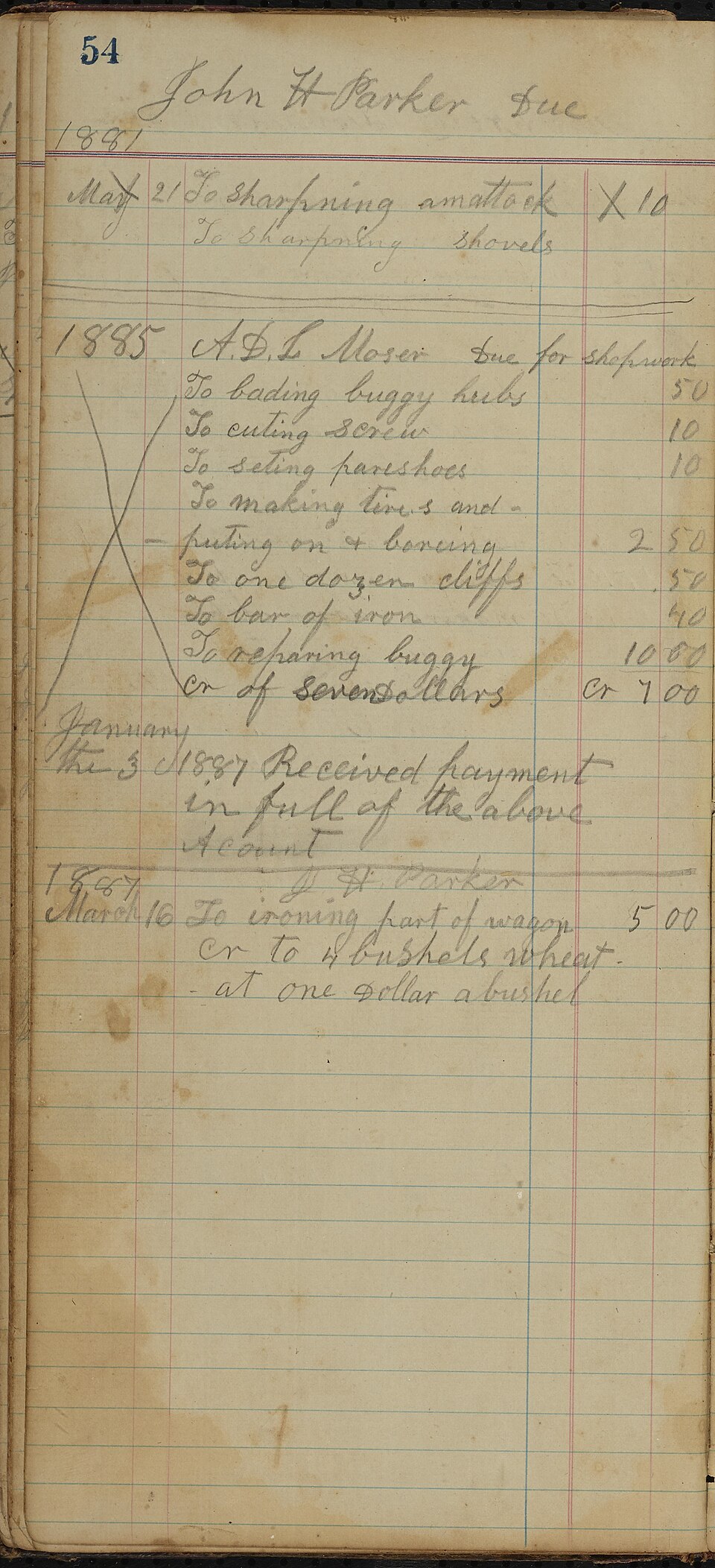 A real ledger book page with multiple accounts (Cash, Accounts Receivable, etc.). (Image: Public domain, via Wikimedia Commons)
Based on the PU BBA (PU) syllabus for Financial Accounting I, unit 5.
Discussion
Loading…