Principles of ManagementUnit 16 min read
Definitions, Functions, Levels & Importance of Management
Unit 1 of Principles of Management introduces core concepts like management definitions, its functions (planning, organizing, leading, controlling), levels (top, middle, operational), and its importance in organizations—explained with real-world examples from Nepali and global businesses.
Core Concepts of Management
1. Definition of Management
Management is the process of planning, organizing, leading, and controlling organizational resources (human, financial, physical, and informational) to achieve goals efficiently and effectively.
Key Definitions
| Author | Definition |
|---|---|
| Koontz & O’Donnell | "Management is the art of getting things done through and with people in formally organized groups." |
| Henry Fayol | "To manage is to forecast and plan, to organize, to command, to coordinate, and to control." |
| Peter Drucker | "Management is doing things right; leadership is doing the right things." |
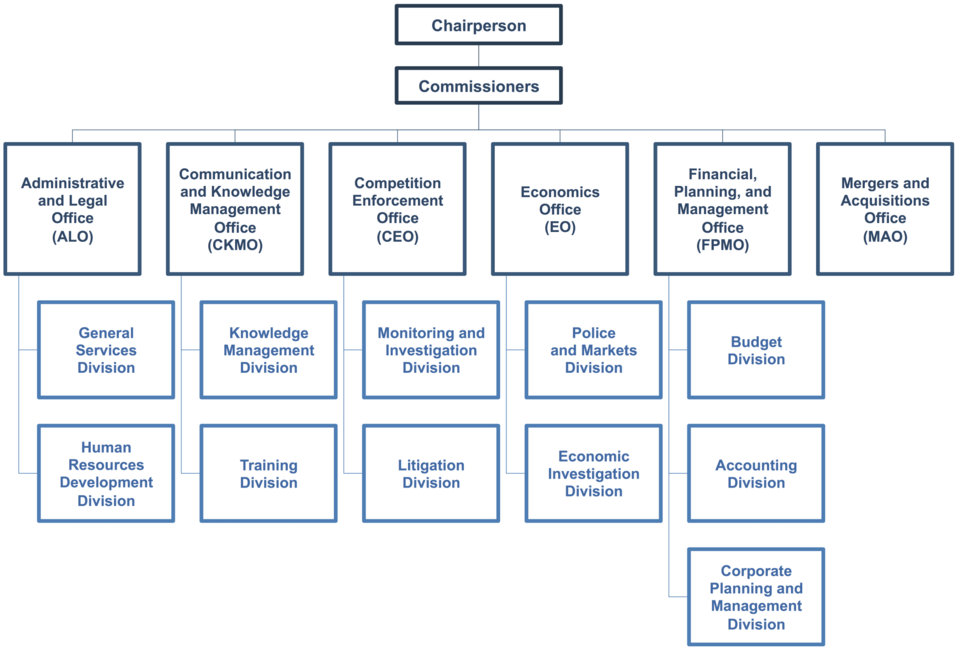 A typical corporate structure showing top, middle, and operational levels. (Image: Martintepongko, CC BY-SA 4.0, via Wikimedia Commons)
2. Functions of Management
Management performs four primary functions (POLC), forming a continuous cycle:
graph TD
    A["Planning"] --> B["Organizing"]
    B --> C["Leading"]
    C --> D["Controlling"]
    D --> A
a) Planning
- Definition: Setting goals and deciding how to achieve them.
- Steps:
- Goal Setting (SMART: Specific, Measurable, Achievable, Relevant, Time-bound).
- Forecasting (predicting future trends).
- Decision Making (choosing the best course of action).
- Formulating Plans (strategic, tactical, operational).
Example:
- Nepal Rastra Bank (NRB) plans monetary policy to control inflation.
- Daraz plans inventory levels based on demand forecasts.
b) Organizing
- Definition: Arranging resources (people, money, equipment) to achieve goals.
- Key Elements:
- Division of Work (specialization).
- Departmentalization (grouping jobs by function, product, or region).
- Authority & Responsibility (who reports to whom).
- Span of Control (how many subordinates a manager oversees).
c) Leading (Directing)
- Definition: Influencing, motivating, and guiding employees to achieve goals.
- Key Tools:
- Leadership Styles (Autocratic, Democratic, Laissez-Faire).
- Motivation Theories (Maslow’s Hierarchy, Herzberg’s Two-Factor Theory).
- Communication (upward, downward, lateral).
Example:
- Pathao motivates drivers with bonuses for high ratings.
- Toyota’s leadership emphasizes teamwork (e.g., "The Toyota Way").
d) Controlling
- Definition: Monitoring performance and correcting deviations from plans.
- Steps:
- Setting Standards (benchmarks).
- Measuring Performance (KPIs, reports).
- Comparing Results (vs. standards).
- Taking Corrective Action (rewards/punishments).
Example:
- NTC controls traffic congestion by monitoring signal timings.
- Khalti controls fraud by tracking transaction patterns.
Levels of Management
Management is organized into three levels, each with distinct roles:
| Level | Position Examples | Key Responsibilities |
|---|---|---|
| Top Level | CEO, MD, Board of Directors | Strategic planning, policy-making, long-term goals (e.g., Chaudhary Group’s expansion). |
| Middle Level | Department Heads, Managers | Tactical planning, coordinating teams (e.g., Daraz’s logistics manager). |
| Operational | Supervisors, Team Leads | Day-to-day operations, implementing plans (e.g., Ncell’s customer service agents). |
Importance of Management
Management is essential for:
- Achieving Organizational Goals (e.g., NEPSE managing stock market stability).
- Efficient Use of Resources (e.g., Himalayan Java optimizing coffee production).
- Adaptability to Change (e.g., Google pivoting to AI and cloud services).
- Employee Satisfaction (e.g., Nabil Bank’s employee engagement programs).
- Social Responsibility (e.g., Pokhara Metropolitan City’s waste management).
In the Real World
eSewa & Khalti (Digital Payments)
- Planning: These apps plan for security updates and user growth.
- Organizing: They structure teams for tech, customer support, and fraud detection.
- Leading: Motivates employees with performance bonuses and stock options.
- Controlling: Monitors transactions in real-time to prevent fraud.
Daraz (E-Commerce)
- Organizing: Uses a flat hierarchy to speed up decision-making (e.g., regional managers report directly to the CEO).
- Controlling: Tracks delivery times via GPS to ensure on-time orders.
NTC (Traffic Management)
- Planning: Designs traffic signal timings based on peak hours.
- Controlling: Uses CCTV to monitor congestion and adjust signals dynamically.
Case Study: Toyota’s Management Principles
Toyota’s success stems from lean management and continuous improvement (Kaizen):
- Planning: Long-term R&D for electric vehicles (e.g., Prius).
- Organizing: Cross-functional teams (engineers, designers, suppliers).
- Leading: Empowering workers to stop production lines if defects are found (Jidoka).
- Controlling: Just-in-Time (JIT) inventory to reduce waste.
Exam Tip
- Definitions: Memorize Koontz, Fayol, and Drucker’s definitions—often asked in short-answer questions.
- POLC Cycle: Draw the management functions cycle in exams (planning → organizing → leading → controlling → back to planning).
- Levels of Management: Compare top, middle, and operational levels with real examples (e.g., CEO vs. branch manager).
- Importance: Link management principles to Nepali companies (e.g., Nabil Bank’s risk management, Daraz’s supply chain).
- Diagrams: Always label organizational charts clearly (e.g., "Who reports to whom?").
- Case Studies: Be ready to analyze Toyota, Daraz, or NTC using management functions.
Key Takeaway: Management is not just a theory—it’s the backbone of every successful business, from Khalti’s digital transactions to NTC’s traffic control. Master the POLC functions and levels, and you’ll ace this unit!
Based on the PU BBA (PU) syllabus for Principles of Management, unit 1.
Discussion
Loading…