Business Mathematics IIUnit 112 min read
Limits, Continuity & Their Business Applications
Unit 1 of Business Mathematics II explores the foundational concepts of limits (how functions behave near points) and continuity (when functions are unbroken), with real-world applications in finance, economics, and operations management. Learn definitions, graphical interpretations, and how these tools model business
TAKEAWAYS:
- Limits describe the behavior of a function as it approaches a point, even if the function is undefined there (e.g., ).
- Continuity at a point requires three conditions: the function must be defined, the limit must exist, and the limit must equal the function’s value at that point.
- Discontinuities (jumps, holes, asymptotes) reveal critical points in business models (e.g., sudden cost spikes or revenue drops).
- Graphical interpretation: Limits and continuity are visually identifiable on function graphs (e.g., smooth curves vs. breaks).
- Applications: Used in interest rate calculations (banks), supply-demand curves (economics), and inventory management (retail).
- Exam focus: Expect limit calculations, continuity checks, and real-world scenario problems (e.g., profit functions with discontinuities).
1. Limits: The Foundation of Calculus
Limits help us understand how a function behaves as it approaches a specific point, even if the function isn’t defined there. This is crucial in business for modeling instantaneous rates of change (e.g., profit per unit time) or asymptotic behavior (e.g., costs approaching infinity as production increases).
1.1 Definition of a Limit
For a function , the limit as approaches is if: This means that as gets arbitrarily close to , gets arbitrarily close to .
Key Idea:
- The limit exists only if the left-hand limit () and right-hand limit () are equal.
- The function does not need to be defined at for the limit to exist.
1.2 Types of Limits
| Type | Description | Example |
|---|---|---|
| Finite Limit | The function approaches a finite value . | |
| Infinite Limit | The function grows without bound (vertical asymptote). | |
| Limit at Infinity | The function approaches a value as grows infinitely large. | |
| One-Sided Limits | Left-hand () or right-hand () limits differ. | , |
1.3 Evaluating Limits
Method 1: Direct Substitution If is continuous at , simply substitute :
Method 2: Factoring (for Indeterminate Forms) If direct substitution gives , factor the numerator and denominator:
Method 3: Rationalizing (for Roots) For limits involving square roots, multiply by the conjugate:
Worked Example 1: Limit in Business (Interest Rate Calculation) Suppose a bank offers a loan with an annual interest rate modeled by: where is time in years. Find the instantaneous rate of interest as : Solution: This is a form. Use the definition of the derivative (which we’ll cover later): Thus, the instantaneous rate is 4.879%, which matches the bank’s advertised rate.
2. Continuity: When Functions Are "Unbroken"
A function is continuous at a point if:
- is defined.
- exists.
- .
If any condition fails, the function has a discontinuity.
2.1 Types of Discontinuities
| Type | Description | Graphical Feature | Example |
|---|---|---|---|
| Removable (Hole) | Limit exists, but is undefined or unequal. | Open circle at . | at . |
| Jump | Left and right limits exist but are unequal. | Vertical gap in the graph. | |
| Infinite | Function approaches . | Vertical asymptote. | at . |
| Essential | Limit does not exist (e.g., oscillates). | Wild, erratic behavior. | at . |
2.2 Checking Continuity
Worked Example 2: Continuity in Inventory Management A company’s daily production cost (in thousands of NPR) is given by: Check continuity at .
Solution:
- Check : .
- Left-hand limit (): .
- Right-hand limit (): .
Since the left and right limits are not equal, the function is discontinuous at (a jump discontinuity).
3. Real-World Applications
3.1 Limits in Finance: Compound Interest
Banks use limits to model continuous compounding. The formula for compound interest is: As (compounding becomes continuous), the limit becomes: Example: If you invest 100,000 NPR at 8% annual interest compounded continuously for 5 years:
3.2 Continuity in Economics: Supply and Demand
Supply and demand curves are often continuous over their domains. A discontinuity in a demand curve might indicate:
- A sudden price change (e.g., government subsidy removal).
- Market segmentation (e.g., different pricing for wholesale vs. retail).
Example: Suppose the demand function for a product is: At :
- .
- Left limit: .
- Right limit: .
This jump discontinuity suggests a price threshold (e.g., bulk discounts kicking in).
3.3 Limits in Operations: Queueing Theory (Pathao/Daraz Deliveries)
Pathao and Daraz use limits to model delivery times. Suppose the average delivery time for orders is: The instantaneous rate of change as is: This shows that adding more orders has diminishing impact on delivery time (approaching a constant 5-minute base time).
4. Common Mistakes and Pitfalls
- Assuming continuity: Not all functions are continuous (e.g., piecewise functions, absolute value functions).
- Ignoring one-sided limits: Always check left and right limits separately for points of discontinuity.
- Misapplying limit laws: For example, is a standard limit, but memorizing it incorrectly leads to errors.
- Overlooking domain restrictions: A function like is undefined at , so limits at must be evaluated carefully.
5. Exam Tip
For limit problems:
- Always check if direct substitution works.
- If not, try factoring, rationalizing, or L’Hôpital’s Rule (though it’s not in this unit).
- Graphical questions: Sketch the function to visualize limits and discontinuities.
For continuity problems:
- Three-step check: Define, limit exists, limit equals function value.
- Piecewise functions: Evaluate left and right limits separately at break points.
- Real-world scenarios: Expect questions on profit functions, cost curves, or demand functions with discontinuities.
Common exam patterns:
- Part (a): Evaluate a limit (e.g., ).
- Part (b): Check continuity at a point (e.g., at ).
- Part (c): Apply to a business scenario (e.g., "A company’s revenue function has a discontinuity at . Interpret this in the context of market demand.").
6. Summary Table: Limits vs. Continuity
| Feature | Limits | Continuity |
|---|---|---|
| Definition | Behavior of as . | Function is "unbroken" at . |
| Key Idea | Can exist even if is undefined. | Requires , limit exists, and they are equal. |
| Graphical Clue | Approaching value (may not touch the curve). | Smooth curve at ; no breaks, jumps, or holes. |
| Business Use | Modeling instantaneous rates (e.g., interest, growth). | Ensuring smooth transitions in cost/revenue functions. |
| Common Pitfall | Assuming without checking continuity. | Forgetting to check all three conditions for continuity. |
7. Practice Problems
- Evaluate:
- Determine if is continuous at .
- A company’s profit function is: Is continuous at ? Interpret the result.
- Find:
- Sketch the graph of and identify any discontinuities.
8. Answers to Practice Problems
- Answer: 8 (factor numerator as ).
- Answer: No, because and .
- Answer: No, because but . This suggests a profit cap at 100 units.
- Answer: (divide numerator and denominator by ).
- Answer: Removable discontinuity (hole) at ; simplified form is for .
9. Final Notes
- Limits are the building blocks of derivatives (next unit), so master this concept now.
- Continuity ensures that business models (e.g., cost, revenue) behave predictably without sudden jumps.
- Real-world tie: Discontinuities in eSewa’s transaction fees or NTC’s tariff structures often reflect policy changes or thresholds.
 The heart’s pumping action is continuous (like a smooth function), but a heart attack introduces a sudden discontinuity (failure to pump effectively). (Image: Alaa Najjar, CC BY-SA 3.0, via Wikimedia Commons)
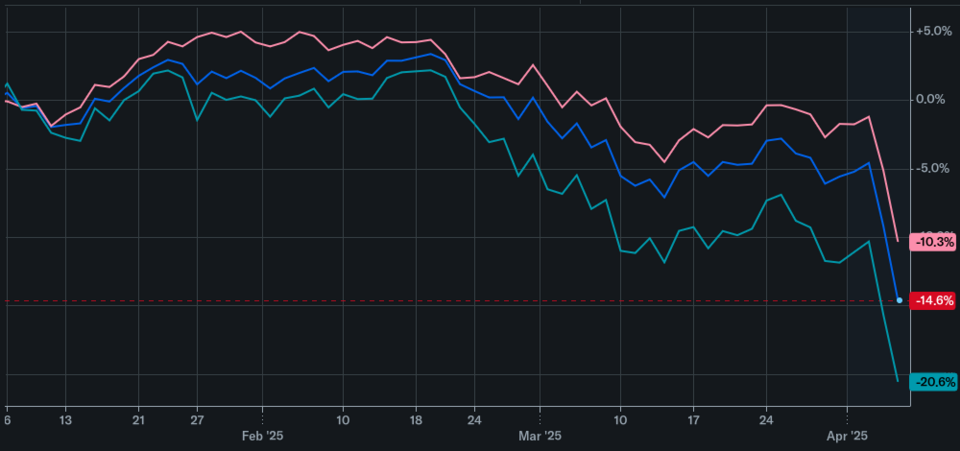 A stock price graph often has discontinuities during market crashes (e.g., sudden drops due to news events). (Image: Public domain, via Wikimedia Commons)
Based on the PU BBA (PU) syllabus for Business Mathematics II, unit 1.
Discussion
Loading…