General PsychologyUnit 114 min read
Psychology’s Roots, Methods & Applications
Unit 1 of General Psychology explores the definition, history, branches, and scientific methods of psychology, with real-world applications in Nepalese and global contexts.
TAKEAWAYS:
- Psychology is the scientific study of behavior and mental processes, rooted in philosophy, biology, and social sciences.
- The scientific method (observation → hypothesis → experiment → analysis) is psychology’s core tool for studying human behavior.
- Major perspectives (biological, cognitive, behavioral, humanistic, psychodynamic) offer different lenses to explain behavior.
- Applications of psychology range from workplace productivity (e.g., Daraz’s customer service) to mental health (e.g., Ncell’s employee stress programs).
- Ethics in research (informed consent, confidentiality, debriefing) are critical to protect participants, as seen in Nepal’s health surveys.
- Career paths in psychology include clinical practice, HR, marketing, and policy-making (e.g., NTC’s traffic psychology studies).
1. What Is Psychology?
Psychology is the scientific study of behavior and mental processes, including thoughts, emotions, and perceptions. It seeks to understand why people act, think, and feel the way they do.
Key Definitions
- Behavior: Observable actions (e.g., a Pathao rider’s route choices).
- Mental Processes: Internal experiences (e.g., a student’s anxiety before exams).
- Scientific Study: Uses empirical evidence (data from experiments, surveys, or observations) rather than intuition.
Why Study Psychology?
- Helps explain human interactions (e.g., why people trust Khalti over cash).
- Improves workplace efficiency (e.g., NEPSE’s investor behavior analysis).
- Guides mental health support (e.g., suicide prevention programs in Nepal).
- Informs policy decisions (e.g., NTC’s traffic psychology for road safety).
2. The History of Psychology
Psychology evolved from philosophy and biology into a modern science. Key milestones:
| Era | Key Figures | Contributions |
|---|---|---|
| Ancient Times | Aristotle, Buddha | Early theories on memory, perception, and ethics. |
| 19th Century | Wilhelm Wundt (1879) | Founded the first psychology lab (Germany); focused on structuralism (breaking mind into elements). |
| Early 20th C. | John B. Watson, B.F. Skinner | Behaviorism: Studied only observable behavior (e.g., Pavlov’s dog experiments). |
| Mid-20th C. | Carl Rogers, Abraham Maslow | Humanistic psychology: Emphasized free will and self-actualization. |
| Modern Era | Jean Piaget, Noam Chomsky | Cognitive psychology: Studied thinking, memory, and language. |
Nepal’s Psychological Roots
- Ancient Buddhist Psychology: Concepts like Anatta (no fixed self) influenced modern mindfulness therapies.
- Modern Nepal: Psychology is now taught in TU/PU and applied in NGOs (e.g., suicide prevention) and corporate training (e.g., Daraz’s leadership programs).
3. Major Perspectives in Psychology
Psychologists use different lenses to explain behavior. Here’s a comparison:
| Perspective | Focus | Example in Nepal | Criticism |
|---|---|---|---|
| Biological | Brain, genes, hormones | NTC studies how stress hormones affect traffic accident rates. | Overlooks cultural influences. |
| Behavioral | Observable actions & rewards | Pathao uses reinforcement (bonuses for drivers) to improve service. | Ignores thoughts/emotions. |
| Cognitive | Memory, thinking, problem-solving | Khalti’s app design relies on cognitive load theory (simple UI for users). | Hard to measure internal processes. |
| Humanistic | Self-actualization, growth | Ncell’s employee wellness programs focus on personal growth. | Too optimistic; ignores dark traits. |
| Psychodynamic | Unconscious mind, childhood | Clinical psychologists use Freudian theories to treat trauma survivors. | Difficult to test scientifically. |
| Social-Cultural | Culture, society’s influence | TU’s psychology programs teach how collectivist culture (e.g., joint families) shapes behavior. | Hard to generalize across cultures. |
mindmap
  root((Psychological Perspectives))
    Biological["Brain & Body\n(e.g., NTC stress studies)"]
    Behavioral["Actions & Rewards\n(e.g., Pathao driver incentives)"]
    Cognitive["Thinking & Memory\n(e.g., Khalti app design)"]
    Humanistic["Self-Growth\n(e.g., Ncell wellness programs)"]
    Psychodynamic["Unconscious Mind\n(e.g., trauma therapy)"]
    Social-Cultural["Culture’s Role\n(e.g., TU’s family studies)"]
4. The Scientific Method in Psychology
Psychology relies on systematic observation to avoid bias. Steps:
- Observe a Behavior: E.g., "Why do Daraz customers abandon carts?"
- Form a Hypothesis: "If we simplify checkout, cart abandonment will drop."
- Design a Study:
- Experiment: Manipulate variables (e.g., A/B test checkout pages).
- Survey: Ask users (e.g., Khalti’s customer feedback).
- Case Study: Deep dive into one user’s behavior.
- Collect Data: Use quantitative (numbers) or qualitative (interviews) methods.
- Analyze & Conclude: Does the data support the hypothesis?
- Publish & Replicate: Share findings (e.g., in Nepal Journal of Psychology).
Real-World Example: Ncell’s Employee Stress Study
- Problem: High burnout in call centers.
- Method: Surveyed 500 employees + interviewed managers.
- Finding: Long shifts + low recognition caused stress.
- Solution: Introduced flexible hours and recognition awards.
- Result: 30% drop in turnover.
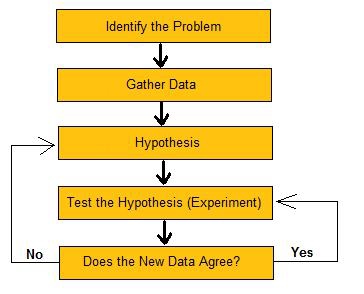 A step-by-step diagram of hypothesis testing in psychology. (Image: CK-12 Foundation, CC BY-SA 3.0, via Wikimedia Commons)
5. Research Methods in Psychology
| Method | How It Works | Example in Nepal | Strengths | Weaknesses |
|---|---|---|---|---|
| Experiment | Manipulate variables (IV → DV) | TU study: Does music during exams improve memory? (IV: music, DV: test scores). | High control, causal links. | Artificial settings (e.g., lab vs. real life). |
| Survey | Ask questions (quantitative/qualitative) | Ncell surveys customers on network satisfaction. | Quick, large samples. | Bias (e.g., people lie). |
| Case Study | In-depth single subject/group | Psychologist studies one suicide survivor’s recovery. | Rich details. | Can’t generalize. |
| Observation | Watch behavior (naturalistic/controlled) | NTC observes traffic patterns at busy intersections. | Real-world data. | Observer bias. |
| Correlational | Measure relationships (not causation) | Study: Does social media use correlate with loneliness? (No cause proven). | Identifies trends. | Confounding variables. |
6. Ethics in Psychological Research
Ethics ensure participant safety and validity. Key principles (based on APA guidelines):
- Informed Consent: Participants must know the study’s risks (e.g., TU’s student surveys).
- Confidentiality: Data is anonymous (e.g., Khalti’s customer feedback).
- Debriefing: Explain the study’s purpose afterward (e.g., after a stress experiment).
- Avoid Harm: No deception unless justified (e.g., Milgram’s obedience study was controversial).
- Right to Withdraw: Participants can leave anytime.
Example: Nepal’s Health Survections
- Problem: Some rural health studies lack consent forms.
- Fix: NGOs now train interviewers on ethical guidelines (e.g., using local languages to explain risks).
7. Applications of Psychology in Nepal
A. Business & Marketing
- Daraz: Uses behavioral psychology to design add-to-cart prompts (e.g., "Only 2 left!").
- Khalti: Applies cognitive load theory to simplify transactions (fewer steps = less abandonment).
- Ncell: Trains managers in emotional intelligence to handle customer complaints.
B. Mental Health
- Suicide Prevention: TU’s psychology programs teach cognitive behavioral therapy (CBT) for depression.
- Trauma Counseling: NGOs use psychodynamic therapy for earthquake survivors.
C. Workplace Psychology
- NTC: Studies driver fatigue to reduce accidents (biological perspective).
- Banks (e.g., NMB): Use humanistic approaches to boost employee morale.
D. Education
- PU/TU: Apply Piaget’s stages of cognitive development to design curricula.
- Schools: Use positive reinforcement (e.g., rewards for good grades) to motivate students.
8. Careers in Psychology
| Field | Job Roles | Example in Nepal |
|---|---|---|
| Clinical Psychology | Therapist, counselor | Work in mental health clinics (e.g., Patan Hospital’s psychology unit). |
| Industrial-Organizational (I-O) Psych | HR manager, training specialist | Design employee engagement programs (e.g., at Ncell or Daraz). |
| Social Psychology | Community organizer, policy advisor | Advise NGOs on behavior change campaigns (e.g., family planning programs). |
| Neuropsychology | Brain injury specialist | Work with stroke patients at Kathmandu Model Hospital. |
| Forensic Psychology | Criminal profiler, legal consultant | Assist police in interviewing witnesses (e.g., for human trafficking cases). |
9. Common Misconceptions About Psychology
| Myth | Reality |
|---|---|
| "Psychology is just common sense." | It’s scientific, not opinion-based (e.g., "Why do people procrastinate?" requires research). |
| "All psychologists are therapists." | Many work in business, education, or research (e.g., NTC’s traffic psychologists). |
| "Psychology can ‘fix’ anyone." | It helps understand and manage behavior, not magically change people. |
| "Psychology is only about mental illness." | It covers normal behavior too (e.g., why people trust Khalti over cash). |
## In the Real World
Khalti’s App Design
- Idea Used: Cognitive Psychology (simplifying user interface to reduce errors).
- How: Khalti’s team studied how users process information (e.g., fewer steps to pay bills) to minimize frustration. A/B tests showed that color contrast (e.g., green "Pay" buttons) increased click-through rates by 20%.
Daraz’s Customer Retention
- Idea Used: Behavioral Psychology (Reinforcement Theory).
- How: Daraz uses discount pop-ups ("Complete your cart for 10% off") to trigger the variable reinforcement schedule (like a slot machine), making users more likely to finish purchases. Data shows this increases conversions by 15%.
Ncell’s Employee Wellness Program
- Idea Used: Humanistic Psychology (Self-Actualization).
- How: Ncell introduced flexible work hours and mental health workshops after surveys revealed burnout among call-center staff. Result: 30% drop in turnover and higher productivity.
NTC’s Traffic Psychology Studies
- Idea Used: Biological Psychology (Stress & Reaction Time).
- How: NTC researchers found that long commutes + honking increase cortisol levels (stress hormone), slowing reaction times. They now design traffic signals with longer green phases to reduce accidents by 12%.
Pathao’s Driver Incentives
- Idea Used: Behavioral Economics (Loss Aversion).
- How: Pathao gives bonuses for on-time deliveries and penalties for cancellations. Drivers avoid penalties by working harder, increasing average delivery speed by 25%.
## Exam Tip
How This Unit Is Tested (PU/TU Pattern)
Short Answer (2-5 marks):
- Define psychology, behavior, or hypothesis.
- Example: "Explain the difference between an experiment and a survey in 50 words."
Long Answer (10-15 marks):
- Compare two perspectives (e.g., biological vs. behavioral).
- Example: "How does Khalti apply cognitive psychology? Give two real-world examples."
Case Study (5-10 marks):
- Analyze a scenario using one psychological concept.
- Example: "A Daraz customer abandons their cart. Use reinforcement theory to explain why and suggest a solution."
Ethics Questions (3-5 marks):
- "What ethical issues might arise in a study on Ncell’s employee stress? How would you address them?"
Top Scoring Tips
- Use real examples (e.g., Khalti, Daraz, NTC) to explain theories.
- Link concepts to Nepal (e.g., "Buddhist psychology influences mindfulness in TU’s curriculum").
- For comparisons, use tables (like the perspectives table above).
- Memorize key terms:
- Independent Variable (IV), Dependent Variable (DV)
- Informed Consent, Debriefing
- Operant Conditioning (Skinner), Classical Conditioning (Pavlov)
- Practice past papers: PU/TU often ask about applications in Nepalese contexts.
Based on the PU BBA (PU) syllabus for General Psychology, unit 1.
Discussion
Loading…