General PsychologyUnit 411 min read
Learning: Theories, Processes & Applications
Unit 4 of General Psychology explores how learning occurs through classical and operant conditioning, observational learning, and cognitive processes, with real-world applications in behavior modification, education, and technology.
What is Learning?
Learning is a relatively permanent change in behavior or knowledge that results from experience. It is not instinctive but acquired through interaction with the environment. Key characteristics:
- Adaptive: Helps organisms adjust to their surroundings.
- Experience-dependent: Requires practice or exposure.
- Not temporary: Unlike fatigue or temporary states, learning lasts.
1. Classical Conditioning (Pavlov’s Theory)
Definition: Learning through association, where a neutral stimulus (NS) becomes a conditioned stimulus (CS) that elicits a response (CR) after pairing with an unconditioned stimulus (UCS).
Key Terms
| Term | Meaning |
|---|---|
| UCS (Unconditioned Stimulus) | Naturally triggers a response (e.g., food → salivation). |
| UCR (Unconditioned Response) | Natural reaction to UCS (e.g., salivation). |
| NS (Neutral Stimulus) | Initially elicits no response (e.g., bell). |
| CS (Conditioned Stimulus) | After pairing, triggers a learned response (e.g., bell → salivation). |
| CR (Conditioned Response) | Learned reaction to CS (e.g., salivation to bell). |
How It Works (Pavlov’s Dog Experiment)
- Before Conditioning:
- UCS (food) → UCR (salivation).
- NS (bell) → No response.
- During Conditioning:
- Pair NS (bell) + UCS (food) → UCR (salivation).
- After Conditioning:
- CS (bell alone) → CR (salivation).
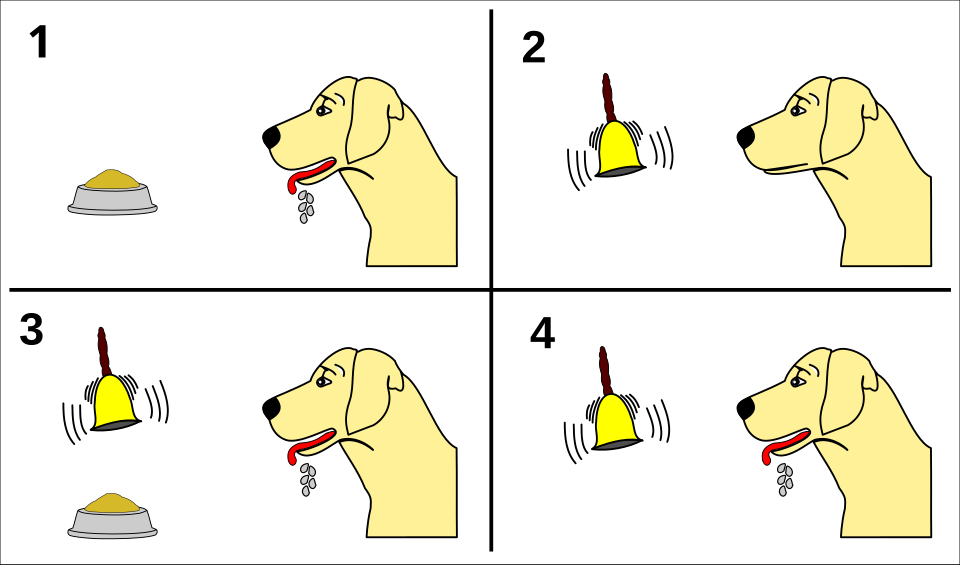 Pavlov’s dog experiment showing the stages of classical conditioning. (Image: Maxxl², CC BY-SA 4.0, via Wikimedia Commons)
Real-World Example: Advertising & Branding
- Company: Coca-Cola, Ncell (Nepal)
- Idea Used: Classical Conditioning
- How?
- Coca-Cola pairs its logo/ads with happiness (UCS: joyful music, UCR: positive feelings).
- Over time, seeing the logo (CS) triggers positive emotions (CR) without the original stimulus.
- Ncell uses jingles and bright colors (CS) associated with connectivity (UCS), making customers feel excited (CR) just by hearing the ringtone.
Applications in Nepal
- eSewa/Khalti: Associating their app icons with quick payments (UCS: convenience → UCR: satisfaction). Over time, seeing the icon (CS) makes users feel confident (CR).
- Traffic Police Whistles: In Kathmandu, whistles (CS) are paired with fear of fines (UCS → UCR: stopping). Eventually, hearing a whistle (CS) alone makes drivers slow down (CR).
2. Operant Conditioning (Skinner’s Theory)
Definition: Learning through consequences of behavior—reinforcement increases behavior, while punishment decreases it.
Key Terms
| Term | Meaning |
|---|---|
| Reinforcement | Increases behavior (positive/negative). |
| Punishment | Decreases behavior (positive/negative). |
| Positive Reinforcement | Adding a reward (e.g., praise, money). |
| Negative Reinforcement | Removing an aversive stimulus (e.g., removing noise after studying). |
| Positive Punishment | Adding an aversive stimulus (e.g., scolding, fine). |
| Negative Punishment | Removing a reward (e.g., taking away phone privileges). |
How It Works (Skinner’s Box Experiment)
Skinner trained rats to press a lever for food (reinforcement). The rat learned that pressing the lever (behavior) leads to a reward (consequence).
Real-World Example: Pathao & Daraz
- Company: Pathao (ride-hailing), Daraz (e-commerce)
- Idea Used: Positive Reinforcement
- How?
- Pathao: Offers discounts (reinforcement) for frequent riders → increases app usage.
- Daraz: "Buy 3, Get 1 Free" (reinforcement) encourages repeat purchases.
- Nepalese Banks: Loyalty points for credit card users (reinforcement) increase spending.
Worked Example: Traffic Rules in Kathmandu
- Behavior: Obeying traffic signals.
- Reinforcement:
- Positive: Police praise (social approval).
- Negative: Avoiding fines (removal of aversive stimulus).
- Punishment:
- Positive: Fines for jaywalking.
- Negative: Losing driving license for repeated offenses.
3. Observational Learning (Bandura’s Social Learning Theory)
Definition: Learning by watching and imitating others (modeling). Key processes:
- Attention: Observing the model.
- Retention: Remembering the behavior.
- Reproduction: Imitating the behavior.
- Motivation: Willingness to perform the behavior.
Key Terms
| Term | Meaning |
|---|---|
| Model | Person/character whose behavior is observed. |
| Imitation | Copying the observed behavior. |
| Vicarious Reinforcement | Learning from consequences of others’ actions. |
| Self-Efficacy | Belief in one’s ability to succeed. |
Real-World Example: YouTube & WhatsApp
- Platform: YouTube (global), WhatsApp (Nepal)
- Idea Used: Observational Learning
- How?
- YouTube: Tutorials (e.g., "How to cook momo") → viewers imitate the chef’s steps.
- WhatsApp: Seeing friends use voice notes → others adopt the same communication style.
- Nepalese Parents: Children learn manners by observing elders (models) on TV or in temples.
Worked Example: Learning to Ride a Bike
- Attention: Watching a sibling ride.
- Retention: Remembering balance techniques.
- Reproduction: Trying to pedal like the sibling.
- Motivation: Praise from parents reinforces the behavior.
4. Cognitive Learning (Tolman’s Theory)
Definition: Learning through mental processes (thinking, problem-solving) without immediate reinforcement. Key ideas:
- Latent Learning: Learning occurs but is not visible until a reward is introduced.
- Insight Learning: Sudden understanding of a problem (e.g., Kohler’s chimpanzee).
Real-World Example: Google Maps & NTC Traffic Updates
- App: Google Maps (global), NTC’s traffic alerts (Nepal)
- Idea Used: Cognitive Learning (Latent Learning)
- How?
- Users mentally map routes (latent learning) but only apply them when needed (e.g., during a festival like Dashain).
- NTC: Traffic updates help commuters plan routes cognitively before driving.
Worked Example: Solving a Math Problem
- A student studies formulas (latent learning) but only applies them during an exam (reinforcement).
Comparison of Learning Theories
| Theory | Key Process | Example | Strengths | Weaknesses |
|---|---|---|---|---|
| Classical Conditioning | Association (Pavlov) | Fear of dogs after a bite | Explains automatic responses | Limited to reflexive behaviors |
| Operant Conditioning | Reinforcement/Punishment (Skinner) | Studying for grades | Explains voluntary behaviors | Overemphasizes external rewards |
| Observational Learning | Imitation (Bandura) | Learning manners from parents | Explains cultural transmission | Requires social context |
| Cognitive Learning | Mental processes (Tolman) | Solving puzzles | Explains complex human learning | Hard to measure directly |
## In the Real World
eSewa & Khalti (Nepal)
- Idea: Classical Conditioning
- How? The green "Pay" button (CS) is paired with quick transactions (UCS → UCR: satisfaction). Over time, seeing the button (CS) alone triggers trust (CR).
Pathao & Daraz (Nepal)
- Idea: Operant Conditioning (Positive Reinforcement)
- How? Cashback offers (reinforcement) increase app usage. Users learn that ordering through Pathao/Daraz leads to rewards.
NTC & Traffic Management
- Idea: Observational Learning
- How? Drivers learn new routes by watching others or following NTC’s traffic updates. Imitation reduces congestion.
YouTube & Online Courses (Global)
- Idea: Cognitive + Observational Learning
- How? Watching tutorials (observation) + practicing mentally (cognitive) leads to skill acquisition (e.g., coding, cooking).
Banks (Global & Nepal)
- Idea: Operant Conditioning (Negative Reinforcement)
- How? Avoiding late fees (removal of aversive stimulus) reinforces timely payments.
## Exam Tip
- Define Clearly: Always define key terms (e.g., CS vs. UCS, reinforcement vs. punishment) with examples.
- Compare Theories: Use comparison tables to distinguish between classical, operant, and observational learning.
- Real-World Links: Relate theories to Nepali contexts (e.g., eSewa, Pathao, NTC) for higher marks.
- Diagrams: Draw Pavlov’s dog experiment or Skinner’s box in exams to visualize processes.
- Applications: Explain how each theory applies to education, marketing, or therapy.
- Avoid Confusion:
- Classical conditioning = automatic responses (e.g., fear, salivation).
- Operant conditioning = voluntary behaviors (e.g., studying, shopping).
- Observational learning = social imitation (e.g., language, manners).
Final Note: Learning theories are not just academic—they explain how you study, how brands influence you, and how societies pass on culture. Master these ideas, and you’ll ace the exam and understand human behavior better!
Based on the PU BBA (PU) syllabus for General Psychology, unit 4.
Discussion
Loading…