General PsychologyUnit 311 min read
Sensation & Perception: How We Experience the World
Unit 3 of General Psychology explores the biological and psychological processes of sensation (detecting stimuli) and perception (interpreting stimuli), including sensory organs, thresholds, illusions, and cognitive influences—essential for understanding human behavior and decision-making.
Key Concepts & Definitions
1. Sensation vs. Perception
- Sensation: The process by which sensory receptors detect and transmit raw sensory information (e.g., light, sound, pressure) to the brain.
- Perception: The brain’s active interpretation of sensory input, giving meaning to stimuli (e.g., recognizing a face or a melody).
- Example: When you see a red traffic light, sensation is the light waves hitting your retina, while perception is understanding it means "stop."
2. The Sensory Process: From Stimulus to Interpretation
flowchart LR
  A["Stimulus (e.g., light waves)"] --> B["Sensory Receptors (e.g., retina)"]
  B --> C["Transduction: Conversion to neural signals"]
  C --> D["Transmission to Brain (via optic nerve)"]
  D --> E["Processing in Brain (e.g., visual cortex)"]
  E --> F["Perception: Meaning assigned (e.g., 'tree')"]
  G["Stimulus (e.g., sound waves)"] --> H["Sensory Receptors (e.g., ear)"]
  H --> I["Transduction: Conversion to neural signals"]
  I --> J["Transmission to Brain (via auditory nerve)"]
  J --> K["Processing in Brain (e.g., auditory cortex)"]
  K --> L["Perception: Meaning assigned (e.g., 'music')"]
General sensory process for vision and hearing (simplified) Key Steps:
- Stimulus: Physical energy (light, sound, pressure) in the environment.
- Reception: Sensory organs (eyes, ears, skin) detect stimuli.
- Transduction: Conversion of stimuli into electrical/chemical signals (e.g., rods/cones in the eye converting light into nerve impulses).
- Transmission: Signals travel via sensory neurons to the brain.
- Processing: The brain organizes and interprets signals (e.g., the occipital lobe processes visual input).
- Perception: The brain constructs a meaningful experience (e.g., recognizing a friend’s voice).
3. Sensory Systems: How We Detect Stimuli
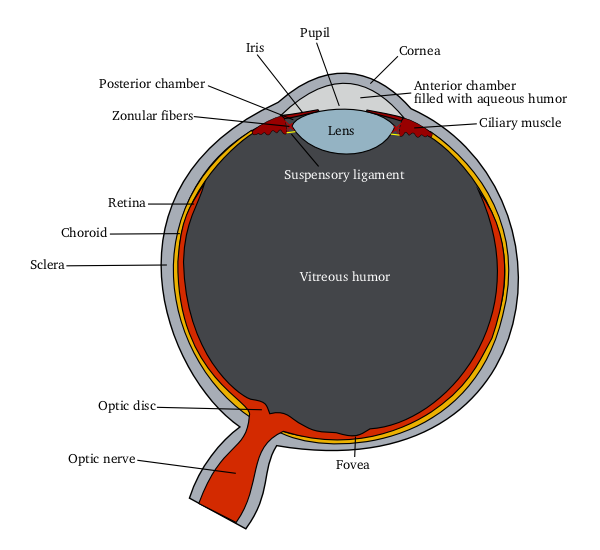 Anatomy of the human eye showing key sensory structures (Image: Delta G, CC BY-SA 3.0, via Wikimedia Commons)
A. Vision: The Eye and Visual Perception
- Key Structures:
- Cornea: Focuses light.
- Lens: Adjusts focus (accommodation).
- Retina: Contains photoreceptors (rods for dim light, cones for color).
- Optic Nerve: Transmits signals to the brain.
- Process: Light → Cornea → Lens → Retina (rods/cones) → Optic Nerve → Visual Cortex (occipital lobe).
- Example: When you read, your eyes scan text, but your brain fills in gaps (e.g., missing letters) due to top-down processing.
B. Hearing: The Ear and Auditory Perception
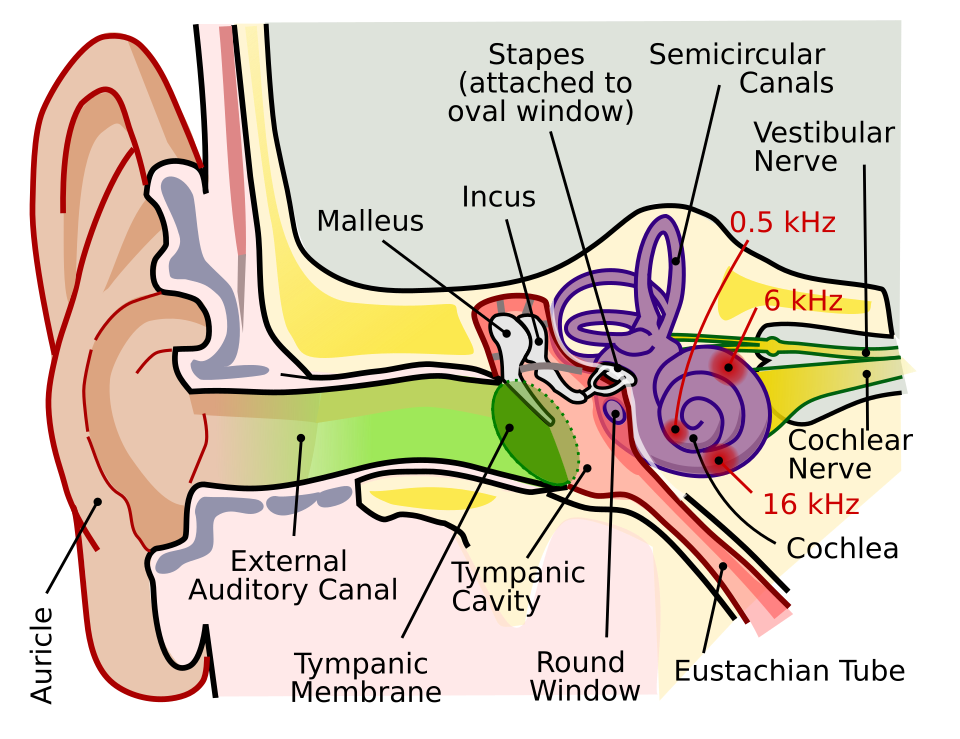 Outer, middle, and inner ear with cochlea (Image: Inductiveload, CC BY-SA 2.5, via Wikimedia Commons)
- Key Structures:
- Outer Ear: Collects sound waves (pinna, ear canal).
- Middle Ear: Amplifies vibrations (ossicles: malleus, incus, stapes).
- Inner Ear: Cochlea converts vibrations into neural signals.
- Process: Sound waves → Outer Ear → Middle Ear → Cochlea → Auditory Nerve → Auditory Cortex (temporal lobe).
- Example: In a noisy classroom, you focus on the teacher’s voice using selective attention (a perceptual process).
C. Other Senses
| Sense | Receptors | Example of Perception |
|---|---|---|
| Touch | Mechanoreceptors, pain | Feeling a cold surface as "chilly." |
| Taste | Taste buds (sweet, sour) | Identifying salt in food. |
| Smell | Olfactory epithelium | Detecting smoke as a "burning" odor. |
| Balance | Vestibular system | Knowing your head is tilted during a ride. |
4. Absolute and Difference Thresholds
A. Absolute Threshold
- The minimum intensity of a stimulus needed to detect it 50% of the time.
- Example: The faintest sound you can hear in a quiet room (varies by frequency).
- Real-World Link: Ncell’s signal strength is designed to be above your absolute threshold for sound (ringtone volume).
B. Difference Threshold (Just Noticeable Difference, JND)
- The smallest change in a stimulus that can be detected 50% of the time.
- Weber’s Law: The JND is proportional to the original stimulus intensity.
- Formula: (where = change, = original intensity, = constant).
- Example: If you’re holding a 100g weight, you might notice a 2g increase, but not a 1g increase (JND depends on baseline).
Worked Example (Nepal Context):
- Scenario: A Daraz seller ships a 1kg package. The postal service’s scale has a JND of 50g. If the actual weight is 1.05kg, will the customer notice?
- Calculation: (5%). If the JND constant for weight is ~0.02, the customer won’t notice the 50g difference.
5. Sensory Adaptation
- Definition: Diminished sensitivity to a constant stimulus over time.
- Examples:
- Smell of incense in a temple fades after a few minutes.
- You stop noticing your watch on your wrist after wearing it.
- Why It Matters: Helps us focus on changing stimuli (e.g., a sudden noise in traffic).
6. Perceptual Organization: Gestalt Principles
The brain groups sensory input into meaningful patterns using Gestalt laws:
Example:
- Figure-Ground: In a crowded Kathmandu Durbar Square, you perceive a statue (figure) against the crowd (ground).
- Closure: You recognize the Nepal flag even if some stripes are missing.
7. Perceptual Illusions
Mistakes in perception due to cognitive shortcuts or sensory conflicts.
 Two lines of equal length appearing unequal due to arrows (Image: Subsidiary account, Public domain, via Wikimedia Commons)
- Types:
- Ambiguous: Necker Cube (can flip between 2D and 3D).
- Distorting: Ponzo Illusion (rails make objects seem farther away).
- Paradoxical: Penrose Triangle (impossible figure).
- Why It Happens: The brain relies on depth cues (e.g., linear perspective) even when they’re misleading.
- Real-World Link: eSewa’s UI uses color contrast to make buttons "pop," but poor contrast can create illusions (e.g., a "Submit" button looking disabled).
8. Bottom-Up vs. Top-Down Processing
| Feature | Bottom-Up Processing | Top-Down Processing |
|---|---|---|
| Definition | Data-driven (sensory input first) | Concept-driven (expectations first) |
| Example | Recognizing a face from pixels | Reading a blurry sign based on context |
| Brain Areas | Sensory cortex (e.g., visual) | Prefrontal cortex (memory/experience) |
| Speed | Slower (requires analysis) | Faster (uses prior knowledge) |
Worked Example (Banking):
- Bottom-Up: You count 100 notes in a bundle by visually inspecting each.
- Top-Down: You trust a Nabil Bank teller to give you the correct amount without recounting (using past experience).
9. Applications in Everyday Life
A. Technology and Design
- WhatsApp Notifications: Uses auditory cues (vibrations/sounds) to exceed your absolute threshold for attention.
- YouTube’s Autoplay: Relies on visual motion (bottom-up) and contextual cues (top-down, e.g., "Recommended" labels).
- Khalti’s OTP System: Uses tactile feedback (phone vibration) to confirm input, leveraging sensory adaptation (you ignore constant vibrations but notice new ones).
B. Marketing and Advertising
- Daraz’s Product Photos: Use figure-ground contrast (white background) to highlight items.
- NTC’s Billboards: Employ closure (e.g., partial images with "Complete the logo" contests).
- Pathao’s App Design: Uses proximity (grouping ride options) to simplify choices.
C. Healthcare and Safety
- Nepal Police’s Emergency Sirens: Designed to exceed the absolute threshold for hearing.
- Traffic Light Colors: Red/green use color contrast (bottom-up) and cultural associations (top-down, e.g., red = stop).
10. Common Exam Pitfalls & How to Avoid Them
- Confusing Sensation and Perception:
- ❌ "Sensation is interpreting stimuli."
- ✅ Sensation = detection; Perception = interpretation.
- Ignoring Context in Illusions:
- Always explain illusions using Gestalt principles or depth cues (e.g., Ponzo Illusion = linear perspective).
- Mixing Bottom-Up/Top-Down:
- Bottom-Up: "I see the letters and then read the word."
- Top-Down: "I recognize the word ‘Nepal’ even if some letters are missing."
- Weber’s Law Misapplication:
- Remember: JND is a proportion, not a fixed amount (e.g., a 1g difference matters more for a 10g weight than a 100g weight).
In the Real World
eSewa’s Two-Factor Authentication (2FA):
- Uses multimodal sensation (SMS + app notification) to ensure you detect the OTP via both touch and sound, reducing errors from sensory adaptation (e.g., ignoring one channel).
Pathao’s Ride Queue System:
- Implements Weber’s Law by showing dynamic wait times (e.g., "3 min" vs. "3.5 min")—small changes that drivers perceive as meaningful due to proportional thresholds.
Nepal Rastra Bank’s Currency Design:
- Uses figure-ground contrast (raised ink, color shifts) to help visually impaired users distinguish denominations via touch (bottom-up) and color memory (top-down).
Exam Tip
- Diagrams Are Your Friends: For questions on the eye/ear, always draw and label the path of a stimulus (e.g., light → retina → brain).
- Illusion Questions: Name the illusion + explain it using one Gestalt principle or depth cue.
- Thresholds: For absolute/difference thresholds, always include units (e.g., "decibels" for sound, "grams" for weight).
- Real-World Links: Connect concepts to Nepalese apps/companies (e.g., "Khalti uses sensory adaptation to avoid notification fatigue").
- Process Questions: Use the 6-step sensory process (stimulus → transduction → transmission → processing → perception) as a framework for long answers.
Key Formula to Memorize: Weber’s Law: (Use in JND calculations, e.g., "If for weight, what’s the JND for 500g?" → .)
Based on the PU BBA (PU) syllabus for General Psychology, unit 3.
Discussion
Loading…