Essentials of FinanceUnit 714 min read
Bond Valuation: Pricing, Yields, and Risk Analysis
Unit 7 of Essentials of Finance explains how to value bonds using present value techniques, calculate yields (current, yield-to-maturity), and analyze bond risk (interest rate, default, reinvestment). Includes real-world examples from NEPSE-listed companies and Nepali financial instruments.
TAKEAWAYS:
- Bonds are debt instruments with fixed coupon payments and face value; their price is the present value of future cash flows.
- Yield measures (current yield, YTM, YTC) differ in scope and assumptions—YTM is the most comprehensive.
- Interest rate risk (price sensitivity to rates) is quantified by duration and convexity.
- Default risk and liquidity risk affect bond valuation; credit ratings (e.g., CRISIL, ICRA) provide signals.
- Nepali bonds (e.g., NTC’s debt securities, NMB Bank’s bonds) follow similar valuation principles but may have unique features like rupee-denominated coupons or sovereign guarantees.
- Arbitrage opportunities arise when bonds trade at prices inconsistent with their cash flows or market rates.
1. What Are Bonds?
Bonds are long-term debt instruments issued by governments, corporations, or financial institutions to raise capital. Investors lend money in exchange for periodic coupon payments and repayment of the face value (par value) at maturity.
Key Features of Bonds
classDiagram
    class Bond {
        +Face Value (Par Value): ₹100, ₹1,000, etc.
        +Coupon Rate (% of face value)
        +Coupon Payment: Fixed or floating
        +Maturity Date: Short-term (1-5y) to long-term (30y+)
        +Issuer: Govt (e.g., Nepal Govt Bonds), Corp (e.g., NMB Bank), or Financial Inst (e.g., NTC)
        +Risk: Interest rate, default, liquidity
    }
    class Coupon {
        <<enumeration>>
        FIXED
        FLOATING (e.g., tied to 91-day T-bill rate)
        ZERO (e.g., Treasury bills)
    }
    Bond --> Coupon : "has"
Types of Bonds in Nepal
| Type | Example (Nepal) | Key Feature |
|---|---|---|
| Government Bonds | Nepal Government Securities (NGS) | Low risk, tax-free interest (for some types). |
| Corporate Bonds | NMB Bank’s ₹1000 bonds (10% coupon) | Higher yield, higher default risk. |
| Financial Inst. Bonds | NTC’s debt securities | Often backed by assets (e.g., toll revenues). |
| Inflation-Linked Bonds | Rare in Nepal (global example: TIPS) | Coupons adjust with inflation. |
| Zero-Coupon Bonds | Treasury bills (T-bills) | Sold at discount, no periodic payments. |
2. Bond Valuation: The Core Formula
Bond price = Present Value (PV) of all future cash flows Cash flows include:
- Periodic coupon payments (annuity).
- Face value repayment at maturity.
Formula
For a bond with:
- Face value (FV) = ₹1,000
- Coupon rate = 8% → Annual coupon = ₹80
- Maturity = 5 years
- Market interest rate (r) = 10%
Price =
Worked Example: Valuing a NMB Bank Bond
Scenario: NMB Bank issues a 5-year bond with:
- Face value = ₹1,000
- Coupon rate = 9% (₹90/year, paid annually)
- Market interest rate = 12%
Step-by-Step Calculation
- Coupon Payments PV:
- Face Value PV:
- Total Bond Price: → The bond trades at a discount (₹891.86 < ₹1,000) because the market rate (12%) > coupon rate (9%).
TABLE: Bond Valuation Components
| Year | Coupon (₹) | PV Factor (12%) | PV of Coupon | PV of Face Value |
|---|---|---|---|---|
| 1 | 90 | 0.8929 | 80.36 | — |
| 2 | 90 | 0.7972 | 71.75 | — |
| 3 | 90 | 0.7118 | 64.06 | — |
| 4 | 90 | 0.6355 | 57.20 | — |
| 5 | 90 + 1000 | 0.5674 | 51.07 | 567.43 |
| Total | — | — | 324.43 | 567.43 |
Why This Matters for Nepali Investors:
- If you buy this NMB bond at ₹891.86, your YTM (see next section) will be 12%—higher than the coupon rate.
- Compare this to Nepal Rastra Bank’s policy rate (current: ~7.5%)—bonds like this offer higher yields for taking on credit risk.
3. Yield Measures: How to Compare Bonds
Yields tell you the actual return you earn from a bond. Three key types:
A. Current Yield
Example: If the NMB bond above trades at ₹850 instead of ₹891.86: Limitation: Ignores capital gains/losses from price changes or face value repayment.
B. Yield to Maturity (YTM)
The internal rate of return (IRR) that makes the PV of cash flows equal to the bond’s price. Solved using: For the NMB bond (₹891.86 price):
- We already know YTM = 12% (used to calculate the price).
- If the bond price changes, YTM changes inversely.
TABLE: YTM vs. Bond Price (Other Factors Held Constant)
| Bond Price (₹) | YTM (%) | Interpretation |
|---|---|---|
| 800 | 14.2% | High yield (bond trades at premium) |
| 891.86 | 12.0% | Fair value |
| 1,000 | 9.0% | Low yield (bond trades at par) |
C. Yield to Call (YTC)
For callable bonds (e.g., NTC’s bonds may have call options), YTC assumes the bond is called at the first possible date. Formula: Similar to YTM but uses the call price and years to call.
Comparison Table
| Measure | Formula | Use Case | Limitation |
|---|---|---|---|
| Current Yield | Coupon / Price | Quick comparison of income | Ignores price changes |
| YTM | IRR of all cash flows | Full return including capital gains | Assumes reinvestment at YTM |
| YTC | IRR assuming early redemption | Callable bonds | Uncertainty if bond isn’t called |
REAL WORLD:
- Nepal Rastra Bank (NRB) uses YTM to price its Treasury Bonds when auctioning them to banks.
- NMB Bank’s 2023 bond issue (₹1000, 10% coupon, 7-year maturity) was priced at ₹980—its YTM was ~10.2%, reflecting higher risk than govt bonds.
- NTC’s debt securities often have call options; investors must compare YTM vs. YTC to decide.
4. Bond Risk: What Can Go Wrong?
Bonds are not risk-free. Three key risks:
A. Interest Rate Risk
- Problem: If market rates rise, bond prices fall (inverse relationship).
- Measure: Duration (weighted avg. time to receive cash flows) and convexity (curvature of price-yield curve).
Example: A 5-year bond with 8% coupon and 10% YTM has a Macauley duration of ~4.1 years. If rates rise by 1%, the bond’s price drops by ~4.1%.
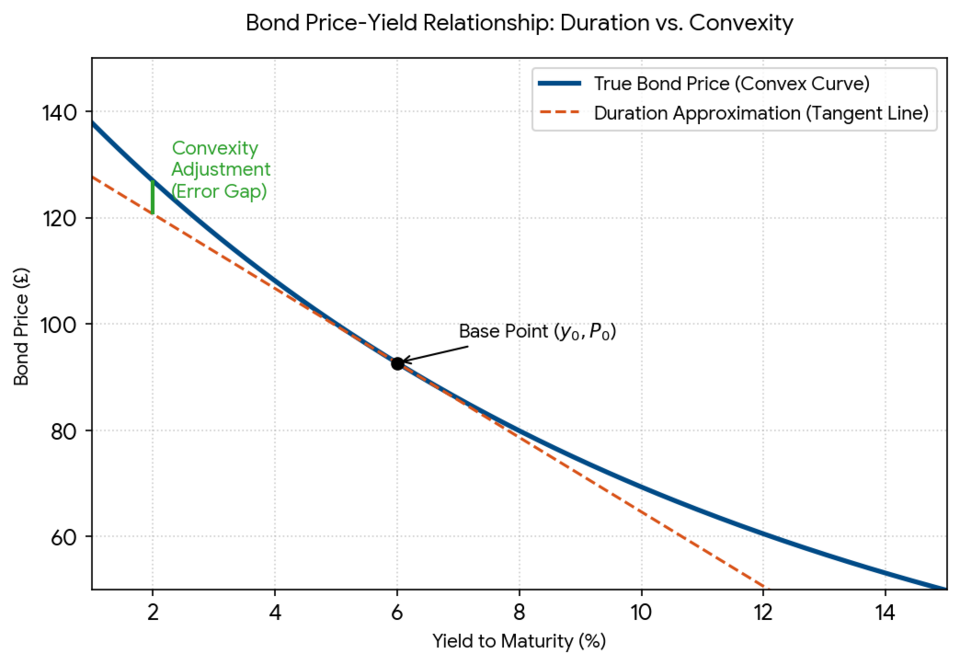 A downward-sloping curve showing how a 10-year bond’s price falls as yields rise. (Image: SpookiePuppy, CC0, via Wikimedia Commons)
B. Default Risk
- Problem: Issuer may fail to pay coupons or face value.
- Measure: Credit ratings (e.g., CRISIL AAA to D by Nepal’s CRISIL or ICRA).
- Nepal Govt Bonds: AAA (lowest risk).
- NMB Bank Bonds: AA+ (higher yield, slightly riskier).
- Smaller corporate bonds: May be BB or below (higher default risk).
TABLE: Credit Risk and Yield Spreads (Nepal Example)
| Issuer | Credit Rating | Yield Spread vs. Govt Bond | Default Probability |
|---|---|---|---|
| Nepal Government | AAA | 0% | ~0.1% |
| NMB Bank | AA+ | +1.5% | ~0.5% |
| Himalayan Bank | BBB | +3.0% | ~2% |
| Small Corporate Bond | BB- | +5.0% | ~5%+ |
C. Reinvestment Risk
- Problem: If rates fall, coupon payments must be reinvested at lower rates.
- Affected: Long-term bonds with high coupons (e.g., a 30-year bond with 12% coupons in a falling-rate environment).
REAL WORLD:
- Nepal’s 2022 bond market: Govt bonds yielded ~7.5%, while NTC’s bonds (backed by toll revenues) yielded ~9%. Investors demanded higher yields for NTC’s liquidity risk (harder to sell quickly).
- Pathao’s debt (if issued): Likely rated BB due to high growth risk; investors would demand ~11% YTM vs. ~7.5% for govt bonds.
5. Special Cases in Nepali Bonds
A. Rupee-Denominated Foreign Bonds (e.g., ADB-Listed Bonds)
- Issued by ADB or World Bank but traded in Nepal.
- Example: ADB’s ₹1000 bond (8% coupon, 10 years) trades at ₹950.
- YTM = ~8.4% (higher than govt bonds due to foreign issuer risk).
B. Inflation-Linked Bonds (Rare in Nepal)
- Coupons adjust with CPI inflation (e.g., +5% inflation → +5% coupon).
- Global example: TIPS (US); Nepal has no equivalent yet.
C. Zero-Coupon Bonds (Treasury Bills)
- Sold at discount to face value (e.g., ₹950 for ₹1000 due in 1 year).
- YTM = [(FV - Price)/Price] × 100
- Example: YTM = [(1000-950)/950] × 100 = 5.26%.
6. The Accounting Perspective: How Bonds Appear in Financial Statements
For issuers (e.g., NMB Bank), bonds are recorded as:
- Liability at amortized cost (price + accrued interest).
- Interest expense recognized over time (not all at once).
Journal Entry for Bond Issuance
Scenario: NMB Bank issues ₹10,000,000 of 10-year, 9% bonds at ₹9,500,000 (discount).
| Date | Account | Dr (₹) | Cr (₹) | Narration |
|---|---|---|---|---|
| 2023-01-01 | Cash | 9,500,000 | Issued 10-year, 9% bonds at discount | |
| Discount on Bonds | 500,000 | |||
| Bonds Payable | 10,000,000 |
Amortization of Discount (Straight-Line Method)
Annual amortization = ₹500,000 / 10 years = ₹50,000.
| Year | Interest Expense | Discount Amortized | Carrying Value |
|---|---|---|---|
| 1 | ₹950,000 | ₹50,000 | ₹9,550,000 |
| 2 | ₹950,000 | ₹50,000 | ₹9,600,000 |
| ... | ... | ... | ... |
| 10 | ₹950,000 | ₹50,000 | ₹10,000,000 |
For Investors: Bonds are recorded at cost and adjusted for unrealized gains/losses (mark-to-market).
7. Arbitrage and Bond Mispricing
Arbitrage occurs when a bond’s price does not match its cash flows. Example:
Scenario: A ₹1,000 bond with:
- 8% coupon (₹80/year)
- 5 years to maturity
- Market price = ₹900
- Market rate = 10%
Check: But the bond trades at ₹900—undervalued by ₹23.26. Arbitrage Strategy:
- Buy the bond at ₹900.
- Hold until maturity; earn ₹80/year + ₹1000 at end.
- YTM = ~10.3% > market rate → profit.
REAL WORLD:
- In 2021, Nepal’s corporate bonds occasionally traded at prices inconsistent with their cash flows due to low liquidity. Savvy investors (e.g., merchant banks) exploited these mispricings.
In the Real World
Nepal Rastra Bank (NRB) Auctions:
- NRB sells Treasury Bonds via auction. Investors (banks, insurance firms) bid based on YTM calculations. For example, a 5-year bond with 8% coupon may auction at ₹980, implying a YTM of ~8.2%.
- Why it matters: Banks like Global IME or NIC Asia use bond valuation to decide how much to bid.
NMB Bank’s Retail Investor Bonds:
- NMB offers ₹1000 bonds at 10% coupon to retail investors. If market rates rise to 11%, the bond’s price drops to ~₹910. Investors who bought at ₹1000 face a capital loss.
- Lesson: Bond prices and yields move inversely—just like how NEPSE’s stock prices react to market sentiment.
NTC’s Debt Securities:
- NTC issues bonds to fund infrastructure (e.g., highways). These bonds have higher yields (~9-10%) because they’re backed by future toll revenues—but if traffic drops (e.g., due to COVID-19), default risk rises.
- Real example: In 2020, NTC’s bond yields spiked as investors feared lower toll collections during lockdowns.
Exam Tip
Memorize the YTM formula and practice solving for YTM using financial calculators or Excel’s
RATEfunction.- Excel Shortcut:
=RATE(nper, pmt, pv, [fv], [type])- For the NMB bond:
=RATE(5, 90, -891.86, 1000)→ Returns 12%.
- For the NMB bond:
- Excel Shortcut:
Duration vs. Convexity:
- Duration tells you price sensitivity to rate changes.
- Convexity adjusts for the curvature of the price-yield relationship (longer bonds have higher convexity).
- Exam trick: If asked about a bond’s risk, always mention duration and whether it’s high/low.
Real-world applications:
- Compare govt bonds vs. corporate bonds in terms of yield spreads.
- Explain why NTC bonds yield more than NMB bonds (higher risk).
- Calculate YTM for a given bond price—this is a high-weightage question.
Common Pitfalls:
- Mixing current yield and YTM: Current yield is coupon/price; YTM is the true return.
- Ignoring compounding: Always use the correct periodicity (annual vs. semi-annual coupons).
- Assuming bonds trade at par: Most bonds trade at discount or premium unless rates = coupon rate.
Numerical Problems:
- Always show your work in tables (like the NMB bond example above).
- Label all variables (e.g., "Let FV = ₹1000, C = ₹90, r = 12%").
- Check your answer: If YTM > coupon rate, the bond should trade at a discount.
flowchart TD
    A["Start: Bond Issuance"] --> B["Issuer Records Liability at Amortized Cost"]
    B --> C["Investor Buys Bond at Market Price"]
    C --> D["Periodic Coupon Payments"]
    D --> E["Interest Expense for Issuer\nDiscount/Premium Amortized"]
    E --> F["Maturity: Face Value Repaid"]
    F --> G["End: Bond Retired"]
    H["Market Rates Change"] -->|"Rise"| I["Bond Price Falls"]
    H -->|"Fall"| J["Bond Price Rises"]
    I --> K["Capital Loss for Investor"]
    J --> L["Capital Gain for Investor"]
    M["Default Risk"] --> N["Credit Rating Downgrade"]
    N --> O["Yield Spread Widens"]
Based on the PU BBA (PU) syllabus for Essentials of Finance, unit 7.
Discussion
Loading…