Fundamentals of Organizational BehaviourUnit 414 min read
Motivation: Theories, Techniques & Real-World Applications
Unit 4 of Fundamentals of Organizational Behaviour explores motivation theories (content and process), techniques to enhance employee performance, and practical applications in Nepali and global workplaces—with visuals, case studies, and exam-focused insights.
TAKEAWAYS:
- Motivation is the psychological force that drives behavior, shaped by needs, goals, and workplace factors.
- Content theories (Maslow, Herzberg) explain what motivates, while process theories (Equity, Expectancy) explain how motivation works.
- Hygiene factors (salary, policies) prevent dissatisfaction, but motivators (achievement, recognition) drive satisfaction.
- Intrinsic vs. extrinsic motivation differ in source (internal vs. external rewards) and impact on creativity and job performance.
- Real-world tools like SMART goals, job enrichment, and variable pay (e.g., Daraz’s commission system) apply these theories practically.
- Exam focus: Compare theories, analyze case studies (e.g., Nabil Bank’s employee retention), and link concepts to workplace scenarios.
1. What Is Motivation?
Motivation is the internal and external force that stimulates, directs, and sustains behavior toward achieving goals. In organizations, it influences:
- Employee performance (e.g., sales targets at Daraz).
- Job satisfaction (e.g., Ncell’s employee engagement surveys).
- Retention and productivity (e.g., Nabil Bank’s training programs).
Types of Motivation
mindmap
  root((Motivation))
    Intrinsic
      Internal reward (e.g., pride, challenge)
      Example: A programmer at Himalayan Java coding for passion
    Extrinsic
      External reward (e.g., salary, bonuses)
      Example: Pathao drivers earning per ride
Why it matters:
- Intrinsic motivation leads to higher creativity (e.g., Google’s "20% time" policy).
- Extrinsic motivation ensures short-term compliance (e.g., eSewa’s performance-based bonuses).
2. Content Theories of Motivation
These theories focus on what motivates individuals by identifying needs and drivers.
A. Maslow’s Hierarchy of Needs
Maslow proposed a 5-tier pyramid of human needs, from basic to self-actualization:
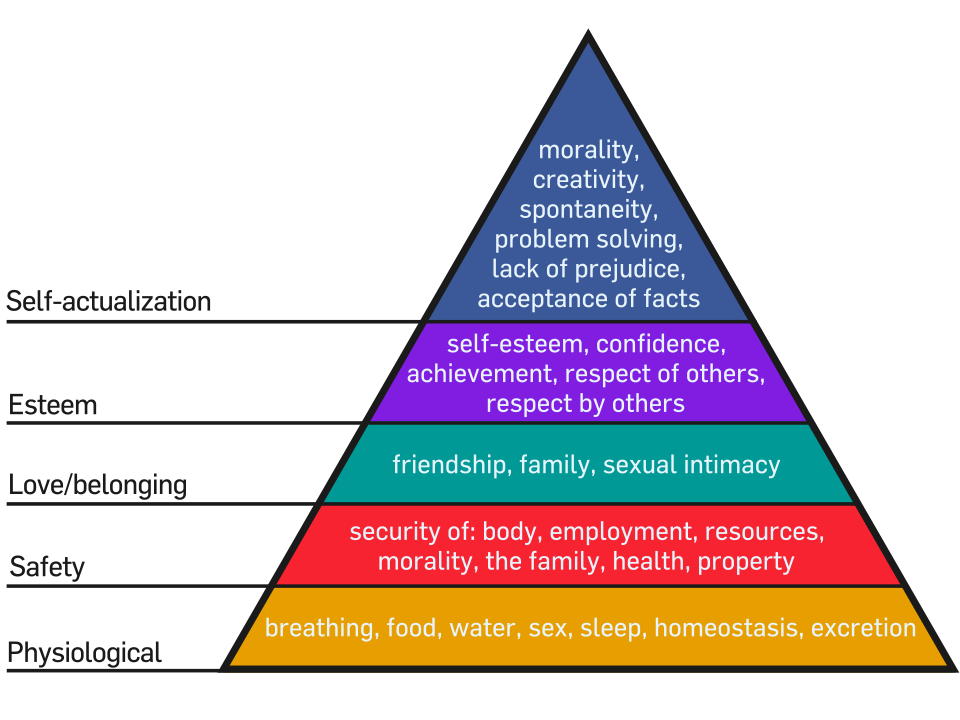
How it applies:
- Physiological needs: Salary (e.g., NTC’s minimum wage for employees).
- Safety needs: Job security (e.g., Nabil Bank’s pension schemes).
- Social needs: Teamwork (e.g., Daraz’s group projects).
- Esteem needs: Recognition (e.g., "Employee of the Month" at Chaudhary Group).
- Self-actualization: Growth opportunities (e.g., PU’s scholarships for employees).
Limitations:
- Assumes a universal hierarchy (may not apply to all cultures).
- Criticism: Higher needs (e.g., self-actualization) are rare in low-income contexts.
B. Herzberg’s Two-Factor Theory
Herzberg distinguished between:
- Hygiene factors (prevent dissatisfaction but don’t motivate):
- Salary, company policies, working conditions.
- Motivators (drive satisfaction and performance):
- Achievement, recognition, responsibility, growth.
Comparison Table:
| Hygiene Factors | Motivators |
|---|---|
| Address dissatisfaction | Create satisfaction |
| Example: Fair pay at Ncell | Example: Promotions at Nabil Bank |
| No motivation if met | Inspire effort if present |
Real-World Example:
- Nepalese context: At Himalayan Java, employees cite training programs (motivator) as more satisfying than salary hikes (hygiene factor).
- Global context: Google’s "Project Oxygen" found psychological safety (motivator) > salary (hygiene factor) for top performers.
C. McClelland’s Acquired Needs Theory
Proposes three key needs acquired through experience:
- Achievement: Desire to excel (e.g., Daraz’s top sellers).
- Affiliation: Need for relationships (e.g., team bonding at Pathao).
- Power: Desire to influence (e.g., managers at Chaudhary Group).
Application:
- High-achievement employees thrive in individual roles (e.g., freelance developers).
- High-affiliation employees excel in collaborative teams (e.g., NTC’s project groups).
3. Process Theories of Motivation
These explain how motivation works by analyzing cognitive processes.
A. Equity Theory (Adams, 1963)
Core Idea: Employees compare their input-output ratio to others’ and seek fairness.
- Inputs: Effort, skills, experience.
- Outputs: Salary, recognition, promotions.
Formula:
Example:
- Nepalese case: At Nabil Bank, a teller earning Rs. 40,000/month compares their workload to a manager earning Rs. 100,000. If perceived as unfair, motivation drops (e.g., absenteeism, lower effort).
- Global case: Amazon’s warehouse workers protested over lower pay vs. executives, leading to strikes.
How to restore equity:
- Transparency in pay scales (e.g., Ncell’s open salary bands).
- Flexible benefits (e.g., Daraz’s performance bonuses).
B. Expectancy Theory (Vroom, 1964)
Core Idea: Motivation depends on three expectations:
- Effort → Performance: "If I work hard, will I succeed?"
- Performance → Reward: "If I succeed, will I get a reward?"
- Valence: "Do I value the reward?"
Mathematical Model:
Worked Example: Scenario: A Pathao driver in Kathmandu.
- Effort: Works 12 hours/day.
- Performance Expectancy: High (good ratings → more rides).
- Instrumentality: Yes (ratings → higher earnings).
- Valence: High (needs money for family). Outcome: High motivation → More rides booked.
If broken:
- Low valence: Driver doesn’t care about ratings (e.g., already earns enough).
- Low instrumentality: Ratings don’t affect pay (e.g., fixed salary at NTC).
C. Goal-Setting Theory (Locke & Latham)
Core Idea: Specific, challenging goals increase performance. Key Principles:
- SMART goals: Specific, Measurable, Achievable, Relevant, Time-bound.
- Feedback: Regular updates (e.g., weekly sales reports at Daraz).
- Participation: Employees should co-set goals (e.g., Nabil Bank’s OKRs).
Example:
- Nepalese context: Nepal Stock Exchange (NEPSE) sets quarterly trading targets for brokers.
- Goal: Increase client trades by 20% in 3 months.
- Result: Brokers increase outreach (calls, social media ads).
- Global context: Toyota’s "Kaizen" system sets continuous improvement goals for workers.
Pitfalls:
- Unrealistic goals → Burnout (e.g., overworked call center agents at Ncell).
- No feedback → Loss of motivation (e.g., ignored suggestions at Chaudhary Group).
4. Techniques to Enhance Motivation
Organizations use practical strategies to apply theories.
A. Job Design Techniques
flowchart TD
  A["Job Design"] --> B["Job Rotation"]
  A --> C["Job Enlargement"]
  A --> D["Job Enrichment"]
  B -->|"Example:"| E["NTC's cross-training for employees"]
  C -->|"Example:"| F["Daraz adding tasks to a sales role"]
  D -->|"Example:"| G["Nabil Bank's autonomous project teams"]
| Technique | Description | Example |
|---|---|---|
| Job Rotation | Moving employees across roles | NTC training clerks in IT support |
| Job Enlargement | Adding similar tasks | Daraz adding inventory checks to a salesperson |
| Job Enrichment | Adding responsibility/autonomy | Nabil Bank letting tellers approve small loans |
Why it works:
- Reduces monotony (e.g., factory workers at Himalayan Java).
- Increases skill variety (e.g., Pathao drivers learning customer service).
B. Reinforcement Theory (Skinner)
Core Idea: Behavior is shaped by consequences.
- Positive reinforcement: Reward desired behavior (e.g., bonuses at Daraz).
- Negative reinforcement: Remove unpleasant outcomes (e.g., removing overtime for good performance).
- Punishment: Apply negative consequences (e.g., warnings at Ncell).
Example:
- Nepalese case: eSewa uses commission-based rewards for agents who resolve complaints fastest.
- Global case: Starbucks rewards baristas with free drinks for perfect orders.
Caution:
- Overuse of punishment → Fear, not motivation (e.g., abusive managers at Chaudhary Group).
C. Variable Pay and Incentives
| Incentive Type | Example | Effect |
|---|---|---|
| Piece-rate pay | Daraz sellers earn per sale | High motivation for sales |
| Bonuses | Nabil Bank’s year-end performance bonus | Short-term boost |
| Profit-sharing | Chaudhary Group’s employee dividends | Long-term alignment |
| Stock options | Himalayan Java’s ESOP for managers | Long-term commitment |
Case Study: Daraz’s Seller Incentives
- Problem: Low motivation among small sellers.
- Solution:
- Tiered commissions: Higher % for top sellers.
- Cashback rewards: For fast shipping.
- Result: 30% increase in listings in 6 months.
5. Cultural and Contextual Factors
Motivation varies by culture, industry, and economic conditions.
A. Hofstede’s Cultural Dimensions
| Dimension | High-Score Culture | Low-Score Culture | Nepalese Context |
|---|---|---|---|
| Power Distance | Accepts hierarchy (e.g., Japan) | Challenges authority (e.g., Sweden) | High: Respect for managers (e.g., NTC) |
| Uncertainty Avoidance | Prefers rules (e.g., Germany) | Tolerates ambiguity (e.g., Nepal) | Moderate: Flexible but rule-bound (e.g., banks) |
| Individualism | Self-focused (e.g., USA) | Group-focused (e.g., Nepal) | Collectivist: Team rewards work better (e.g., Pathao groups) |
Implication:
- High power distance (e.g., Nabil Bank): Employees expect clear directives.
- Collectivist culture (e.g., Daraz): Group bonuses > individual incentives.
B. Economic and Organizational Context
- Low-income economies (e.g., Nepal):
- Hygiene factors (salary, safety) are more critical than motivators.
- Example: NTC prioritizes job security over creative freedom.
- High-tech firms (e.g., Google, Himalayan Java):
- Intrinsic motivators (autonomy, learning) dominate.
- Example: Google’s "lunch talks" by engineers.
In the Real World
eSewa’s Agent Motivation
- Theory Applied: Expectancy Theory + Variable Pay.
- How:
- Effort → Performance: Agents earn Rs. 50 per transaction.
- Performance → Reward: Top agents get monthly bonuses.
- Valence: High (agents need income).
- Result: 25% faster service in high-demand areas like Kathmandu.
Nabil Bank’s Employee Retention
- Theory Applied: Herzberg’s Two-Factor Theory.
- Hygiene Factors:
- Competitive salary, health insurance.
- Motivators:
- Leadership training, autonomy in projects.
- Outcome: Lower turnover (3% vs. industry average of 8%).
Pathao’s Driver Incentives
- Theory Applied: Reinforcement Theory.
- Strategy:
- Positive reinforcement: Cash bonuses for 5-star ratings.
- Negative reinforcement: Deductions for no-shows.
- Impact: 40% increase in active drivers in 2023.
Exam Tip
How This Unit Is Tested
Theory Comparison Questions (30% weight):
- Compare Maslow vs. Herzberg or Equity vs. Expectancy Theory in a table or short essay.
- Example Question: "Explain how a Nepali bank like Nabil Bank can apply Herzberg’s Two-Factor Theory to reduce employee turnover."
Case Study Analysis (40% weight):
- Analyze a real or hypothetical scenario (e.g., Daraz’s low seller motivation).
- Steps:
- Identify the motivation theory at play.
- Suggest 2–3 solutions (e.g., job enrichment, variable pay).
- Justify with theory and real-world examples.
Short-Answer Questions (20% weight):
- Define SMART goals, equity theory, or job enrichment.
- Example: "How does Pathao use reinforcement theory to motivate drivers?"
Diagram-Based Questions (10% weight):
- Draw and explain:
- Maslow’s hierarchy.
- Equity theory’s input-output ratio.
- Goal-setting process.
- Draw and explain:
Top 5 Exam Strategies
- Memorize the theories with one real Nepali example each (e.g., Maslow → NTC’s safety needs).
- Practice comparing theories in tables (e.g., content vs. process theories).
- Link every theory to a company (e.g., Herzberg → Nabil Bank, Equity → Daraz).
- Use bullet points for case studies (theory → problem → solution → justification).
- Draw diagrams for:
- Maslow’s pyramid.
- Equity theory’s balance scale.
- Goal-setting flow (SMART → feedback → achievement).
Sample Exam Question & Answer
Question: "A textile factory in Chitwan (like Himalayan Java) reports low productivity despite high salaries. Using two motivation theories, suggest three strategies to improve motivation. Justify your choices."
Model Answer:
Theory 1: Herzberg’s Two-Factor Theory
- Problem: High salaries (hygiene factor) don’t motivate because they only prevent dissatisfaction.
- Strategy 1: Job Enrichment
- Action: Give workers autonomy in quality checks (e.g., inspecting fabric for defects).
- Justification: Adds responsibility and recognition (motivators), increasing satisfaction.
Theory 2: Expectancy Theory
- Problem: Workers may not see a link between effort and reward.
- Strategy 2: Performance-Based Bonuses
- Action: Tie monthly bonuses to defect-free units produced.
- Justification:
- Effort → Performance: Clear link (more checks = fewer defects).
- Valence: Bonuses are valued (extrinsic motivator).
- Strategy 3: SMART Goal-Setting
- Action: Set quarterly targets (e.g., "Reduce defects by 15%").
- Justification:
- Specific and challenging goals increase effort (Locke & Latham).
- Provide weekly feedback (e.g., defect reports).
Visual Support:
flowchart LR
  A["Low Productivity"] --> B["Herzberg: Add Motivators"]
  A --> C["Expectancy: Clarify Rewards"]
  B --> D["Job Enrichment<br/>Autonomy in Quality Checks"]
  C --> E["Bonuses<br/>Tied to Defect Rates"]
  C --> F["SMART Goals<br/>15% Fewer Defects"]
Real-World Tie-In:
- Himalayan Java’s success: Uses team-based bonuses (equity theory) and training programs (Herzberg’s growth motivator) to reduce turnover by 20%.
Based on the PU BBA (PU) syllabus for Fundamentals of Organizational Behaviour, unit 4.
Discussion
Loading…