Fundamentals of Organizational BehaviourUnit 610 min read
Teams: Types, Dynamics, and Effectiveness
Unit 6 of Fundamentals of Organizational Behaviour explores the structure, roles, and performance of teams in organizations, covering team types, stages of development, roles, norms, cohesion, and factors affecting team effectiveness.
TAKEAWAYS:
- Teams are distinct from groups due to their shared goals, interdependence, and accountability for outcomes.
- Team effectiveness depends on composition, context, and process, with stages like forming, storming, norming, and performing.
- Roles in teams (task, maintenance, and individual) impact performance, while norms and cohesion shape behavior and productivity.
- Conflict in teams can be functional or dysfunctional, requiring management for optimal outcomes.
- Real-world applications include cross-functional teams in tech startups, project teams in construction, and virtual teams in global corporations.
What is a Team?
A team is a small number of people with complementary skills who are committed to a common purpose, hold themselves mutually accountable, and work interdependently to achieve specific goals. Unlike groups, teams have:
- Clear, shared goals
- Interdependence (members rely on each other)
- Accountability (collective responsibility for outcomes)
mindmap
  root((Team))
    Definition
      Small group
      Complementary skills
      Shared goals
      Mutual accountability
    vs Group
      No shared goals
      Individual accountability
      Less interdependence
Types of Teams
Teams vary based on purpose, structure, and composition. Below are key types:
| Type of Team | Description | Example |
|---|---|---|
| Functional Teams | Members from the same department working on related tasks. | Marketing team in a company developing a new ad campaign. |
| Cross-Functional Teams | Members from different departments with diverse skills. | Product development team (designers, engineers, marketers). |
| Virtual Teams | Geographically dispersed members communicating via technology. | Remote software development team using Slack and Zoom. |
| Self-Managed Teams | Teams that manage their own work without direct supervision. | Google’s "20% time" teams working on side projects. |
| Project Teams | Temporary teams formed for specific projects. | Construction team building a new hospital wing. |
| Committee Teams | Groups formed to discuss and make decisions on specific issues. | University senate committee reviewing curriculum changes. |
Stages of Team Development (Tuckman’s Model)
Teams evolve through distinct stages, each with unique challenges:
flowchart LR
  A["Forming"] --> B["Storming"]
  B --> C["Norming"]
  C --> D["Performing"]
  D --> E["Adjourning"]
- Forming: Members join, get to know each other, and establish roles.
- Example: New hires in a bank’s customer service team learning about policies.
- Storming: Conflict arises as members assert their ideas and roles.
- Example: A software team debating the best programming language for a project.
- Norming: Cohesion develops, and members agree on roles and processes.
- Example: A hospital emergency response team standardizing communication protocols.
- Performing: The team works efficiently toward goals.
- Example: A Daraz logistics team optimizing delivery routes for peak season.
- Adjourning: The team disbands after completing its task.
- Example: A temporary event management team after a concert.
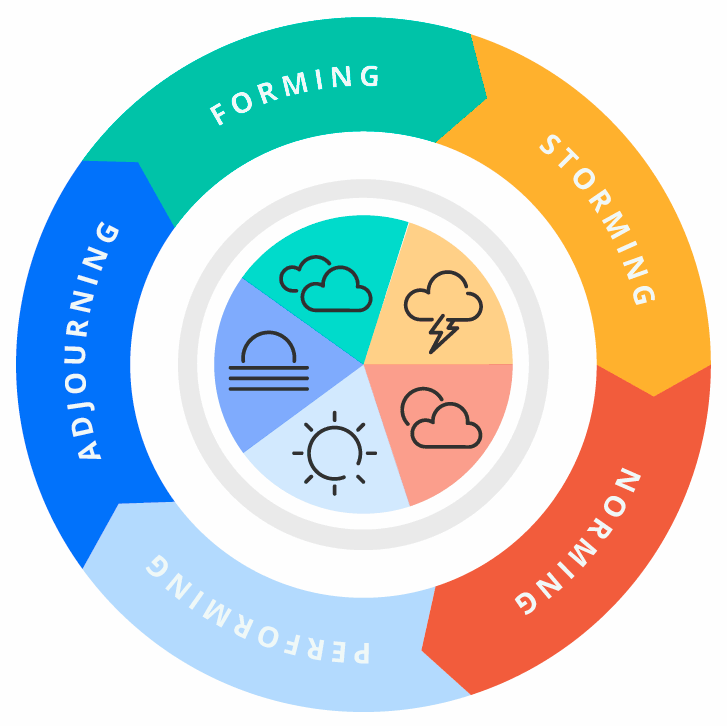 A labeled diagram showing the five stages with brief descriptions. (Image: DovileMi, CC BY-SA 4.0, via Wikimedia Commons)
Roles in Teams (Belbin’s Team Roles)
Teams require different roles to function effectively. Belbin’s model identifies nine key roles:
| Role Type | Description | Example |
|---|---|---|
| Task Roles | Focus on getting the work done. | Coordinator, Shaper, Implementer, Completer-Finisher. |
| Maintenance Roles | Ensure harmony and smooth functioning. | Team Worker, Resource Investigator, Monitor-Evaluator. |
| Individual Roles | Can be positive or negative; disrupt team dynamics if overused. | Specialist (positive), Dominator (negative). |
Worked Example: Nabil Bank’s Loan Approval Team
- Task Roles: The loan officer (Implementer) processes applications, while the credit analyst (Completer-Finisher) ensures all documents are checked.
- Maintenance Roles: The team leader (Coordinator) ensures smooth communication, while the HR representative (Team Worker) resolves conflicts.
- Conflict: If a Dominator insists on approving loans without analysis, the Monitor-Evaluator must intervene to maintain objectivity.
Team Norms and Cohesion
- Norms: Informal rules governing team behavior (e.g., punctuality, decision-making processes).
- Cohesion: The degree of attraction members feel toward the team and its goals.
- High Cohesion: Stronger commitment, better performance (e.g., a football team winning championships).
- Low Cohesion: Conflict, low productivity (e.g., a dysfunctional office team missing deadlines).
Real-World Example: Pathao’s Delivery Teams
- Norms: Drivers must use the shortest route, communicate delays, and rate passengers fairly.
- Cohesion: Pathao’s driver communities (e.g., WhatsApp groups) share tips, leading to higher retention and efficiency.
Factors Affecting Team Effectiveness
Effective teams depend on three key factors:
- Composition: Skills, personalities, and diversity of members.
- Example: A software team with front-end, back-end, and UX designers ensures a complete product.
- Context: Organizational support, resources, and leadership.
- Example: Google’s "20% time" policy allows teams to innovate (e.g., Gmail originated from this).
- Process: How the team communicates, makes decisions, and manages conflict.
- Example: Agile teams in startups use daily stand-ups to track progress.
Conflict in Teams
Conflict can be functional (improves performance) or dysfunctional (hurts productivity). Types of conflict:
| Type | Description | Example |
|---|---|---|
| Task Conflict | Disagreements about ideas or work methods. | Two designers arguing over a logo’s color scheme. |
| Relationship Conflict | Personal clashes or animosity. | Coworkers refusing to collaborate due to past grudges. |
| Process Conflict | Disputes over how work should be done. | Team members debating whether to use Trello or Asana for project management. |
Managing Conflict:
- Collaboration: Address issues openly (e.g., brainstorming sessions).
- Compromise: Find middle-ground solutions (e.g., splitting tasks).
- Avoidance: Temporarily sidestepping conflict (not ideal long-term).
Case Study: Kathmandu Traffic Management Team
- Conflict: Police and traffic controllers disagree on route prioritization during Dashain.
- Solution: A cross-functional team (including app developers like eSewa) created dynamic rerouting alerts, reducing congestion.
Virtual Teams: Challenges and Best Practices
Virtual teams rely on technology but face unique challenges:
Challenges:
- Lack of face-to-face communication.
- Time zone differences.
- Trust issues.
Best Practices:
- Use collaboration tools (Slack, Zoom, Microsoft Teams).
- Set clear expectations (e.g., response times).
- Foster trust through regular check-ins.
Example: Daraz’s Global Supply Chain Team
- Challenge: Coordinating warehouses across Nepal and Southeast Asia.
- Solution: Virtual teams use real-time inventory dashboards and daily video updates to align operations.
In the Real World
Khalti’s Payment Processing Teams
- Type: Cross-functional teams (developers, security experts, customer support).
- Process: Agile sprints to roll out features like UPI integration.
- Conflict Management: Daily stand-ups prevent miscommunication between front-end and back-end teams.
NTC’s Network Maintenance Teams
- Type: Project teams (engineers, technicians, project managers).
- Norms: Strict adherence to safety protocols during fiber optic repairs.
- Cohesion: Shared training programs (e.g., emergency response drills) strengthen teamwork.
Himalayan Java’s Quality Control Teams
- Type: Self-managed teams (baristas, roasters, customer feedback analysts).
- Roles: Baristas (Implementers) ensure consistency, while the QA lead (Monitor-Evaluator) checks taste profiles.
- Conflict: Resolved through weekly "kafe sammelan" (coffee chats) to discuss issues openly.
Exam Tip
- Define Clearly: Always start with a precise definition of "team" vs. "group."
- Use Models: Draw Tuckman’s stages or Belbin’s roles in exams—they fetch marks!
- Real-World Links: Relate theories to Nepali companies (e.g., Daraz’s logistics teams, Nabil Bank’s loan teams).
- Case Studies: Expect questions on conflict resolution or virtual team challenges—practice with examples like Pathao or NTC.
- Advantages/Disadvantages: For each team type (e.g., cross-functional vs. virtual), list 2 pros and 2 cons.
- Diagrams: If allowed, sketch a team effectiveness model (composition + context + process).
Key Formula to Remember: Team Effectiveness = Composition × Context × Process (Memorize this for short-answer questions!)
Based on the PU BBA (PU) syllabus for Fundamentals of Organizational Behaviour, unit 6.
Discussion
Loading…