Business Research MethodsUnit 715 min read
Questionnaire Design: Types, Principles & Best Practices
Unit 7 of Business Research Methods explores how to design effective questionnaires for data collection, covering types (structured/unstructured), key principles, question formats, and common pitfalls—with real-world examples from Nepali businesses like eSewa and Daraz.
What is a Questionnaire?
A questionnaire is a structured set of questions designed to collect data from respondents systematically. It is a primary data collection tool used in surveys, interviews, and experiments to gather quantitative or qualitative information.
Why is Questionnaire Design Critical?
- Poorly designed questionnaires lead to biased, incomplete, or unusable data.
- A well-designed questionnaire ensures accuracy, reliability, and validity of research findings.
- It helps in standardizing data collection, making comparisons easier.
Types of Questionnaires
Questionnaires can be classified based on structure, administration method, and purpose. Below is a comparison table:
| Type | Description | Example Use Case | Advantages | Disadvantages |
|---|---|---|---|---|
| Structured | Predefined questions with fixed response options (e.g., Likert scale). | Customer satisfaction surveys (eSewa app). | Easy to analyze, consistent responses. | Limited flexibility, may miss insights. |
| Unstructured | Open-ended questions allowing free responses. | Qualitative market research (Daraz feedback). | Rich, detailed responses. | Hard to quantify, time-consuming. |
| Semi-structured | Mix of structured and open-ended questions. | Employee feedback surveys (Nabil Bank). | Balances structure and flexibility. | Moderate analysis effort. |
| Online | Administered via digital platforms (Google Forms, SurveyMonkey). | NEPSE investor sentiment surveys. | Fast, cost-effective, global reach. | Tech dependency, sampling bias. |
| Paper-based | Distributed physically (e.g., door-to-door surveys). | Local market research (Kathmandu traffic study). | No tech required, good for rural areas. | Slow, labor-intensive. |
| Telephonic | Conducted via phone calls. | Customer service feedback (Ncell). | Direct interaction, good for elderly. | High cost, respondent fatigue. |
| Face-to-face | Conducted in person (e.g., interviews). | High-stakes business research (Chaudhary Group). | High response rate, clarifications possible. | Expensive, time-consuming. |
Key Principles of Questionnaire Design
A well-designed questionnaire follows these 7 golden rules:
Clarity & Simplicity
- Use simple, unambiguous language (avoid jargon).
- Example: Instead of "To what extent do you agree with our service’s efficiency?", ask: "How satisfied are you with our delivery speed?" (Scale: 1-5).
Relevance
- Every question should directly relate to research objectives.
- Example: If studying customer retention, avoid questions about product packaging unless relevant.
Avoid Bias
- Leading questions (e.g., "Don’t you think our service is the best?") skew responses.
- Double-barreled questions (asking two things at once) confuse respondents.
- ❌ "Do you like our app’s speed and design?"
- ✅ "How satisfied are you with our app’s speed?" (1-5) + "How satisfied are you with our app’s design?" (1-5)
Logical Flow
- Start with easy, general questions, then move to specific/demographic details.
- Example:
- "How often do you use Pathao?" (Daily/Weekly/Monthly)
- "What features do you use most?" (Check all that apply)
- "What improvements would you suggest?" (Open-ended)
Response Options
- Closed-ended questions (multiple-choice, Likert scale) are easier to analyze.
- Open-ended questions provide qualitative insights but require manual coding.
- Example of a Likert scale (1-5): "How likely are you to recommend Khalti to a friend?" 1 (Not at all) → 5 (Extremely likely)
Avoid Overloading
- 10-15 minutes max for online surveys; shorter for phone/paper.
- Example: A Daraz order tracking survey should not exceed 8 questions.
Pilot Testing
- Test the questionnaire on a small group before full deployment.
- Example: Before launching a NTC customer satisfaction survey, test it with 10 employees for clarity.
Question Formats & Their Uses
1. Open-Ended Questions
- Definition: Respondents answer in their own words.
- When to Use:
- Exploring new topics (e.g., "What challenges do you face using eSewa?").
- Gathering qualitative data (e.g., "Why did you switch from Ncell to NTC?").
- Example: "Describe your experience with Daraz’s return policy."
2. Closed-Ended Questions
- Definition: Fixed response options (multiple-choice, yes/no, rating scales).
- When to Use:
- Quantitative data (e.g., "How often do you use WhatsApp for business?").
- Large-scale surveys (e.g., "Are you satisfied with Nabil Bank’s loan process?" Yes/No/Maybe).
- Subtypes:
- Multiple Choice: Only one correct answer allowed.
- Example: "Which payment method do you prefer?" (Khalti/eSewa/Cash/Card)
- Check-all-that-apply: Multiple answers allowed.
- Example: "Which features do you use in Google Maps?" (Check all that apply: Directions/Routes/Traffic/Reviews)
- Likert Scale: Measures degree of agreement (1-5 or 1-7).
- Example: "How would you rate Pathao’s driver reliability?" (1=Poor, 5=Excellent)
- Multiple Choice: Only one correct answer allowed.
3. Dichotomous Questions
- Definition: Only two response options (Yes/No, Agree/Disagree).
- When to Use:
- Quick screening (e.g., "Have you ever used a digital wallet?" Yes/No).
- Binary data (e.g., "Do you have a bank account?" Yes/No).
- Example: "Have you faced any issues with NEPSE’s trading platform?" (Yes/No)
4. Ranking Questions
- Definition: Respondents order options by preference.
- When to Use:
- Prioritizing features (e.g., "Rank these Daraz delivery options from fastest to slowest").
- Market research (e.g., "Rank these phone brands by importance: Ncell, Smart, Nepal Telecom").
- Example:
"Rank the following eSewa services by how often you use them:"
- Bill Payment
- Money Transfer
- Recharge
5. Scaling Questions
- Definition: Measures intensity of response (e.g., satisfaction, agreement).
- Types:
- Likert Scale (1-5 or 1-7).
- Semantic Differential Scale (e.g., "Fast" (1) ———— "Slow" (5)).
- Example (Semantic Differential): "How would you describe Daraz’s customer service?" Poor (1) 2 3 4 5 Excellent
Common Mistakes in Questionnaire Design
| Mistake | Example | How to Fix |
|---|---|---|
| Leading Questions | "Don’t you think our service is terrible?" | Rephrase neutrally: "How would you rate our service?" (1-5) |
| Double-Barreled Qs | "Are you satisfied with our app’s speed and design?" | Split into two: "How satisfied are you with speed?" + "How satisfied with design?" |
| Ambiguous Language | "How often do you utilize our platform?" (What does "utilize" mean?) | Use simple words: "How often do you use our app?" (Daily/Weekly/Monthly) |
| Overuse of Open-Ended Qs | Too many "Why?" questions in a survey. | Limit to 2-3 open-ended questions max. |
| Biased Response Options | "Which is better: Our product or our competitor’s?" (Forces comparison) | Avoid forced choices; ask separately: "How satisfied are you with our product?" |
| Skipping Pilot Test | Launching a survey without testing it first. | Always test with 5-10 respondents before full rollout. |
Step-by-Step Questionnaire Design Process
flowchart TD
    A["Define Research Objectives"] --> B["Review Literature"]
    B --> C["Develop Questions"]
    C --> D["Pretest Questionnaire"]
    D --> E["Revise Based on Feedback"]
    E --> F["Finalize & Deploy"]
    F --> G["Collect & Analyze Data"]
Step 1: Define Research Objectives
- What problem are you solving?
- Example: "How can eSewa improve user experience for bill payments?"
- What data do you need?
- Quantitative (numbers) or qualitative (opinions)?
Step 2: Review Literature
- Check if similar questions have been asked before.
- Example: If studying customer loyalty, review past surveys from Nabil Bank or Global IME.
Step 3: Develop Questions
- Start with broad questions, then narrow down.
- Example for Daraz delivery delays:
- "How often do you experience delayed deliveries?" (Never/Rarely/Often)
- "What are the main reasons for delays?" (Open-ended)
- "Would you switch to another platform if delays persist?" (Yes/No)
Step 4: Pretest the Questionnaire
- Test with 5-10 respondents (colleagues, friends, or a small sample).
- Ask:
- "Was any question confusing?"
- "Did you skip any questions? Why?"
Step 5: Revise & Finalize
- Remove ambiguous or redundant questions.
- Ensure logical flow (easy → difficult, general → specific).
Step 6: Deploy & Analyze
- Distribute via online tools (Google Forms), paper, or interviews.
- Example: NEPSE investor survey → Deploy via email with a Google Form link.
Real-World Applications in Nepal
1. eSewa: Improving User Experience
- Problem: High customer complaints about failed transactions.
- Solution: Designed a structured questionnaire with:
- Closed-ended: "How often do transactions fail?" (Never/1-2 times/3+ times).
- Open-ended: "What steps should eSewa take to reduce failures?"
- Outcome: Identified bank integration issues as the main problem → led to API improvements.
2. Daraz: Customer Satisfaction Survey
- Problem: High cart abandonment rate.
- Questionnaire Design:
- Likert Scale: "How satisfied are you with checkout speed?" (1-5).
- Ranking: "Rank these checkout issues by importance" (Payment options, Loading speed, Security).
- Result: Found slow loading speed was the top issue → optimized server response time.
3. Ncell: Network Quality Feedback
- Problem: Customers complaining about dropped calls.
- Questionnaire Approach:
- Dichotomous: "Do you experience dropped calls?" (Yes/No).
- Open-ended: "Describe the situation when calls drop."
- Insight: Most drops occurred in hilly areas → led to tower upgrades in remote regions.
4. Nabil Bank: Loan Repayment Behavior
- Problem: High default rates on personal loans.
- Research Questions:
- "What is your primary reason for taking a loan?" (Education/House/Business).
- "How confident are you in repaying?" (1-5 Likert scale).
- Finding: Lack of financial literacy was a key factor → led to mandatory repayment counseling.
Case Study: Chaudhary Group’s Market Research
Problem: Declining sales in retail stores despite high footfall. Solution: Designed a mixed-method questionnaire for customers.
Questionnaire Structure
| Section | Question Type | Example Question |
|---|---|---|
| Demographics | Closed-ended | "What is your age group?" (18-25, 26-35, 36-45, 45+) |
| Shopping Habits | Multiple Choice | "How often do you visit Chaudhary stores?" (Daily/Weekly/Monthly) |
| Satisfaction | Likert Scale | "How would you rate our product variety?" (1-5) |
| Pain Points | Open-ended | "What products do you find missing in our stores?" |
| Loyalty | Dichotomous | "Would you recommend Chaudhary stores to friends?" (Yes/No) |
Key Findings & Actions
- 60% of customers wanted more organic products → Led to expanded organic section.
- 30% complained about long queues → Introduced self-checkout kiosks.
- Low satisfaction with online orders → Improved e-commerce logistics.
Exam Tip: How to Score Full Marks
1. Understand the Marking Scheme
- Definition (5 marks): Clearly explain what a questionnaire is and its purpose.
- Types (10 marks): Compare structured vs. unstructured with real examples (e.g., eSewa vs. Daraz feedback).
- Question Formats (15 marks): Know when to use open-ended vs. closed-ended with examples.
- Design Principles (10 marks): List and explain clarity, relevance, no bias, logical flow.
- Case Study (10 marks): Apply concepts to a real Nepali business (e.g., NTC, Nabil Bank).
2. Common Exam Questions & How to Answer
| Question Type | How to Answer for Full Marks |
|---|---|
| "Explain the importance of questionnaire design." | Discuss accuracy, reliability, validity + real-world impact (e.g., Daraz improving delivery). |
| "Differentiate between structured and unstructured questionnaires." | Use a table with examples (e.g., NEPSE survey vs. open-ended Nabil Bank feedback). |
| "Design a questionnaire for [topic]." | Follow step-by-step process, include mix of question types, and justify choices. |
| "What are the common mistakes in questionnaire design?" | List 5 mistakes with examples and fixes (e.g., leading questions → rephrase neutrally). |
| "How would you pretest a questionnaire?" | Explain pilot testing, feedback collection, and revisions with a real example (e.g., eSewa). |
3. Model Answer Structure (10 Marks)
Question: "Design a questionnaire to assess customer satisfaction with Pathao’s ride-hailing service."
Answer:
Introduction (1 mark)
- "A well-structured questionnaire ensures accurate data collection for improving Pathao’s services."
Research Objectives (2 marks)
- "Assess satisfaction with driver behavior, app usability, and pricing."
Questionnaire Design (5 marks)
- Section 1: Demographics (Age, location, frequency of use).
- Section 2: Driver Experience (Likert scale: "How satisfied are you with driver punctuality?").
- Section 3: App Usability (Ranking: "Which feature do you use most?").
- Section 4: Pricing (Open-ended: "Do you find fares reasonable? Why/why not?").
- Section 5: Feedback (Open-ended: "What improvements would you suggest?").
Pilot Testing (1 mark)
- "Test with 10 regular Pathao users to check clarity and response time."
Conclusion (1 mark)
- "This questionnaire will help Pathao identify key pain points and enhance customer experience."
Final Checklist Before Submission
- All question types (open/closed, Likert, ranking) are justified.
- Real-world examples (eSewa, Daraz, Ncell) are integrated.
- Avoids bias, ambiguity, and leading questions.
- Follows logical flow (easy → difficult, general → specific).
- Includes a pilot testing plan.
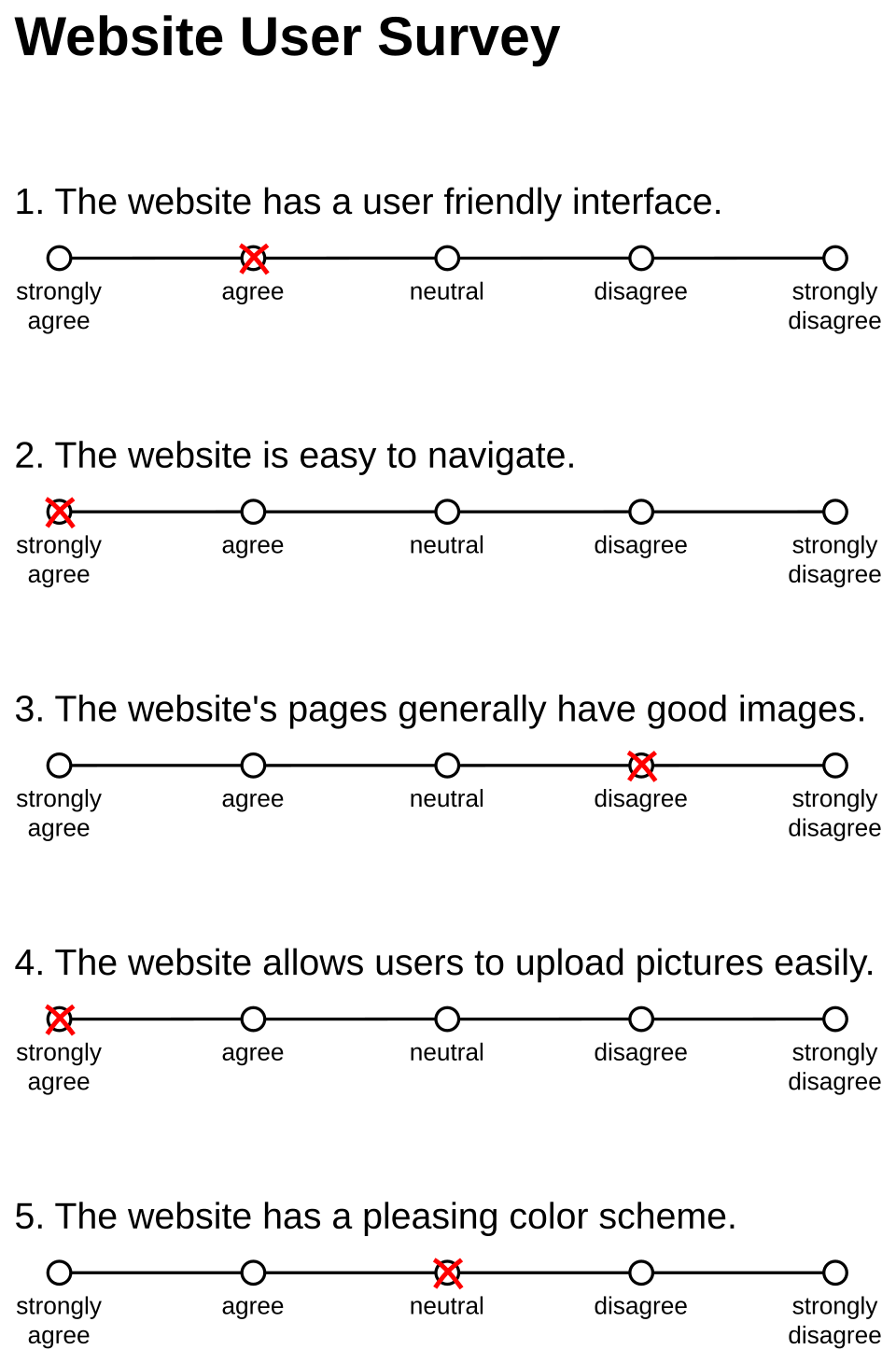 How to design a 5-point Likert scale for satisfaction (Image: Nicholas Smith vectorization: Own work, CC BY-SA 3.0, via Wikimedia Commons)
Based on the PU BBA (PU) syllabus for Business Research Methods, unit 7.
Discussion
Loading…