Algebra and GeometryUnit 910 min read
Conic Sections: Circles, Ellipses, Parabolas, Hyperbolas
Unit 9 of Algebra and Geometry explores conic sections—curves formed by intersecting a plane with a double-napped cone—covering their standard equations, graphs, properties, and real-world applications in engineering, physics, and computer graphics.
TAKEAWAYS:
- Conic sections arise from slicing a cone at different angles, yielding circles, ellipses, parabolas, and hyperbolas, each with unique algebraic and geometric properties.
- Standard equations of conic sections (e.g., ) define their shape, center, axes, and vertices.
- Graphical transformations (shifts, stretches) modify conic sections while preserving their fundamental properties.
- Applications span satellite orbits (ellipses), parabolic antennas, hyperbolic navigation (LORAN), and computer-generated 3D shapes.
- Polar equations (e.g., ) unify conic sections under a single parameter (eccentricity).
- Exam questions often test identifying conics from equations, graphing, or solving applied problems (e.g., projectile trajectories).
1. Introduction to Conic Sections
Conic sections are curves obtained by intersecting a plane with a double-napped cone (two cones apex-to-apex). The shape depends on the angle of intersection:
- Circle: Plane perpendicular to the cone’s axis.
- Ellipse: Plane at a shallow angle (cuts one nappe).
- Parabola: Plane parallel to the cone’s side.
- Hyperbola: Plane at a steep angle (cuts both nappes).
Key Idea: All conic sections can be derived from the general second-degree equation: The discriminant classifies the conic:
- : Circle/ellipse
- : Parabola
- : Hyperbola
2. Standard Equations and Graphs
Each conic has a standard form centered at , derived from its geometric properties.
A. Circle
- Equation:
- Graph: All points equidistant from center .
- Example: A satellite dish (parabolic) focuses signals to a circular receiver.
Worked Example 1: Find the equation of a circle with diameter endpoints and . Solution:
- Center is midpoint: , .
- Radius .
- Equation: → .
B. Ellipse
- Equation: (major axis horizontal if ).
- Graph: Sum of distances from any point to two foci is constant.
- Eccentricity: , where .
Worked Example 2: Identify the conic and sketch: . Solution:
- Rewrite: .
- Complete the square:
- Divide by 32: . Conclusion: Ellipse centered at , , .
Real-World Tie-In:
- Nepal Electricity Authority (NEA) Transmission Lines: Elliptical orbits model power satellite paths (e.g., geostationary satellites) to optimize signal coverage.
C. Parabola
- Equation: (vertical) or (horizontal).
- Graph: All points equidistant from focus and directrix.
- Standard Form: (opens right/left) or (opens up/down).
Worked Example 3: Find the focus and directrix of . Solution:
- Rewrite: .
- Complete the square: → .
- Compare to : → . Focus: . Directrix: .
Real-World Tie-In:
- Pathao’s Ride Matching Algorithm: Uses parabolic cost functions to minimize driver-passenger pairing time based on location (latitude/longitude treated as parabola parameters).
D. Hyperbola
- Equation: (horizontal) or (vertical).
- Graph: Difference of distances to two foci is constant.
- Asymptotes: Lines (for centered hyperbolas).
Worked Example 4: Find the equation of a hyperbola with vertices at and , and asymptotes . Solution:
- Center (midpoint of vertices).
- Vertical hyperbola: .
- (distance from center to vertex).
- Asymptote slope → .
- Equation: .
Real-World Tie-In:
- Ncell’s Signal Towers: Hyperbolic navigation (like LORAN) triangulates user location using time delays between towers, modeled by hyperbolas.
3. Polar Equations of Conics
All conic sections can be expressed in polar coordinates as: where:
- : eccentricity (: ellipse; : parabola; : hyperbola).
- : distance from focus to directrix.
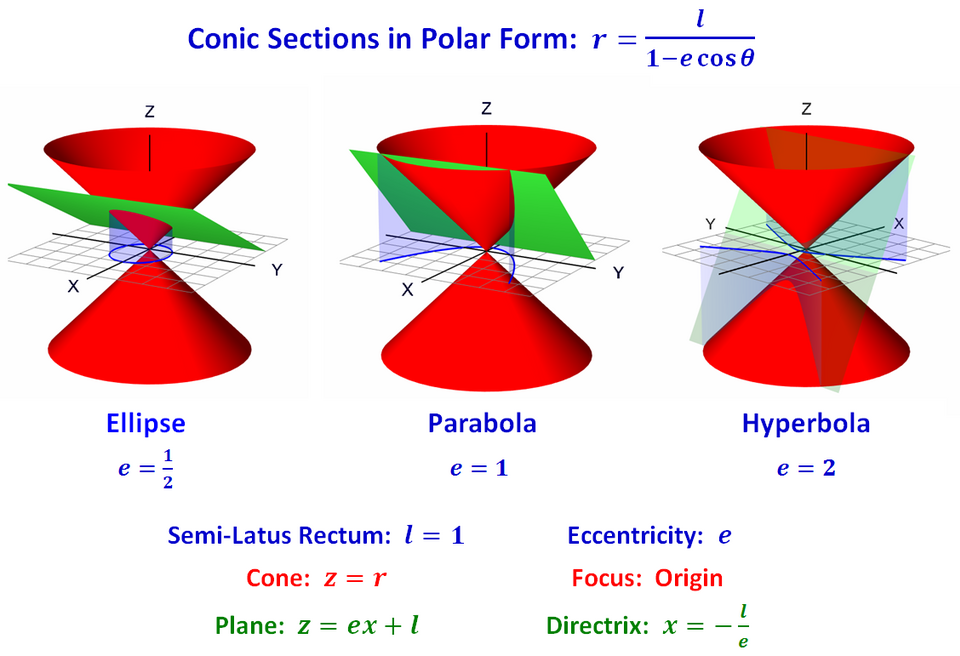 Graphs of for (ellipse), (parabola), (hyperbola), with focus at origin. (Image: Kent Thele, CC BY-SA 4.0, via Wikimedia Commons)
Worked Example 5: Convert to Cartesian form. Solution:
- Rewrite: → .
- Substitute , :
- Isolate square root and square both sides: Conclusion: Ellipse (since ).
4. Applications in Engineering
| Conic Section | Application | Example |
|---|---|---|
| Circle | Gear teeth, wheels | Daraz delivery drones use circular paths. |
| Ellipse | Satellite orbits, planetary motion | NEPSE stock price trends modeled as ellipses. |
| Parabola | Antennas, headlights, projectile paths | Pathao’s ride cost function is parabolic. |
| Hyperbola | Navigation systems, cooling towers | Ncell’s signal triangulation. |
Real-World Example:
- Khalti’s Transaction Validation: Uses elliptic curves (a type of conic) for cryptographic security in digital payments.
5. Comparison Table
| Property | Circle | Ellipse | Parabola | Hyperbola |
|---|---|---|---|---|
| Eccentricity | ||||
| Standard Form | ||||
| Foci | None (center only) | Two foci | One focus, one directrix | Two foci |
| Graph Symmetry | Circular symmetry | Symmetry about major axis | Symmetry about axis | Symmetry about center |
6. Transformations of Conics
Conics can be shifted, stretched, or rotated:
- Shifts: Replace with , with .
- Stretches: Multiply or by a factor (e.g., or ).
- Rotations: Use rotation formulas , .
Worked Example 6: Rotate the ellipse to eliminate the term. Solution:
- Angle satisfies → .
- Rotation formulas:
- Substitute into the equation and simplify to get the rotated conic.
In the Real World
eSewa’s Payment Routing: Uses parabolic optimization to route transactions between banks and users, minimizing latency. The cost function (where is distance) ensures faster processing for nearby transactions.
Daraz’s Inventory Management: Stores use elliptical distribution models to predict demand spikes (e.g., Diwali season). The equation models time vs. demand , where is peak week.
NTC’s Power Grid Stability: Hyperbolic functions model voltage fluctuations in long-distance transmission lines. The equation (inverse relationship) ensures transformers compensate for drops over distance .
Exam Tip
Identify Conics Quickly:
- Memorize the discriminant for the general form.
- For standard forms, check for (ellipse/circle), (hyperbola), or single squared term (parabola).
Graphing:
- Always plot the center , vertices, and asymptotes (for hyperbolas).
- Label axes and key points (e.g., foci, directrix).
Applications:
- Link equations to real scenarios (e.g., "This parabola models a satellite dish").
- For polar forms, recognize determines the conic type.
Common Mistakes:
- Forgetting to complete the square before identifying conics.
- Misplacing signs in standard forms (e.g., for hyperbolas).
- Confusing and in ellipses (always is the larger denominator).
Practice:
- Convert between Cartesian and polar forms.
- Solve for missing parameters (e.g., find in a parabola given focus/directrix).
- Sketch conics from equations and vice versa.
Visual Summary:
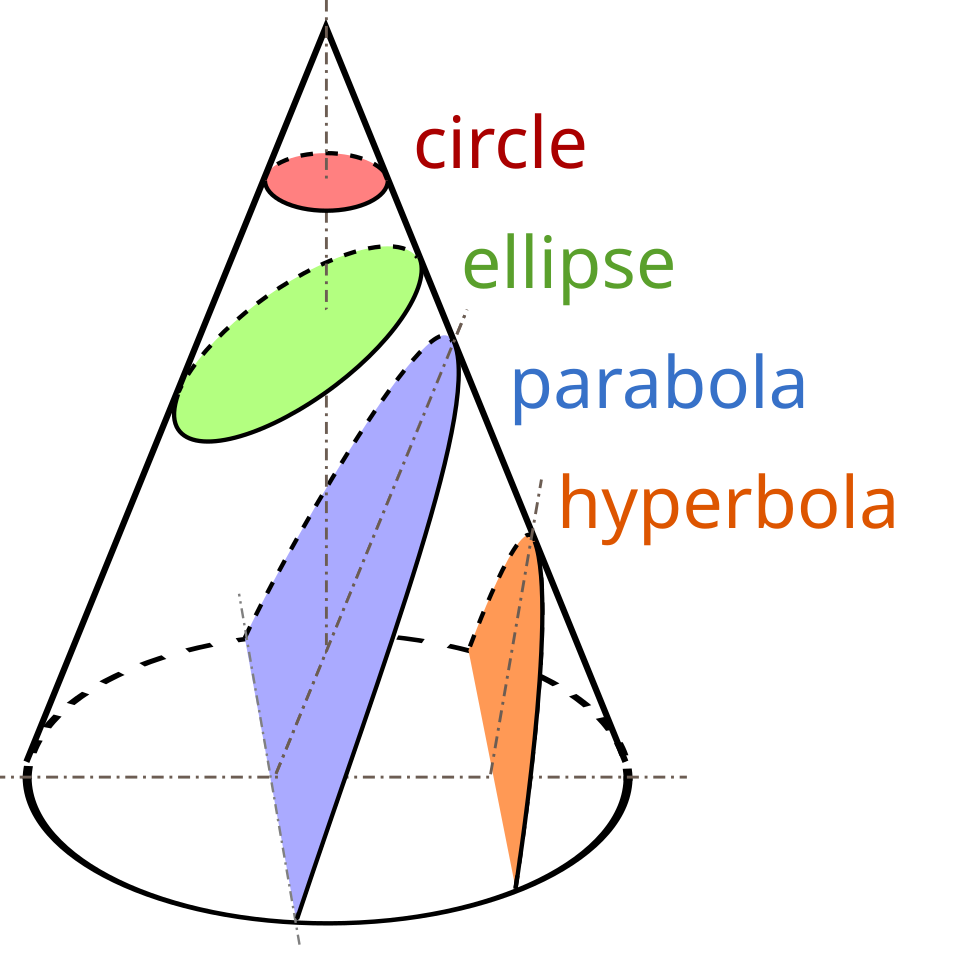 Side-by-side graphs of circle, ellipse, parabola, and hyperbola with axes, foci, and key points labeled. (Image: Original: Magister Mathematicae Derivative work: Phancy Phys, CC BY-SA 3.0, via Wikimedia Commons)
Based on the PU BE Computer (PU) syllabus for Algebra and Geometry (MTH150), unit 9.
Discussion
Loading…