Applied ChemistryUnit 313 min read
Corrosion: Causes, Types, Prevention & Engineering Solutions
Unit 3 of Applied Chemistry explores the electrochemical nature of corrosion, its mechanisms in metals, environmental factors, and practical prevention methods—essential for protecting infrastructure, machinery, and electronic components in engineering applications.
Key Concepts and Definitions
What is Corrosion?
Corrosion is the gradual destruction of materials (usually metals) by chemical or electrochemical reactions with their environment. It is a natural process that converts a refined metal into a more stable compound (e.g., rust on iron). Corrosion costs billions annually in infrastructure damage, equipment failure, and maintenance.
Electrochemical Nature of Corrosion
Corrosion is primarily an electrochemical process involving:
- Oxidation (anode): Metal loses electrons and forms ions (e.g., ).
- Reduction (cathode): Electrons reduce another species (e.g., in neutral/alkaline media).
- Electrolyte: A conductive medium (e.g., moisture, salts) allows ion flow between anode and cathode.
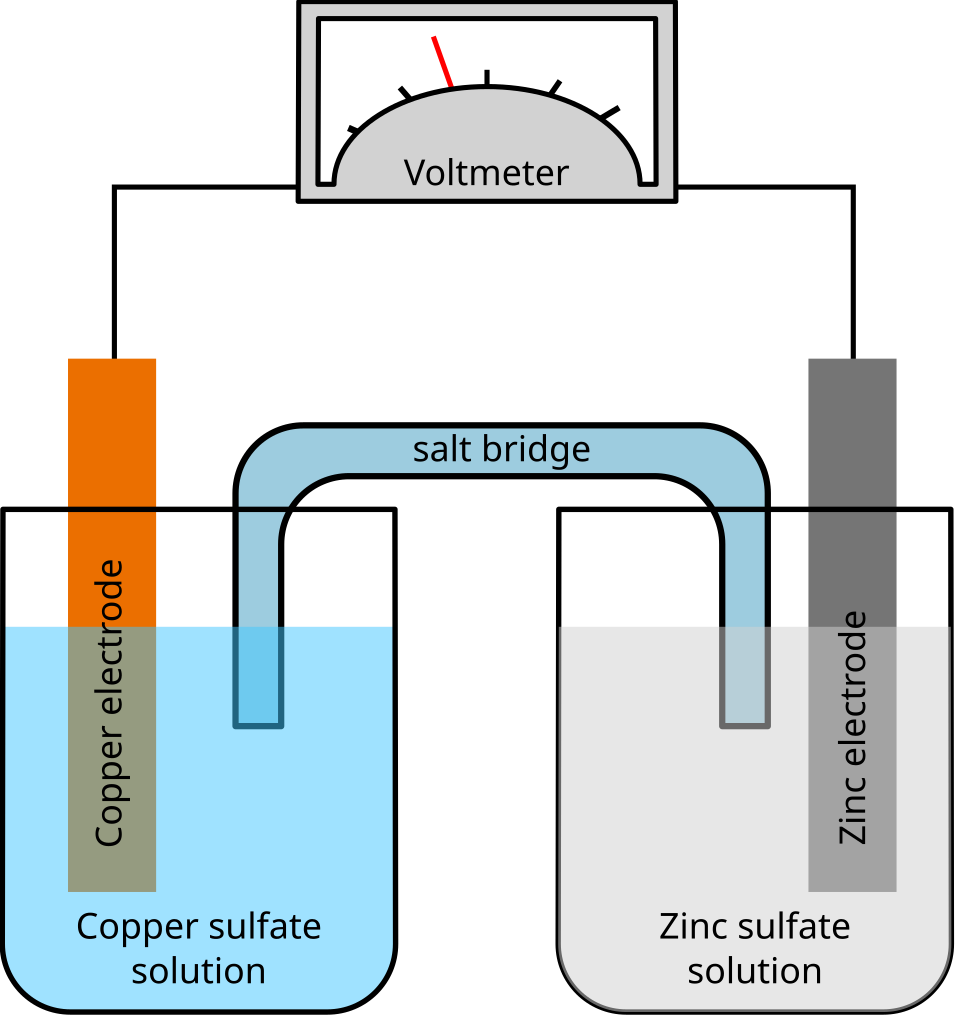 A labelled diagram showing anode, cathode, salt bridge, and electron flow in a simple electrochemical cell. (Image: Gringer, CC BY-SA 3.0, via Wikimedia Commons)
Types of Corrosion
1. Uniform (General) Corrosion
- Definition: Even attack over the entire surface of the metal.
- Example: Rusting of iron in moist air.
- Mechanism:
- Iron oxidizes to at the anode.
- Oxygen reduces to at the cathode.
- reacts with to form , which further oxidizes to rust ().
2. Galvanic Corrosion
- Definition: Accelerated corrosion of a metal when in electrical contact with a more noble metal in the presence of an electrolyte.
- Example: Corrosion of steel bolts in contact with brass in seawater.
- Factors Affecting Galvanic Corrosion:
- Electrode potential difference: Larger differences accelerate corrosion.
- Surface area ratio: A small anode to large cathode ratio increases corrosion rate.
- Electrolyte conductivity: Higher conductivity (e.g., saltwater) worsens corrosion.
Galvanic Series (Noble to Active Metals):
Gold, Platinum, Graphite, Titanium, Stainless Steel (passive), Copper, Brass, Nickel, Tin, Lead, Stainless Steel (active), Iron, Zinc, Magnesium, Aluminum
3. Pitting Corrosion
- Definition: Localized corrosion that penetrates deeply into the metal, forming small pits.
- Example: Pitting of stainless steel in chloride-rich environments (e.g., seawater).
- Mechanism:
- Chloride ions break down the passive oxide layer () on stainless steel.
- Pits form where the metal is exposed to the electrolyte.
4. Crevice Corrosion
- Definition: Corrosion occurring in confined spaces (e.g., under gaskets, lap joints) where stagnant solutions accumulate.
- Example: Corrosion under rubber washers in pipes.
- Mechanism:
- Oxygen depletion in crevices leads to differential aeration cells.
- Acidification occurs due to hydrolysis of metal ions.
5. Stress Corrosion Cracking (SCC)
- Definition: Cracking induced by the combined influence of tensile stress and a corrosive environment.
- Example: Failure of brass ammunition cases in humid environments.
- Mechanism:
- Stress concentrates at microscopic flaws.
- Corrosive environment propagates cracks.
6. Intergranular Corrosion
- Definition: Corrosion along grain boundaries, weakening the metal.
- Example: Weld decay in stainless steel due to chromium carbide precipitation.
- Mechanism:
- Impurities or phases at grain boundaries are more anodic than the bulk metal.
Factors Affecting Corrosion
| Factor | Effect on Corrosion | Example |
|---|---|---|
| Environment | Moisture, oxygen, and salts accelerate corrosion. | Rusting of iron in humid climates. |
| Temperature | Higher temperatures increase reaction rates. | Corrosion of car engines in hot climates. |
| pH | Acidic or alkaline conditions can enhance corrosion. | Acid rain corroding steel structures. |
| Pollutants | Chlorides, sulfides, and CO2 accelerate corrosion. | Seawater corroding ship hulls. |
| Metal Purity | Impurities act as cathodic or anodic sites. | Zinc impurities in copper accelerate corrosion. |
| Mechanical Stress | Increases susceptibility to SCC and fatigue corrosion. | Failure of bridges under load in corrosive environments. |
Prevention and Control of Corrosion
1. Material Selection
- Use corrosion-resistant materials such as:
- Stainless steels (high chromium content).
- Aluminum alloys (natural oxide layer).
- Copper and brass (resistant to atmospheric corrosion).
- Plastics and ceramics (non-metallic alternatives).
2. Coatings and Paint
- Barrier coatings physically separate the metal from the environment.
- Examples: Paint, epoxy resins, grease, oil.
- Sacrificial coatings (e.g., zinc in galvanizing) corrode instead of the base metal.
- IMAGE: galvanized steel wire | A photograph of zinc-coated steel wire used in construction.
3. Cathodic Protection
- Sacrificial Anodes: More active metals (e.g., zinc, magnesium) are attached to the structure to act as anodes.
- Example: Protection of underground pipelines and ship hulls.
- Impressed Current: External DC current is applied to make the structure cathodic.
- Example: Protection of water tanks and offshore platforms.
flowchart TD
    A["Metal Structure"] -->|"Electrical Connection"| B["Sacrificial Anode<br/>(Zinc/Magnesium)"]
    B -->|"Corrodes Instead"| C["Protects Structure"]
    A -->|"No Corrosion"| D["Safe Operation"]
4. Environmental Modification
- Reduce moisture: Use desiccants or dehumidifiers.
- Remove oxygen: Use inhibitors or inert gas blanketing.
- Control pH: Neutralize acidic or alkaline environments.
5. Design Improvements
- Avoid crevices, sharp edges, and stagnant areas where corrosion can initiate.
- Use corrosion-resistant fasteners (e.g., stainless steel bolts).
- Ensure proper drainage to prevent water accumulation.
6. Inhibitors
- Chemical additives that slow down corrosion by:
- Forming protective films (e.g., chromates, phosphates).
- Passivating the metal surface (e.g., nitrites in cooling water).
- Neutralizing aggressive ions (e.g., calcium bicarbonate in water treatment).
Real-World Applications in Nepal and Globally
1. eSewa and Khalti (Digital Payments)
- Corrosion Prevention in Payment Terminals:
- Payment terminals (e.g., POS machines) are exposed to humidity and dust in Nepal’s climate.
- Solution: Use of stainless steel or aluminum enclosures and corrosion-resistant coatings to prevent failure.
- Example: Khalti’s payment kiosks use powder-coated steel to resist rust in outdoor settings.
2. NTC and Ncell (Telecommunication Infrastructure)
- Corrosion in Telecommunication Towers:
- Steel towers in hilly regions of Nepal are exposed to rain, fog, and salt-laden winds.
- Solution: Galvanized steel and cathodic protection are used to extend the lifespan of towers.
- Example: Ncell’s base stations in remote areas use hot-dip galvanized steel to prevent rust.
3. Daraz and Pathao (Logistics and Delivery)
- Corrosion in Delivery Vehicles:
- Vehicles like Pathao bikes and Daraz delivery vans are exposed to road salts (in winter) and moisture.
- Solution: Use of epoxy-coated undercarriages and stainless steel parts to prevent rust.
- Example: Pathao’s electric scooters use aluminum alloy frames for lightweight corrosion resistance.
4. Nepal Rastra Bank (NRB) and Commercial Banks
- Corrosion in ATMs and Vaults:
- ATMs and bank vaults are exposed to humidity and acidic gases in urban areas like Kathmandu.
- Solution: Stainless steel safes, humidity control systems, and corrosion inhibitors in cooling systems.
- Example: NRB’s data centers use dehumidifiers and corrosion-resistant server racks.
5. NEPSE (Stock Exchange Infrastructure)
- Corrosion in Electrical Wiring and Servers:
- Electrical wiring in stock exchange buildings must withstand moisture and temperature fluctuations.
- Solution: Copper wiring with PVC insulation and regular maintenance with corrosion inhibitors.
- Example: NEPSE’s trading terminals use tinned copper cables to prevent oxidation.
6. Traffic Management Systems (Kathmandu Traffic Police)
- Corrosion in Traffic Lights and Signs:
- Traffic lights and road signs in Kathmandu face acid rain and dust.
- Solution: Anodized aluminum signs and stainless steel traffic light poles.
- Example: Traffic lights on Ring Road use galvanized steel poles with epoxy coatings.
Worked Example: Corrosion of Iron in Soil
Scenario: A steel pipe buried in moist, slightly acidic soil (pH 6) with chloride ions.
Steps:
Identify the Corrosion Type:
- Likely galvanic corrosion if dissimilar metals (e.g., steel and copper) are in contact.
- Pitting corrosion if chloride ions are concentrated.
Electrochemical Reactions:
- Anode (Iron):
- Cathode (Oxygen Reduction):
- Rust Formation:
Prevention Methods:
- Cathodic Protection: Attach a magnesium anode to the pipe.
- Coating: Apply a bituminous coating to block moisture.
- Material Upgrade: Use duplex stainless steel (ferritic-austenitic) for high resistance.
Comparison Table: Corrosion Prevention Methods
| Method | Mechanism | Advantages | Disadvantages | Best For |
|---|---|---|---|---|
| Galvanizing | Sacrificial zinc coating protects steel. | Long-lasting, cost-effective. | Limited to iron/steel, coating can degrade. | Construction, automotive parts. |
| Paint/Coatings | Physical barrier against moisture/oxygen. | Versatile, easy to apply. | Requires maintenance, can chip/crack. | Bridges, ships, buildings. |
| Cathodic Protection | Sacrificial anode or impressed current makes structure cathodic. | Highly effective for large structures. | High initial cost, requires power (impressed current). | Pipelines, offshore platforms. |
| Inhibitors | Chemical additives slow corrosion reactions. | Effective in closed systems (e.g., cooling water). | Toxicity concerns, requires monitoring. | Industrial water systems, engines. |
| Material Selection | Use corrosion-resistant alloys (e.g., stainless steel, aluminum). | Long-term durability. | Higher cost, limited applications. | Chemical plants, medical devices. |
Exam Tip
- Understand the Electrochemical Basis: Always relate corrosion to oxidation-reduction reactions. Examiners often ask for half-reactions or cell diagrams.
- Differentiate Corrosion Types: Know when to apply galvanic, pitting, or SCC based on real-world scenarios (e.g., "Why does stainless steel fail in seawater?" → pitting due to chlorides).
- Prevention Methods: Be ready to match scenarios to solutions (e.g., "How would you protect a ship hull?" → cathodic protection + paint).
- Real-World Applications: Connect theory to Nepali contexts (e.g., corrosion in NTC towers, Khalti terminals, or Pathao bikes).
- Diagrams: Draw galvanic cells, corrosion profiles, or protection setups in exams—visuals score extra marks!
- Common Mistakes to Avoid:
- Confusing sacrificial anodes (active metal) with impressed current (external power).
- Ignoring environmental factors (e.g., pH, temperature) in corrosion rate calculations.
- Overlooking design flaws (e.g., crevices) as corrosion initiators.
Final Note: Corrosion is not just a chemistry problem—it’s an engineering challenge. Every structure, from a Daraz delivery van to an Ncell tower, relies on corrosion science to stay functional. Master the mechanisms, types, and prevention methods, and you’ll ace both the exam and real-world applications!
Based on the PU BE Computer (PU) syllabus for Applied Chemistry (CHM110), unit 3.
Discussion
Loading…