Applied ChemistryUnit 28 min read
Electrochemistry: Cells, Batteries, Corrosion & Faraday’s Laws
Unit 2 of Applied Chemistry explores electrochemical cells (galvanic and electrolytic), Faraday’s laws of electrolysis, Nernst equation, corrosion mechanisms, and real-world applications in energy storage (batteries), metal refining, and anti-corrosion coatings—essential for computer engineering materials and power sys
Core Concepts: Electrochemical Cells and Reactions
Electrochemistry studies the relationship between electricity and chemical reactions. It is divided into two main types of cells:
1. Galvanic (Voltaic) Cells: Spontaneous Energy Conversion
A galvanic cell converts chemical energy into electrical energy via a spontaneous redox reaction. Key components:
- Anode: Site of oxidation (loss of electrons, negative terminal in a galvanic cell).
- Cathode: Site of reduction (gain of electrons, positive terminal).
- Salt bridge: Maintains electrical neutrality by allowing ion migration.
- Electrolyte: Conducts ions between electrodes.
How it works:
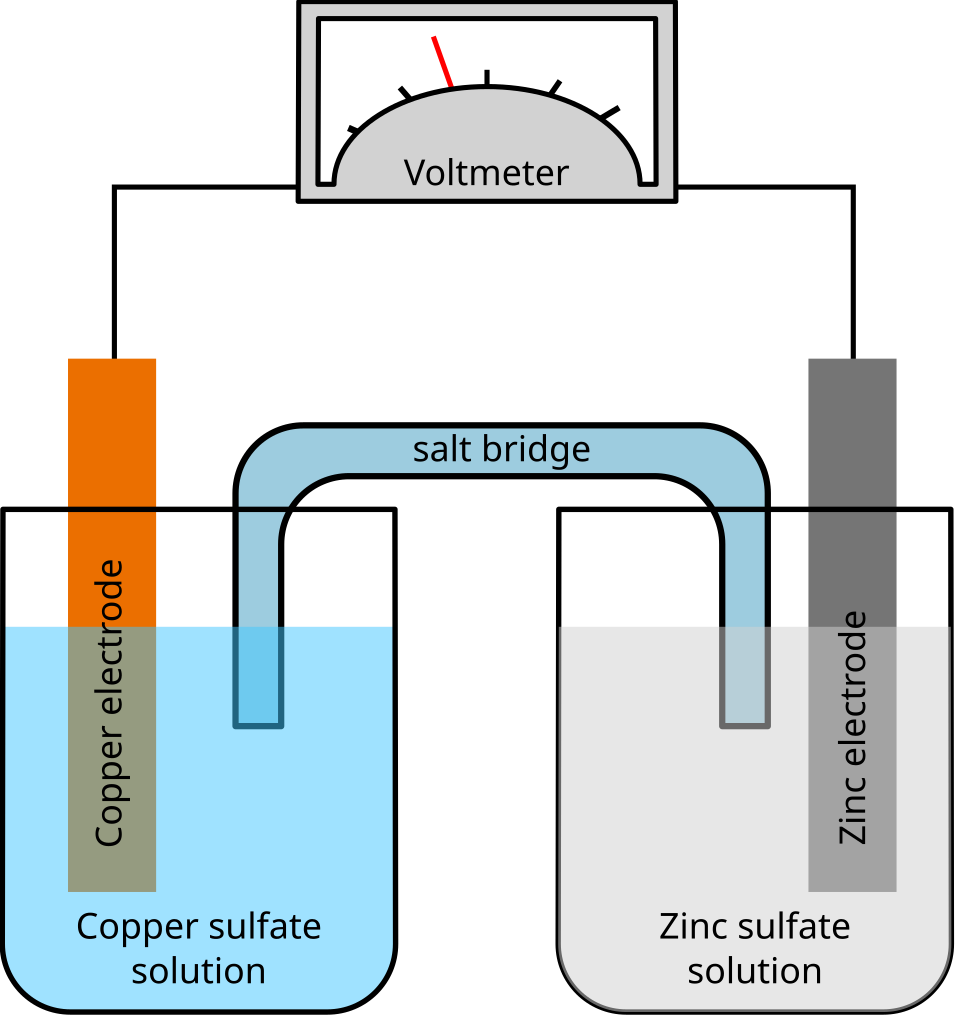 galvanic cell diagram with labels (Image: Gringer, CC BY-SA 3.0, via Wikimedia Commons)
Example: Daniell Cell
galvanic cell diagram with labels (Image: Gringer, CC BY-SA 3.0, via Wikimedia Commons)
Example: Daniell Cell
- Anode (Zn):
- Cathode (Cu):
- Overall reaction:
- EMF (E°cell):
Real-world tie-in: Khalti’s Payment System uses electrochemical principles in Li-ion batteries (galvanic cells) to power mobile devices during transactions. The battery’s anode (graphite) and cathode (LiCoO₂) drive the redox reactions that store/release energy for quick payments.
2. Electrolytic Cells: Non-Spontaneous Energy Input
Electrolytic cells force a non-spontaneous reaction using an external power source (e.g., batteries, solar panels). Applications:
- Electroplating (e.g., chrome plating on car bumpers).
- Metal refining (e.g., copper purification).
- Chlor-alkali process (NaCl → NaOH + Cl₂).
Example: Electrolysis of Molten NaCl
graph LR
    A["Power Source"] -->|"e⁻"| B["Cathode: 2Na⁺ + 2e⁻ → 2Na(l)"]
    C["Anode: 2Cl⁻ → Cl₂(g) + 2e⁻"] -->|"Salt bridge"| D["Molten NaCl"]
    B --> D
    C --> D
Key equations:
- Cathode:
- Anode:
- Overall:
Real-world tie-in: Nepal Electricity Authority (NEA) uses electrolytic cells in water splitting (electrolysis) to produce hydrogen for fuel cells in remote areas. The process requires ~1.23 V to split into and , stored for later use in generators.
Faraday’s Laws of Electrolysis
Quantify the relationship between electricity and chemical change during electrolysis.
First Law
The mass of a substance deposited at an electrode is directly proportional to the quantity of electricity (charge) passed through the electrolyte.
Mathematically: Where:
- = mass deposited (g),
- = electrochemical equivalent (g/C),
- = current (A),
- = time (s).
Example: Copper Electroplating
- Given: Current , time , .
- Calculation:
Real-world tie-in: Daraz’s Warehouse Automation uses electroplating to coat metal shelves with corrosion-resistant chromium. Faraday’s laws ensure precise control over plating thickness, extending shelf life and reducing maintenance costs.
Second Law
The mass of a substance deposited by a given quantity of electricity is proportional to its equivalent weight.
Mathematically: Where:
- = molar mass (g/mol),
- = number of electrons transferred per ion.
Example: Comparing Silver and Copper
| Metal | Molar Mass () | Electrons () | Equivalent Weight () |
|---|---|---|---|
| Ag | 107.87 g/mol | 1 | 107.87 g/mol |
| Cu | 63.55 g/mol | 2 | 31.77 g/mol |
Worked Example: If 1 Faraday (96,500 C) deposits 107.87 g of Ag, how much Cu is deposited?
Nernst Equation: Cell Potential Under Non-Standard Conditions
The Nernst equation calculates the cell potential (E) under non-standard conditions (e.g., varying concentrations, temperature).
Where:
- = standard cell potential (V),
- = gas constant (8.314 J/mol·K),
- = temperature (K),
- = moles of electrons transferred,
- = Faraday’s constant (96,500 C/mol),
- = reaction quotient.
Simplified at 298 K:
Example: Daniell Cell with Non-Standard Concentrations
- Given: , , , .
- Calculation:
Real-world tie-in: Ncell’s Battery Charging Stations use the Nernst equation to monitor battery health. As a Li-ion battery discharges, increases in the cathode, shifting and indicating remaining capacity. This helps optimize charging cycles for longevity.
Corrosion: Electrochemical Destruction of Metals
Corrosion is an electrochemical process where metals oxidize, forming oxides/hydroxides. Common types:
- Uniform Corrosion: Even attack (e.g., rusting of iron).
- Galvanic Corrosion: Different metals in contact (e.g., brass bolts in steel ships).
- Pitting Corrosion: Localized holes (e.g., stainless steel in chloride environments).
Mechanism of Iron Rusting:
graph LR
    A["Anode: Fe → Fe²⁺ + 2e⁻"] -->|"O₂ + H₂O"| B["Cathode: O₂ + 2H₂O + 4e⁻ → 4OH⁻"]
    C["Fe²⁺ + 2OH⁻ → Fe(OH)₂"] --> D["4Fe(OH)₂ + O₂ + 2H₂O → 4Fe(OH)₃"]
    D --> E["2Fe(OH)₃ → Fe₂O₃·xH₂O (Rust)"]
Real-world tie-in: Kathmandu Traffic Signals suffer from galvanic corrosion where zinc-coated steel poles (sacrificial anode) corrode faster than copper wires. Replacing zinc every 2–3 years costs NPR 500,000 annually. Engineers use stainless steel or polymer coatings to mitigate this.
Preventing Corrosion: Engineering Solutions
| Method | Mechanism | Example Applications |
|---|---|---|
| Barrier Coatings | Physical barrier (paint, oil) | Car bodies, bridges |
| Sacrificial Anodes | Active metal corrodes instead | Ship hulls (Zn/Mg), water pipes |
| Cathodic Protection | External current reverses reaction | Underground pipelines, NTC substations |
| Alloying | Stainless steel (Cr/Ni addition) | Surgical tools, chemical tanks |
Example: Cathodic Protection for NTC Transmission Lines
- Setup: A DC power source connects a sacrificial anode (Mg) to the steel tower.
- Reaction:
- Anode (Mg):
- Cathode (Steel):
- Outcome: Steel remains protected as Mg corrodes instead.
Exam Tip
- Cell Diagrams: Always write anode | anode solution || cathode solution | cathode (e.g., ).
- Faraday’s Laws: Memorize and . Use units consistently (grams, coulombs).
- Nernst Equation: Plug in values step-by-step. At 298 K, use the simplified logarithmic form.
- Corrosion: Link real-world examples (e.g., rusting of bicycle chains, Ncell battery terminals) to mechanisms.
- Sign Conventions:
- Galvanic cell: .
- Electrolytic cell: (external voltage must exceed ).
Common Pitfalls:
- Mixing up anode/cathode in galvanic vs. electrolytic cells.
- Forgetting to convert time to seconds in Faraday’s law calculations.
- Ignoring ion charges in the Nernst equation (e.g., using for ).
Visual Summary:
mindmap
  root((Electrochemistry))
    Galvanic Cells
      Spontaneous
      Zn|Zn²⁺||Cu²⁺|Cu
      E°cell = +1.10 V
    Electrolytic Cells
      Non-spontaneous
      NaCl → Na + Cl₂
      Requires external voltage
    Faraday's Laws
      m ∝ Q (First Law)
      m ∝ Equivalent Weight (Second Law)
    Nernst Equation
      E = E° - (RT/nF)lnQ
    Corrosion
      Fe → Fe²⁺ + 2e⁻
      Prevention: Coatings, Sacrificial Anodes
Based on the PU BE Computer (PU) syllabus for Applied Chemistry (CHM110), unit 2.
Discussion
Loading…