Applied ChemistryUnit 412 min read
Water Treatment: Processes, Pollutants & Tech
Unit 4 of Applied Chemistry covers the principles, methods, and technologies used to purify water for industrial, municipal, and environmental applications, including physical, chemical, and biological treatment techniques, pollutant removal, and real-world case studies from Nepal and global companies.
Why Water Treatment Matters
Water is essential for life, industry, and agriculture, but natural sources (rivers, lakes, groundwater) often contain harmful contaminants. Water treatment removes pollutants to make water safe for drinking, irrigation, or industrial use. In Nepal, eSewa (for online bill payments) relies on treated water for its servers, while NTC and Ncell use treated water in cooling systems. Globally, Google’s data centers require ultra-pure water for cooling, and WhatsApp’s servers depend on advanced filtration to prevent corrosion in hardware.
1. Sources of Water and Common Pollutants
Water can be sourced from:
- Surface water (rivers, lakes, ponds)
- Groundwater (wells, springs)
- Rainwater (harvested for drinking)
Types of Pollutants
Pollutants are classified based on their origin and nature:
mindmap
  root((Water Pollutants))
    Physical
      "Suspended solids (silt, clay)"
      "Color, odor, turbidity"
    Chemical
      "Inorganic: Heavy metals (Pb, Hg, As), nitrates, fluorides"
      "Organic: Pesticides, oil, phenols"
    Biological
      "Pathogens: Bacteria (E. coli), viruses, parasites (Giardia)"
      "Algae (eutrophication)"
    Radioactive
      "Uranium, radium (from mining)"
Real-world example:
- Kathmandu’s Bagmati River is polluted with domestic sewage (biological pollutants), industrial waste (chemical pollutants like lead and mercury), and plastic waste (physical pollutants). Treating this water is critical for public health and agriculture.
2. Stages of Water Treatment
Water treatment follows a multi-stage process to remove different types of pollutants. The stages are:
A. Pre-treatment
Removes large debris before primary treatment.
- Screening: Removes large objects (leaves, plastic, trash) using bar screens or micro-screens.
- Aeration: Adds oxygen to remove volatile organic compounds (e.g., hydrogen sulfide) and reduce odor. (Example: Aeration removes benzene from groundwater near fuel storage tanks.)
B. Coagulation and Flocculation
Coagulation neutralizes charged particles so they can clump together.
- Coagulants (e.g., alum \ce{Al2(SO4)3.14H2O}, ferric chloride \ce{FeCl3}) are added to destabilize colloidal particles.
- Flocculation gently mixes water to form flocs (clumps of pollutants).
Chemical Reaction (Alum Coagulation): \ce{Al2(SO4)3 + 3Ca(HCO3)2 -> 2Al(OH)3 + 3CaSO4 + 6CO2}
Worked Example: If 10 mg/L of alum is added to water, how many moles of \ce{Al(OH)3} are formed? Solution: Molar mass of alum = 600.3 g/mol Moles of alum = mol Since 1 mol alum → 2 mol \ce{Al(OH)3}, Moles of \ce{Al(OH)3} = mol.
Real-world link:
- Nepal Water Supply Corporation (NWSC) uses alum coagulation in its treatment plants to remove turbidity from the Koshi River before supplying water to Biratnagar.
C. Sedimentation
Flocs settle out in sedimentation tanks (clarifiers) due to gravity.
- Detention time: 2–4 hours.
- Sludge (settled solids) is removed and disposed of or treated further.
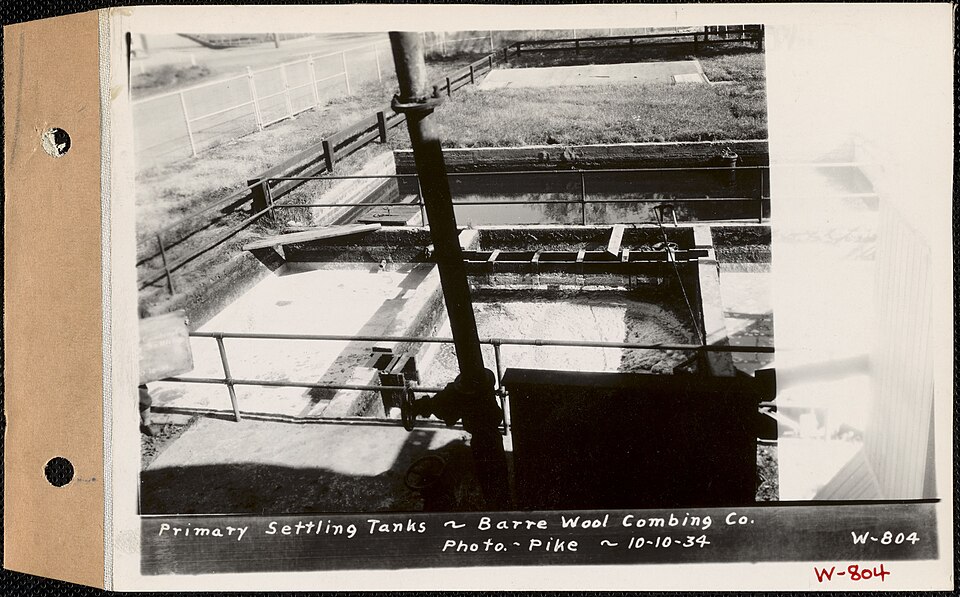 A clarifier tank showing floc settling. (Image: Massachusetts. Metropolitan District Water Supply Commission, Public domain, via Wikimedia Commons)
D. Filtration
Removes remaining suspended particles using filter media:
- Slow sand filters: Use sand layers (1–2 m deep) for biological and physical filtration.
- Rapid sand filters: Use finer sand (0.3–0.6 mm) with backwashing.
- Activated carbon filters: Remove organic compounds (e.g., pesticides, phenols) via adsorption.
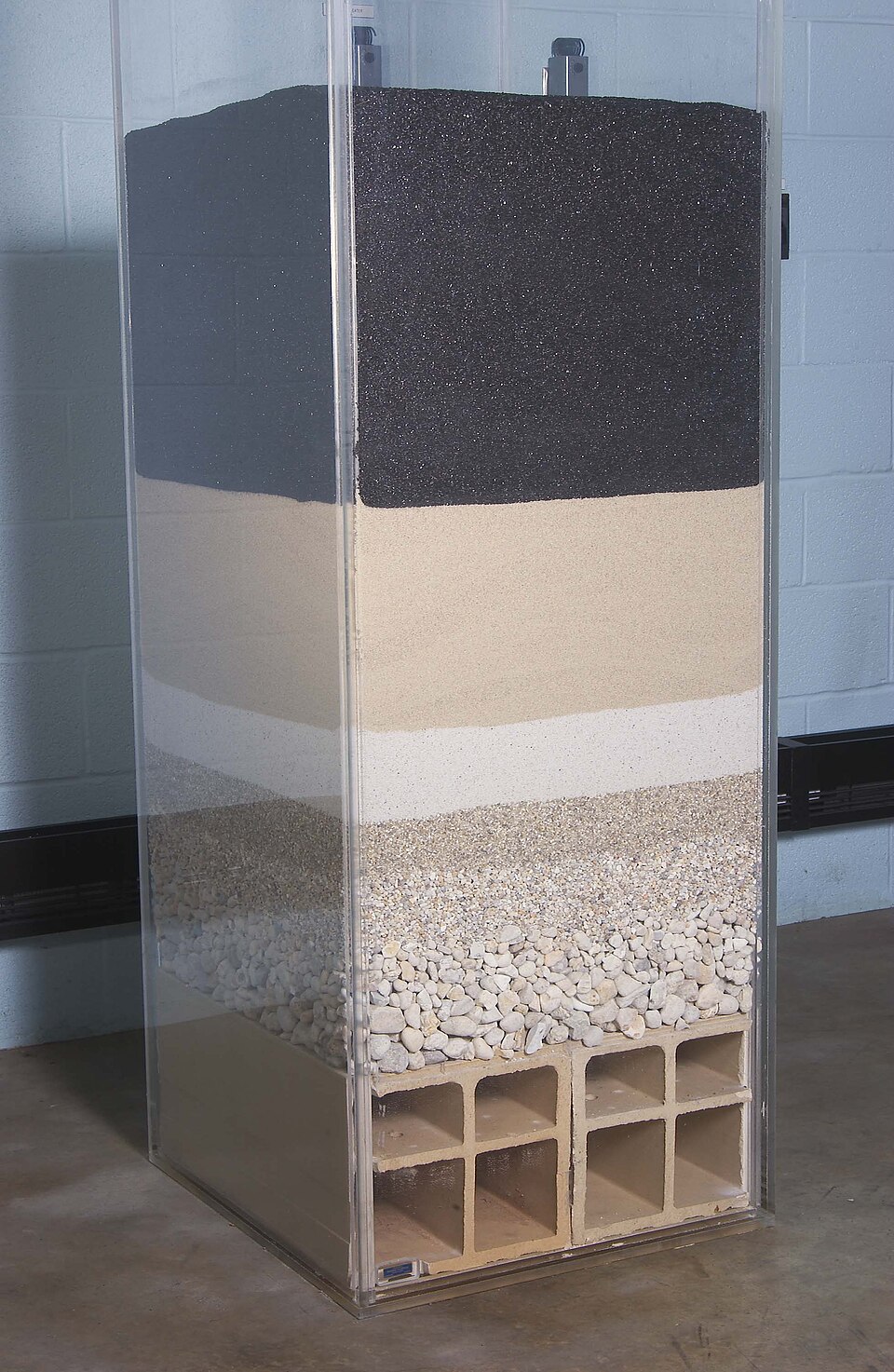 Multi-layer sand filter used in water treatment (gravel, sand, activated carbon) (Image: U.S. Environmental Protection Agency, Public domain, via Wikimedia Commons)
Worked Example: A rapid sand filter removes 90% of remaining turbidity from water with an initial turbidity of 20 NTU. What is the final turbidity? Solution: Final turbidity = Initial turbidity × (1 – removal efficiency) = 20 NTU × (1 – 0.90) = 2 NTU.
Real-world link:
- Daraz’s warehouse water treatment uses activated carbon filters to remove organic pollutants from groundwater used in cooling systems.
E. Disinfection
Kills or inactivates pathogens to make water safe for drinking. Common disinfectants:
| Disinfectant | Mechanism | Dose (mg/L) | Advantages | Disadvantages |
|---|---|---|---|---|
| Chlorine (\ce{Cl2}) | Oxidizes cells, forms HOCl | 0.5–2.0 | Cheap, residual effect | Forms trihalomethanes (THMs) if organic matter is present |
| Chlorine dioxide (\ce{ClO2}) | Strong oxidizer, no THMs | 0.2–1.0 | Effective against crypto, no taste | Expensive, unstable |
| Ozone (\ce{O3}) | Strong oxidizer | 0.3–1.0 | No harmful byproducts, fast | No residual effect, expensive |
| UV Light | Damages DNA of microbes | N/A | Chemical-free, no byproducts | Requires clear water, no residual |
Chemical Reaction (Chlorination): \ce{Cl2 + H2O -> HOCl + HCl} \ce{HOCl -> H+ + OCl-} (hypochlorous acid, stronger disinfectant)
Worked Example: If 1.5 mg/L of chlorine is added to water, and 70% converts to HOCl, how much HOCl is formed? Solution: HOCl formed = 1.5 mg/L × 0.70 = 1.05 mg/L.
Real-world link:
- Nepal’s community water projects (e.g., in Pokhara) often use chlorination due to its low cost and effectiveness against E. coli in surface water.
3. Advanced Water Treatment Techniques
For industrial or high-purity water (e.g., pharmaceuticals, electronics), additional steps are needed:
A. Ion Exchange
Removes ions (e.g., \ce{Ca2+}, \ce{Mg2+}, \ce{Na+}) using resins.
- Cation exchange: Replaces \ce{Ca2+} with \ce{Na+}.
- Anion exchange: Removes \ce{SO4^2-}, \ce{Cl-}.
Example: Softening hard water using sodium zeolite: \ce{2RNa + Ca2+ -> R2Ca + 2Na+}
Real-world link:
- Banks in Nepal (e.g., NMB, Global IME) use ion exchange to remove hardness from water used in ATM cooling systems to prevent scale buildup.
B. Reverse Osmosis (RO)
Forces water through a semi-permeable membrane to remove 99% of dissolved solids.
- Used in desalination and ultra-pure water production.
- Energy-intensive but highly effective.
Worked Example: An RO plant processes 1000 L/hour with 95% recovery. How much wastewater is produced? Solution: Wastewater = Total water × (1 – recovery) = 1000 L/h × (1 – 0.95) = 50 L/h.
Real-world link:
- Google’s data centers in Nepal use RO systems to produce ultra-pure water for cooling servers, preventing corrosion in electronic components.
C. Membrane Filtration
- Microfiltration (MF): Removes bacteria, protozoa (0.1–10 µm).
- Ultrafiltration (UF): Removes viruses, proteins (0.01–0.1 µm).
- Nanofiltration (NF): Removes divalent ions (e.g., \ce{SO4^2-}, \ce{Ca2+}).
Real-world link:
- Pathao’s electric scooters use UF membranes to filter water for battery cooling systems, extending battery life.
4. Wastewater Treatment
Wastewater from homes, industries, and agriculture must be treated before disposal.
A. Primary Treatment
Physical separation of solids:
- Grit removal: Removes sand, gravel.
- Primary sedimentation: Settles organic solids.
B. Secondary Treatment
Biological removal of organic matter:
- Activated sludge process: Microbes break down organics in an aeration tank.
- Trickling filters: Microbes grow on a medium (e.g., rocks) and degrade waste.
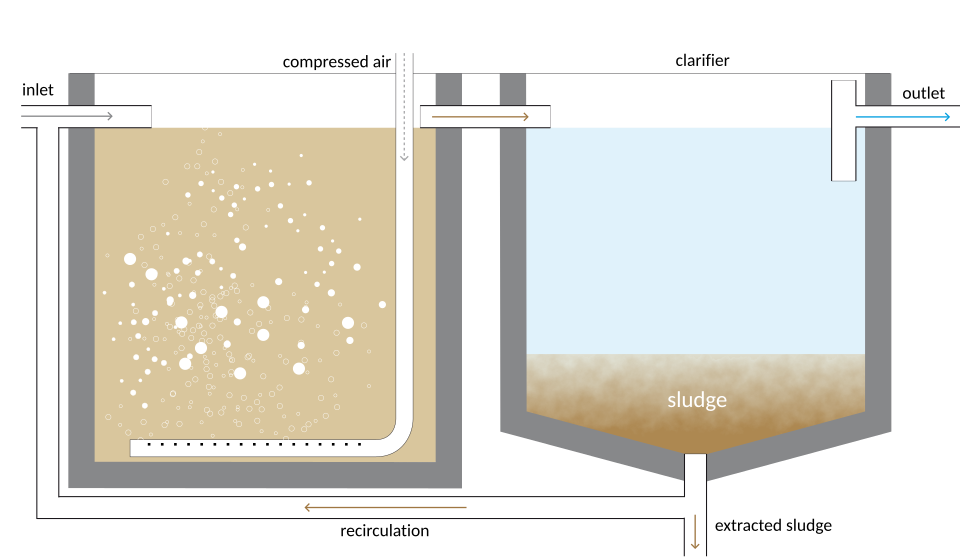 Aeration tank and settling tank in secondary treatment. (Image: Eawag: Swiss Federal Institute of Aquatic Science and Techno, CC BY 3.0, via Wikimedia Commons)
C. Tertiary Treatment
Advanced removal of nutrients and pathogens:
- Nitrification/Denitrification: Removes nitrates via bacteria.
- Phosphorus removal: Uses chemical precipitation (e.g., with ferric chloride).
- Disinfection: UV or chlorination.
Worked Example: A wastewater plant treats 5000 m³/day with 80% BOD removal. If the influent BOD is 200 mg/L, what is the effluent BOD? Solution: Effluent BOD = Influent BOD × (1 – removal efficiency) = 200 mg/L × (1 – 0.80) = 40 mg/L.
Real-world link:
- **Nepal’s Bagmati Action Plan includes tertiary treatment to reduce eutrophication in the Bagmati River caused by domestic sewage.
5. Water Quality Standards
Different standards apply based on use:
| Standard | Parameter | Limit (Drinking Water) | Limit (Industrial Cooling) |
|---|---|---|---|
| Turbidity | NTU | ≤ 1 | ≤ 5 |
| pH | - | 6.5–8.5 | 6–9 |
| Dissolved Oxygen (DO) | mg/L | ≥ 5 | ≥ 3 |
| Hardness (\ce{CaCO3}) | mg/L | ≤ 200 | ≤ 500 |
| Lead (Pb) | µg/L | ≤ 10 | ≤ 50 |
| E. coli | CFU/100 mL | 0 | ≤ 100 |
Real-world link:
- **Nepal’s Drinking Water Quality Standards (2019) enforce ≤ 1 NTU turbidity and pH 6.5–8.5 to prevent waterborne diseases like cholera.
6. Emerging Contaminants and Challenges
New pollutants require advanced solutions:
- Pharmaceuticals (e.g., antibiotics, hormones) → Advanced oxidation (AOPs).
- Microplastics → Membrane filtration + activated carbon.
- PFAS ("Forever Chemicals") → Granular activated carbon (GAC) + ion exchange.
Real-world link:
- **Nepal’s Kathmandu Valley faces microplastic pollution from plastic waste; sand filters + UV treatment are being tested to remove them.
In the Real World
eSewa’s Server Cooling
- Uses reverse osmosis + ion exchange to produce ultra-pure water for cooling servers, preventing corrosion in electronic components and scaling in pipes.
Ncell’s Base Station Water Treatment
- Activated carbon filters remove volatile organic compounds (VOCs) from groundwater used in cooling towers, extending equipment life.
Daraz’s Warehouse Water Management
- Multi-stage filtration (sand + carbon + UV) ensures low turbidity (<1 NTU) and zero bacteria in water used for fire suppression systems and HVAC cooling.
Nepal’s Community Water Projects (e.g., Pokhara)
- Chlorination + slow sand filters provide safe drinking water to rural areas, reducing waterborne diseases like dysentery.
Nepal Stock Exchange (NEPSE) Data Centers
- Deionized water (via ion exchange) is used in cooling systems to prevent electrical shorts and corrosion in servers.
Exam Tip
- Understand the stages: Always explain water treatment in the correct order (pre-treatment → coagulation → sedimentation → filtration → disinfection).
- Chemical reactions matter: Know the reactions for coagulation (alum), chlorination, and ion exchange.
- Real-world applications: Relate treatment methods to Nepali companies (eSewa, NTC, banks) or global tech (Google, WhatsApp).
- Calculations: Practice BOD removal, turbidity reduction, and chemical dosing problems.
- Standards: Memorize drinking water vs. industrial water limits (e.g., turbidity, hardness, E. coli).
- Diagrams: Draw sedimentation tanks, activated sludge processes, and RO setups in exams.
- Emerging contaminants: Know PFAS, microplastics, and pharmaceuticals as new challenges in water treatment.
Final Note: Water treatment is not just science—it’s engineering in action. Whether it’s keeping eSewa’s servers cool, making Ncell’s towers reliable, or providing safe drinking water in rural Nepal, the principles you learn here directly impact technology, health, and industry. Master the stages, chemistry, and calculations, and you’ll excel in both exams and real-world applications.
Based on the PU BE Computer (PU) syllabus for Applied Chemistry (CHM110), unit 4.
Discussion
Loading…