Applied PhysicsUnit 28 min read
Waves & Acoustics: Types, Properties & Applications
Unit 2 of Applied Physics explores wave mechanics—transverse/longitudinal waves, sound propagation, Doppler effect, resonance, and acoustic applications in engineering, from musical instruments to ultrasound imaging.
TAKEAWAYS:
- Waves transfer energy without medium displacement; transverse (e.g., light) and longitudinal (e.g., sound) differ in particle motion.
- Sound waves in air follow , where speed depends on medium density/temperature (331 m/s at 0°C).
- Doppler effect shifts frequency for moving sources/observers (e.g., ambulance sirens, radar speed guns).
- Resonance amplifies vibrations (e.g., bridges collapsing, musical instruments tuning).
- Acoustic impedance determines reflection/transmission at boundaries (key in ultrasound and speaker design).
- Standing waves form nodes/antnodes (e.g., guitar strings, organ pipes) with harmonics at .
Core Concepts
1. Wave Basics: Types and Properties
Waves are disturbances propagating through a medium (or vacuum) via energy transfer, not particle movement. Classify them by:
- Direction of oscillation:
- Transverse: Oscillation perpendicular to propagation (e.g., light, water ripples).
- Longitudinal: Oscillation parallel to propagation (e.g., sound, seismic P-waves).
- Medium requirement:
- Mechanical waves: Need a medium (sound, water waves).
- Electromagnetic waves: Travel in vacuum (light, radio).
Key Parameters:
- Amplitude (A): Maximum displacement (determines intensity/loudness).
- Wavelength (λ): Distance between crests (m).
- Frequency (f): Cycles per second (Hz).
- Speed (v): (m/s). In air, (°C).
graph LR
A["Wave Types"] --> B["Transverse"]
A --> C["Longitudinal"]
B --> D["Light\nEM Wave"]
B --> E["Water Ripples"]
C --> F["Sound\nAir"]
C --> G["Seismic P-Waves"] Shows displacement vs. propagation for both types. (Image: Guy vandegrift, CC0, via Wikimedia Commons)
2. Sound Waves: Physics and Behavior
Sound is a longitudinal pressure wave in a medium (air, water, solids). Key properties:
- Speed in air: (m/s). Faster in denser media (e.g., 1482 m/s in water).
- Intensity (I): Power per unit area (), measured in decibels (dB):
- Pitch vs. Loudness:
- Pitch = frequency (high = high pitch).
- Loudness = amplitude/intensity (dB scale).
Worked Example: Doppler Effect in Kathmandu Traffic A police siren (500 Hz) moves toward you at 30 m/s. Air speed = 340 m/s.
- Frequency heard: .
- Result: Siren sounds ~10% higher-pitched when approaching.
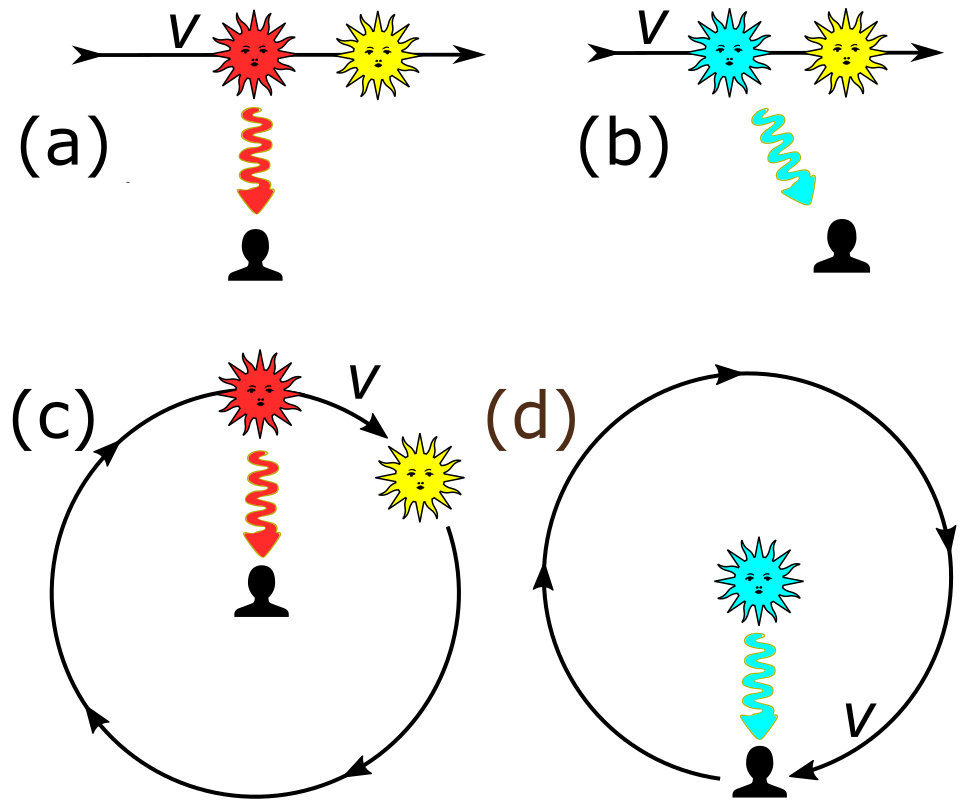 Shows frequency shift for moving source/observer. (Image: Prokaryotic Caspase Homolog, CC BY-SA 4.0, via Wikimedia Commons)
3. Wave Interference and Superposition
When two waves meet, they superpose (add amplitudes). Outcomes:
- Constructive interference: Crests align → amplified wave.
- Destructive interference: Crest meets trough → cancellation.
- Standing waves: Fixed nodes/antnodes (e.g., guitar strings, organ pipes).
Standing Wave Formula: For a string fixed at both ends: Example: A 1 m guitar string vibrates at 440 Hz (fundamental). Its 3rd harmonic is Hz.
4. Resonance and Applications
Resonance occurs when a system’s natural frequency matches an external force, leading to amplified oscillations.
- Dangers: Tacoma Narrows Bridge (1940) collapsed due to wind-induced resonance.
- Applications:
- Musical instruments: Tuning forks, violins.
- Ultrasound imaging: High-frequency sound waves reflect off tissues.
- Radio tuning: Circuits resonate at specific frequencies.
5. Acoustic Impedance and Reflection
When sound meets a boundary (e.g., air/water), part reflects/transmits based on acoustic impedance (Z): where = density, = speed.
- High impedance mismatch → more reflection (e.g., sound bouncing off walls).
- Low mismatch → transmission (e.g., ultrasound through skin).
Example: Ultrasound gel reduces impedance mismatch between transducer and skin, improving signal transmission.
6. Beats and Waveforms
Beats occur when two close frequencies interfere: Example: Tuning pianos using a 440 Hz reference tone. If a string produces 444 Hz, beats at 4 Hz help adjust pitch.
In the Real World
eSewa/Khalti Payments:
- Doppler effect is used in RFID-based payment authentication. The system emits a signal and measures the reflected frequency shift to verify card proximity, preventing fraud.
Pathao/Ncell Ride-Hailing:
- Ultrasound sensors in autonomous vehicles (e.g., Tesla) detect obstacles via echo time-of-flight, similar to bats’ echolocation. The system calculates distance using , where is the round-trip time of the reflected sound wave.
NTC Power Grid Monitoring:
- Standing waves are analyzed in high-voltage transmission lines to detect faults. Resonance frequencies help identify cracks or loose connections before they cause blackouts.
NEPSE Stock Market Alerts:
- Beats and interference principles are used in audio-based trading signals. Some algorithms convert market data into sound waves; traders listen for "beats" (frequency differences) to spot trends.
Kathmandu Traffic Noise Pollution:
- Acoustic impedance explains why traffic noise is louder in valleys (sound reflects off buildings/mountains). Engineers use sound-absorbing materials (e.g., foam panels) to reduce impedance mismatches and dampen echoes in concert halls or metro stations.
Exam Tip
Memorize formulas:
- , Doppler shift (), standing wave harmonics ().
- Decibel scale: .
Graphs are critical:
- Sketch displacement-time graphs for transverse/longitudinal waves.
- Plot standing wave patterns with nodes/antnodes labeled.
- Draw Doppler effect frequency shifts for moving sources/observers.
Real-world applications:
- Link resonance to musical instruments or structural failures.
- Relate Doppler effect to radar guns or medical imaging (e.g., blood flow measurement).
- Explain acoustic impedance in ultrasound or speaker design.
Unit consistency:
- Always convert temperatures to Celsius for sound speed calculations.
- Use SI units (Hz, m, s) in all problems.
Common pitfalls:
- Transverse vs. longitudinal: Sound is always longitudinal in fluids.
- Doppler sign conventions: Observer moving toward source → + in numerator; source moving toward observer → – in denominator.
- Standing waves: Only odd harmonics exist for fixed-fixed ends (e.g., strings); all harmonics for open pipes.
Visual Summary Table:
| Concept | Formula | Real-World Example | Graph/Diagram |
|---|---|---|---|
| Wave speed | Sound in air (331 m/s at 0°C) | IMAGE: sound wave labelled diagram | |
| Doppler effect | Ambulance siren pitch change | IMAGE: Doppler effect labelled diagram | |
| Standing waves | Guitar string harmonics | IMAGE: standing waves in string | |
| Intensity (dB) | Noise pollution in cities | Decibel scale graph | |
| Acoustic impedance | Ultrasound imaging | Boundary reflection diagram |
Based on the PU BE Computer (PU) syllabus for Applied Physics, unit 2.
Discussion
Loading…