Data CommunicationUnit 47 min read
Synchronous vs Asynchronous Communication: Timing, Framing & Efficiency
Unit 4 of Data Communication explores how data is transmitted in real-time (synchronous) versus self-timed (asynchronous) methods, covering clocking mechanisms, framing techniques, and their trade-offs in modern networks like eSewa payments or Pathao ride queues.
TAKEAWAYS:
- Synchronous communication uses a shared clock signal to align sender/receiver timing, while asynchronous uses start/stop bits for self-timing.
- Synchronous achieves higher throughput (e.g., 100 Mbps Ethernet) but requires precise clock synchronization; asynchronous is simpler but slower (e.g., UART).
- Framing techniques (bit stuffing, flags) distinguish data from control signals in both methods.
- Real-world examples: Khalti’s payment API (synchronous HTTP requests), WhatsApp messages (asynchronous framing with escape sequences).
- Errors in timing (skew, drift) and framing (bit stuffing overflow) are critical failure points.
- Exam focus: Compare bit rates, clocking methods, and error handling in both modes.
1. Core Concepts: Clocking and Timing
1.1 Asynchronous Communication: Self-Timed Framing
Asynchronous (or start-stop) communication transmits data without a shared clock. Each character (or byte) is framed with:
- Start bit (0): Signals the receiver to prepare.
- Data bits (5–8, LSB first): The actual payload.
- Parity bit (optional): Simple error detection.
- Stop bit(s) (1): Marks the end of the frame.
stateDiagram-v2
    [*] --> Idle
    Idle --> StartBit: "Start bit (0)"
    StartBit --> DataBits: "5–8 data bits"
    DataBits --> ParityBit: "Optional parity"
    ParityBit --> StopBit: "1 or 2 stop bits"
    StopBit --> Idle: "Back to idle"
Why it works:
- The receiver samples the line mid-bit (after the start bit) and counts bits to reconstruct timing.
- No clock synchronization needed between devices.
1.2 Synchronous Communication: Shared Clock
Synchronous communication uses a common clock signal to align sender/receiver bit streams. Key features:
- No start/stop bits: Overhead is lower for bulk data.
- Clock signal (separate wire or embedded in data, e.g., Manchester encoding).
- Framing bits (e.g., flags, sync words) to delimit messages.
Clocking Methods:
| Method | Description | Example |
|---|---|---|
| Separate clock | Dedicated wire carries clock pulses. | Old RS-232 with DTR/DSR lines. |
| Embedded clock | Clock encoded in data (e.g., Manchester, NRZI). | Ethernet, USB. |
| Derived clock | Receiver recovers clock from data transitions (e.g., PLL circuits). | Modern serial ports (UART). |
2. Framing Techniques: Separating Data from Control
Both methods need to distinguish data from control signals (e.g., flags, errors). Common techniques:
2.1 Asynchronous: Start/Stop Bits
- Pros: Simple, no clock sync needed.
- Cons: Overhead (10–20% for 8N1 framing), slow for high-speed links.
Worked Example: UART Transmission
Scenario: Sending 'A' (ASCII 65, 01000001) with 8N1 (8 data, no parity, 1 stop bit).
- Start bit:
0 - Data:
01000001 - Stop bit:
1Total bits: 10 (1 start + 8 data + 1 stop). Bit rate: 9600 baud → 960 characters/sec (9600/10).
2.2 Synchronous: Bit Stuffing and Flags
Synchronous links use flags (e.g., 01111110) to mark frame boundaries. To avoid false flags in data:
- Bit stuffing: Insert a
0after every5 consecutive 1sin the data. - Flag escape: Use
011111100to transmit a literal01111110.
sequenceDiagram
    Sender->>Receiver: Flag (01111110)
    Sender->>Receiver: Data (e.g., 11111011111110)
    Note over Sender,Receiver: Sender inserts 0 after 5th 1: 11111011111010
    Sender->>Receiver: Flag (01111110)
3. Real-World Applications
3.1 Asynchronous in Everyday Life
eSewa Payments:
- When you scan a QR code, your phone sends payment details via UART (asynchronous) to the merchant’s POS terminal.
- Why? Low-cost, simple hardware (no clock sync needed).
- Bit rate: Typically 9600–115200 baud (slow but reliable for short transactions).
WhatsApp Messages:
- Your phone buffers messages and sends them asynchronously over the cellular network (TCP/IP, but lower layers may use async framing for control signals).
- Escape sequences handle special characters (e.g.,
0x10for flags).
3.2 Synchronous in High-Speed Networks
Pathao Ride Allocation:
- When you request a ride, Pathao’s server processes thousands of requests synchronously using HTTP/2 (multiplexed streams with shared clock timing).
- Why? Low latency for real-time matching.
NTC’s Fiber-Optic Backbone:
- Nepal’s national fiber network uses synchronous optical networking (SONET) for 10Gbps+ links.
- Clock recovery: Optical receivers use PLLs to derive timing from incoming signals.
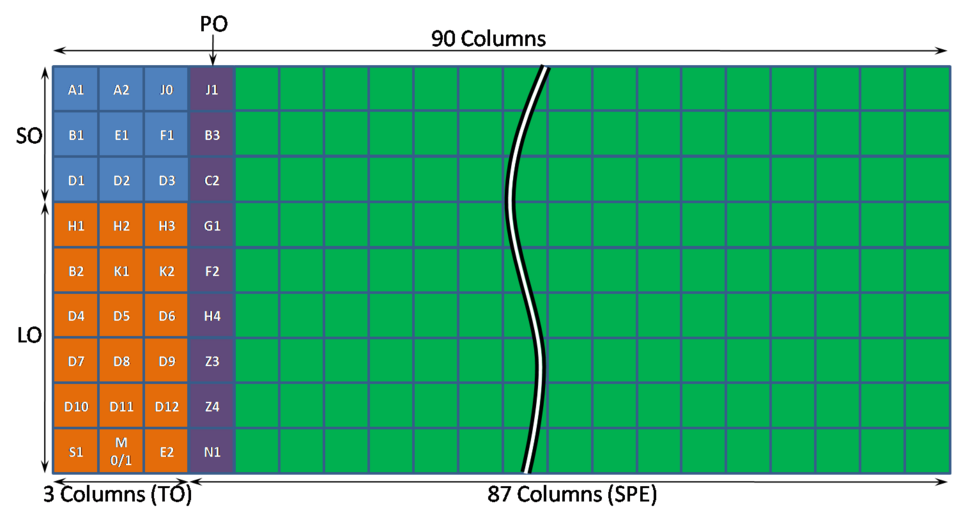 STS-1 frame with overhead and payload bytes (Image: Email4mobile, Public domain, via Wikimedia Commons)
4. Performance Comparison
| Feature | Asynchronous | Synchronous |
|---|---|---|
| Clocking | No shared clock; start/stop bits | Shared clock (embedded/derived) |
| Overhead | High (10–20% for framing) | Low (flags + FCS only) |
| Speed | Slow (max ~115 kbps for UART) | Fast (Mbps–Gbps, e.g., Ethernet) |
| Error Handling | Parity bits only | CRC (e.g., HDLC, PPP) |
| Use Cases | Low-speed devices (modems, sensors) | High-speed networks (Ethernet, USB) |
| Example | RS-232, UART | Ethernet, ATM, SONET |
5. Common Pitfalls and Errors
5.1 Timing Issues
- Bit skew: Clock drift between sender/receiver causes misaligned bits.
- Fix: Use PLLs (Phase-Locked Loops) in synchronous systems.
- Stop-bit errors: Receiver may miss the stop bit if the line is noisy.
- Fix: Increase stop-bit duration or use flow control (XON/XOFF).
5.2 Framing Errors
- Bit stuffing overflow: Too many
1s cause buffer overflow.- Fix: Use longer stuffing sequences (e.g., 6
1s → insert0).
- Fix: Use longer stuffing sequences (e.g., 6
- False flags: Data accidentally matches the flag pattern.
- Fix: Escape sequences (e.g.,
011111100for literal01111110).
- Fix: Escape sequences (e.g.,
Worked Example: Bit Stuffing Overflow
Scenario: Sending 1111111111111111 (16 1s) in HDLC.
- After 5
1s, insert a0:111110111110111110111110. - If the sender doesn’t stuff, the receiver sees
11111110(false flag) and drops the frame.
6. Exam Tip: How to Score Full Marks
Define clearly:
- Asynchronous: "Data transmission without a shared clock, using start/stop bits for framing."
- Synchronous: "Data transmission with a shared clock, using flags or sync words for framing."
Compare with a table (as above) and highlight trade-offs (speed vs. complexity).
Worked examples:
- For async: Calculate bit rate given baud rate (e.g., 9600 baud, 8N1 → 960 chars/sec).
- For sync: Draw a bit-stuffing scenario (like the one above).
Real-world tie-ins:
- Mention eSewa’s UART for async or NTC’s SONET for sync.
- Explain why Pathao uses synchronous HTTP (low latency) vs. WhatsApp’s async framing (simplicity).
Error handling:
- Async: "Parity bits detect single-bit errors but cannot correct them."
- Sync: "CRC in HDLC provides strong error detection (e.g., 16-bit CRC covers 99.99% of errors)."
Based on the PU BE Computer (PU) syllabus for Data Communication, unit 4.
Discussion
Loading…