Data CommunicationUnit 510 min read
Transmission Media & Propagation: Wires, Waves & Light
Unit 5 of Data Communication covers guided (copper/fiber) and unguided (wireless) transmission media, propagation techniques (ground/sky/LOS), signal behavior in media, and real-world deployment examples from Nepalese tech (NTC, Ncell) to global giants (Google Fiber, Starlink).
TAKEAWAYS:
- Media types: Guided (twisted pair, coaxial, fiber) vs. unguided (terrestrial/microwave/satellite) differ in bandwidth, cost, and propagation loss.
- Signal behavior: Attenuation, distortion, and noise degrade signals—fiber minimizes these via total internal reflection.
- Propagation modes: Ground waves hug Earth (AM radio), sky waves bounce off ionosphere (shortwave), LOS requires clear paths (Wi-Fi, 5G).
- Real-world tradeoffs: NTC’s fiber backbone uses fiber for long-haul (low loss) while Ncell’s 4G towers rely on LOS microwave links.
- Design rule: Choose media based on distance (copper <100m, fiber >1km, wireless >1km with LOS).
- Exam focus: Compare media properties, explain propagation techniques, and calculate attenuation (dB loss per km).
1. Transmission Media: Guided vs. Unguided
Transmission media are the physical paths that carry signals. They are classified into guided (bounded) and unguided (wireless) media.
1.1 Guided Media (Bounded)
Guided media confine signals to a path using physical conductors. They offer higher security and lower interference but are limited by distance and bandwidth.
1.2 Unguided Media (Wireless)
Unguided media transmit signals through air or space using electromagnetic waves. They enable mobility but suffer from interference and limited range.
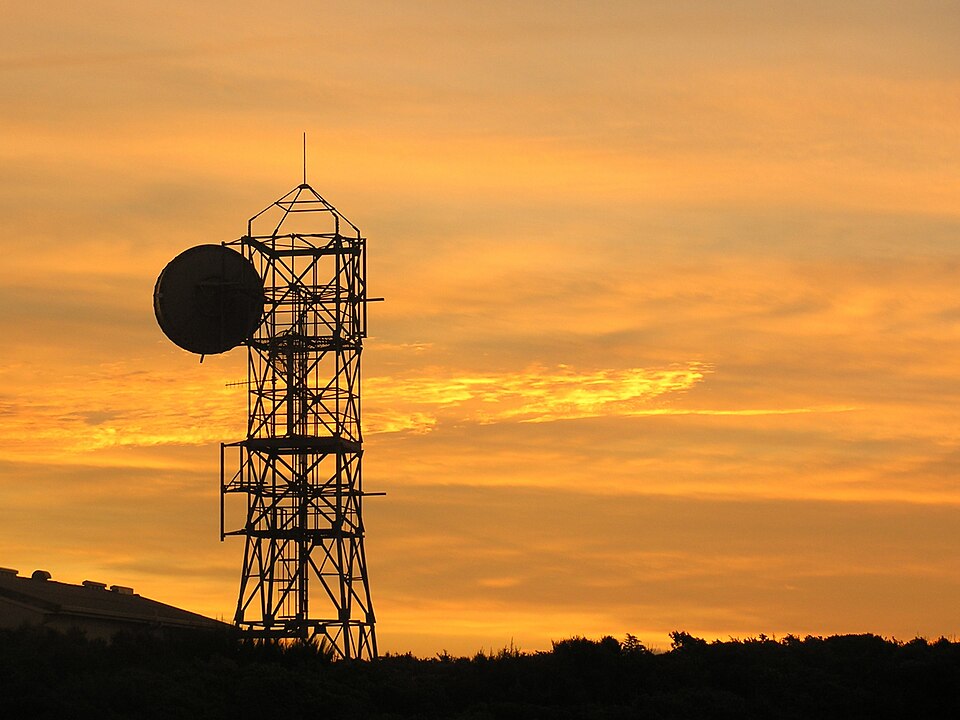 Parabolic dish with LOS path to receiver. (Image: Tony Wills, CC BY 2.5, via Wikimedia Commons)
2. Signal Behavior in Media: Attenuation, Distortion, and Noise
Transmission impairments degrade signal quality. Understanding them helps in designing robust networks.
2.1 Attenuation
Attenuation is the loss of signal strength over distance, measured in decibels (dB).
- Formula:
- Example: A signal loses 3 dB per km in copper cable. For a 5 km link: .
2.2 Distortion
Distortion occurs when different signal frequencies attenuate at different rates, causing waveform corruption.
- Types:
- Amplitude distortion: Unequal gain across frequencies.
- Phase distortion: Delay differences for different frequencies.
- Example: In a voice call, high-frequency sounds (e.g., "s") may weaken more than low frequencies, making speech unclear.
2.3 Noise
Noise is unwanted electrical signals that interfere with data transmission.
- Types:
- Thermal noise: Random electron motion (affects all media).
- Intermodulation noise: Caused by mixing signals in cables.
- Crosstalk: Signal leakage between adjacent wires (common in UTP).
- Impulse noise: Sudden spikes (e.g., lightning).
3. Propagation Techniques: How Signals Travel
Propagation techniques determine how wireless signals travel through space. Choice depends on frequency, distance, and terrain.
3.1 Ground Wave Propagation
- Mechanism: Signals travel along Earth’s surface (like AM radio).
- Frequency: 3–30 MHz (low-frequency waves).
- Range: Limited to ~100 km due to Earth’s curvature and absorption.
- Example: Nepal’s Radio Nepal (AM broadcast) uses ground waves.
3.2 Sky Wave Propagation
- Mechanism: Signals reflect off the ionosphere (a charged layer of the atmosphere).
- Frequency: 3–30 MHz (shortwave radio).
- Range: Can reach thousands of km (used for long-distance communication).
- Limitation: Unpredictable due to ionospheric variations (e.g., solar activity).
- Example: Shortwave radio broadcasts (e.g., Voice of America) reach remote areas in Nepal.
3.3 Line-of-Sight (LOS) Propagation
- Mechanism: Signals travel in a straight line (no reflection/refraction).
- Frequency: >30 MHz (microwave, satellite, Wi-Fi).
- Range: Limited by Earth’s curvature (~50 km for microwave towers).
- Example:
- Ncell’s 4G towers use LOS microwave links between repeaters.
- Wi-Fi routers require LOS for optimal signal (obstacles like walls weaken signal).
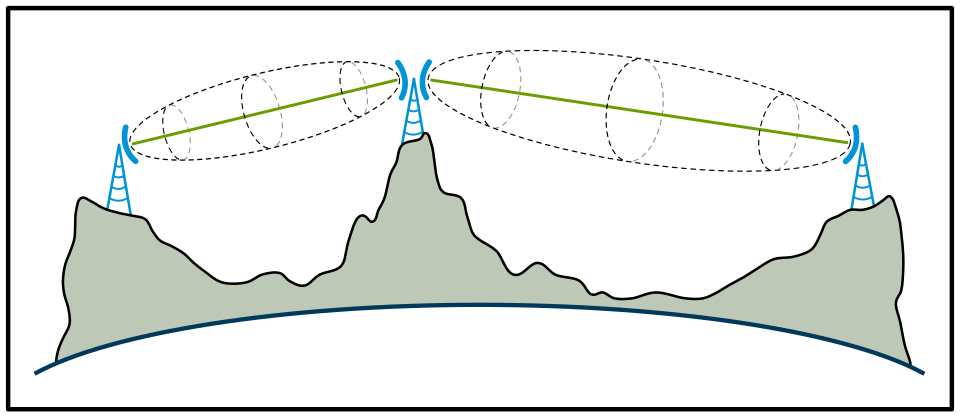 Two towers with direct beam path, blocked by hill. (Image: Micogen, CC BY-SA 3.0, via Wikimedia Commons)
3.4 Satellite Propagation
- Mechanism: Signals bounce off satellites orbiting Earth.
- Types:
- GEO (Geostationary): 36,000 km (fixed position, high latency).
- LEO (Low Earth Orbit): 500–2,000 km (low latency, e.g., Starlink).
- Example:
- Nepal’s satellite TV (e.g., CCTV-4) uses GEO satellites.
- Starlink uses LEO satellites for low-latency internet.
4. Comparing Transmission Media
| Property | Twisted Pair | Coaxial Cable | Optical Fiber | Microwave | Satellite |
|---|---|---|---|---|---|
| Bandwidth | Low (10 Mbps–10 Gbps) | Medium (500 Mbps–2 Gbps) | Very High (10 Gbps–100 Tbps) | High (100 Mbps–1 Gbps) | Medium (1–100 Mbps) |
| Distance | <100 m | <500 m | >100 km (single-mode) | 50 km (LOS) | Global (GEO/LEO) |
| Cost | Low | Medium | High | High (towers) | Very High (launch) |
| Interference | High (crosstalk) | Low | None | High (weather) | High (rain fade) |
| Use Case | Ethernet, phone lines | Cable TV, old Ethernet | Internet backbone | Ncell 4G, Wi-Fi | Nepal TV, Starlink |
5. Real-World Applications in Nepal and Globally
5.1 NTC’s Fiber-Optic Backbone
- Media: Single-mode optical fiber.
- Why fiber?:
- Low attenuation (signals travel 100+ km without repeaters).
- Immune to electromagnetic interference (unlike copper).
- Example: NTC’s Fiber-to-the-Home (FTTH) project uses fiber to provide 1 Gbps internet in Kathmandu.
5.2 Ncell’s 4G Network
- Media: Terrestrial microwave (LOS) + fiber backhaul.
- Challenge: Nepal’s hilly terrain blocks LOS.
- Solution: Ncell uses microwave repeaters on hills to extend coverage.
- Example: A 4G call from Pokhara to Kathmandu may hop through 3–4 microwave towers.
5.3 Google Fiber (USA)
- Media: Optical fiber (FTTH).
- Advantage: Symmetric upload/download speeds (1 Gbps).
- Why it matters: Nepal’s NTC is adopting similar fiber technologies.
5.4 Starlink (Global)
- Media: LEO satellite constellation.
- Propagation: LOS to satellites (no ground infrastructure needed).
- Example: Remote villages in Nepal could use Starlink for internet if deployed.
6. Worked Example: Calculating Attenuation in Copper Cable
Problem: A 100 Mbps Ethernet signal travels 80 meters over Category 5e UTP cable with attenuation of 0.2 dB/m at 100 MHz. Calculate the total attenuation.
Solution:
- Attenuation per meter = 0.2 dB/m.
- Total distance = 80 m.
- Total attenuation = .
Interpretation:
- A 16 dB loss means the signal power is reduced to ~2.5% of its original strength (since ).
- Real-world tie-in: In a Kathmandu office, if a switch is placed 80m from a router, the signal may need repeaters or higher-grade cables (e.g., Cat 6) to maintain strength.
7. Exam Tip: How to Score Full Marks
Define and differentiate:
- Always start with clear definitions (e.g., "Attenuation is the loss of signal strength...").
- Compare media in tables (e.g., bandwidth, distance, cost).
Draw diagrams:
- OSI layers (if asked about protocols).
- Signal propagation (ground wave vs. LOS).
- Fiber optic structure (core/cladding).
Apply formulas:
- Attenuation: .
- Example: "A signal loses 5 dB/km over 3 km → 15 dB total loss."
Real-world links:
- Relate to NTC fiber, Ncell towers, or WhatsApp calls (which use LOS microwave backhaul).
- Example: "Nepal’s internet relies on fiber for backbone and microwave for last-mile connectivity due to terrain."
Common pitfalls:
- Don’t confuse sky wave (ionosphere reflection) with ground wave (surface travel).
- Fiber vs. copper: Fiber has no electromagnetic interference but requires expensive connectors.
- Satellite latency: GEO satellites add 240ms delay (critical for gaming/VoIP).
8. Quick Revision Checklist
- Can you list 3 guided and 3 unguided media with one example each?
- What causes attenuation, distortion, and noise? Give one real-world effect of each.
- Draw and label the 3 propagation techniques (ground, sky, LOS).
- Why does Ncell use microwave towers instead of fiber everywhere?
- Calculate attenuation for a 5 km copper link with 4 dB/km loss.
- Compare GEO vs. LEO satellites in terms of latency and cost.
Based on the PU BE Computer (PU) syllabus for Data Communication, unit 5.
Discussion
Loading…