Computer ArchitectureUnit 48 min read
Arithmetic & Logic Operations: ALU, Flags, Overflow, Micro-ops & Binary Math
Unit 4 of Computer Architecture covers the core arithmetic and logic unit (ALU) operations, flag registers, overflow detection, micro-operations, binary arithmetic (add/subtract/multiply/divide), and how these form the basis of CPU execution—with real-world examples from banking (interest calculations), eSewa (transact
Core Concepts: ALU and Flag Registers
What is an ALU?
The Arithmetic Logic Unit (ALU) is the heart of the CPU that performs all arithmetic and logical operations. It executes instructions like:
- Arithmetic: Addition, subtraction, multiplication, division.
- Logical: AND, OR, NOT, XOR, shifts, rotates.
Flag Registers: How the CPU Knows What Happened
Flags are single-bit status indicators set by the ALU after operations. The most important flags are:
| Flag Name | Set When | Example Use Case |
|---|---|---|
| Zero Flag (Z) | Result = 0 | Loop termination (e.g., while (x != 0) in assembly). |
| Carry Flag (C) | Unsigned overflow (e.g., 8 + 9 in 8-bit). |
Detecting overflow in addition/subtraction (e.g., eSewa transaction limits). |
| Overflow Flag (V) | Signed overflow (e.g., 127 + 1 in 8-bit signed). |
Banking interest calculations (e.g., NMB loan repayment checks). |
| Sign Flag (N) | Result is negative (MSB = 1). | Pathao’s fare computation (distance-based, signed values). |
Binary Arithmetic Operations
1. Addition and Subtraction
How It Works:
- Addition: Bitwise addition with carry propagation.
Example:
5 + 3in 4-bit binary:0101 (5)
0011 (3)
1000 (8)- **Carry Flag (C)**: Set if there’s a carry out of the MSB. - **Overflow Flag (V)**: Set if signed addition exceeds representable range (e.g., `127 + 1` in 8-bit signed).
Worked Example: eSewa Transaction Limit
Suppose eSewa uses 16-bit unsigned integers for transaction amounts. If a user tries to send 65,000 (0xFF9C) to another user, but the limit is 65,535 (0xFFFF), the ALU will set the Carry Flag (C) to indicate overflow.
# Pseudocode for eSewa's overflow check
amount = 0xFF9C  # 65,000
limit = 0xFFFF    # 65,535
if (amount + 1) < amount:  # Check for unsigned overflow
    print("Transaction exceeds limit!")  # C flag is set
Subtraction:
- Borrow Flag: Used in subtraction (similar to carry in addition).
- Two’s Complement: Subtraction is done by adding the negative (e.g.,
A - B = A + (-B)).
2. Multiplication and Division
Multiplication:
- Hardware Method: Shift-and-add (e.g.,
5 * 3 = 5 << 1 + 5). - Flags Affected: Zero Flag (Z), Overflow Flag (V).
- Example: Multiply
6 (0110)by3 (0011):0110 (6) × 0011 (3) -------- 0000 (0) 0110 (6) 1100 (12) -------- 1110 (14)
Division:
- Hardware Method: Repeated subtraction (shift-and-subtract).
- Flags Affected: Zero Flag (Z), Overflow Flag (V) if remainder is non-zero.
- Example: Divide
14 (01110)by3 (0011):14 ÷ 3 = 4 with remainder 2
Logic Operations
The ALU also performs bitwise logical operations:
| Operation | Symbol | Example (A=5, B=3) | Use Case |
|---|---|---|---|
| AND | & |
0101 & 0011 = 0001 |
Masking bits (e.g., Pathao’s route flags). |
| OR | ` | ` | `0101 |
| XOR | ^ |
0101 ^ 0011 = 0110 |
Error detection (e.g., WhatsApp message integrity). |
| NOT | ~ |
~0101 = 1010 |
Inverting bits (e.g., Daraz’s stock availability toggles). |
| Shift Left | << |
0101 << 1 = 1010 |
Fast multiplication (e.g., NEPSE’s volume scaling). |
| Shift Right | >> |
0101 >> 1 = 0010 |
Fast division (e.g., Khalti’s fee reduction). |
Micro-operations and Register Transfers
What Are Micro-operations?
Micro-operations (μ-ops) are the smallest low-level operations performed by the ALU. Examples:
- Arithmetic μ-ops:
ADD,SUB,INC,DEC. - Logical μ-ops:
AND,OR,NOT,XOR. - Shift μ-ops:
SHL,SHR,ROL,ROR.
Register Transfer Notation (RTN)
RTN describes how data moves between registers and the ALU. Example:
- Addition:
A ← A + B(Add contents of B to A, store result in A). - Subtraction:
C ← B - A(Subtract A from B, store in C).
Overflow Detection
Types of Overflow:
- Unsigned Overflow: Occurs when the result exceeds the maximum representable value (e.g.,
255 + 1in 8-bit unsigned).- Detected by: Carry Flag (C).
- Signed Overflow: Occurs when the result exceeds the signed range (e.g.,
127 + 1in 8-bit signed).- Detected by: Overflow Flag (V).
Worked Example: NMB Loan Interest Calculation
Suppose NMB calculates monthly interest on a loan using 32-bit signed integers. If the principal is 2,147,483,647 (0x7FFFFFFF) and the interest rate is 1%, the calculation:
New Amount = Principal + (Principal * 0.01)
           = 2,147,483,647 + 21,474,836.47
           = 2,168,958,483.47
- Problem:
2,147,483,647 + 21,474,836exceeds the 32-bit signed limit (2,147,483,647). - Solution: The ALU sets the Overflow Flag (V), and the bank’s software must handle this gracefully (e.g., switch to floating-point or cap the amount).
Real-World Applications
1. eSewa: Transaction Validation
- Idea Used: Overflow Detection (Carry Flag).
- How: eSewa uses 32-bit unsigned integers for transaction amounts. If a user tries to send 4,294,967,295 (0xFFFFFFFF) to another user, the ALU’s Carry Flag (C) is set when adding to the recipient’s balance, triggering a "Transaction Limit Exceeded" error.
2. Pathao: Distance-Based Fare Calculation
- Idea Used: Signed Arithmetic and Overflow.
- How: Pathao calculates fares using signed integers for distance (e.g.,
-100to100meters). If the distance exceeds the representable range (e.g.,32,767meters in 16-bit signed), the Overflow Flag (V) is set, and the app displays an error ("Distance too long").
3. NMB Bank: Loan Repayment Checks
- Idea Used: Signed Overflow and Division.
- How: When calculating monthly installments, NMB uses 64-bit integers to avoid overflow. If a user’s repayment exceeds the loan amount due to rounding errors in division, the Zero Flag (Z) or Overflow Flag (V) helps detect and correct the discrepancy.
Exam Tip: How to Score Full Marks
- Define Clearly: Always start with definitions (e.g., "The ALU is the component that performs arithmetic and logical operations...").
- Use RTN: For questions on register transfers, write operations in Register Transfer Notation (e.g.,
A ← A + B). - Flag Examples: For overflow/carry questions, always give a numerical example (e.g., "In 8-bit signed arithmetic,
127 + 1sets the Overflow Flag"). - Real-World Tie: Link concepts to eSewa, Pathao, or banking (e.g., "The Carry Flag is used in eSewa to detect transaction limits").
- Diagrams: Draw ALU block diagrams or flag register tables to visualize operations.
- Common Pitfalls:
- Don’t confuse unsigned overflow (Carry Flag) with signed overflow (Overflow Flag).
- Always check if the question asks for 8-bit, 16-bit, or 32-bit operations (affects overflow behavior).
- For micro-operations, specify whether it’s arithmetic or logical.
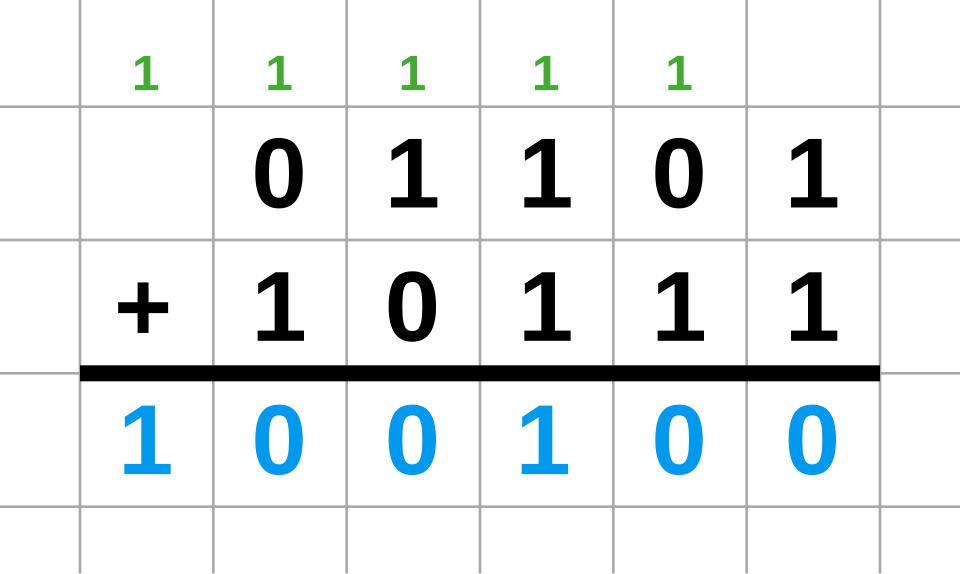 Step-by-step binary addition showing carry propagation. (Image: Phlsph7, CC0, via Wikimedia Commons)
Based on the PU BE Computer (PU) syllabus for Computer Architecture, unit 4.
Discussion
Loading…