Computer NetworksUnit 513 min read
Medium Access Control: Methods, Protocols & Performance
Unit 5 of Computer Networks explores how devices share a communication medium efficiently, covering contention-based (CSMA/CD, CSMA/CA), controlled access (polling, token passing), and channelization methods (FDMA, TDMA, CDMA). It analyzes real-world trade-offs in latency, throughput, and fairness using examples from W
TAKEAWAYS:
- Contention vs. Controlled Access: CSMA/CD (Ethernet) and CSMA/CA (Wi-Fi) resolve collisions differently, while polling and token passing enforce strict turn-taking.
- Channel Partitioning: FDMA, TDMA, and CDMA divide bandwidth by frequency, time, or code—each suited to specific scenarios (e.g., GSM vs. 5G).
- Performance Metrics: Throughput, delay, and fairness are quantified via formulas (e.g., for slotted ALOHA).
- Real-World Impact: MAC protocols directly affect app responsiveness (e.g., Pathao’s ride-matching latency or Ncell’s call setup time).
- Error Handling: CRC and acknowledgments (ACK/NACK) ensure data integrity in noisy environments like Kathmandu’s crowded 4G networks.
- Trade-offs: No single MAC method is optimal—choices depend on cost, scalability, and medium characteristics (wired vs. wireless).
1. Why Medium Access Control (MAC)?
MAC protocols regulate how devices access a shared communication channel to avoid collisions and maximize efficiency. Without MAC, devices would transmit simultaneously, leading to data loss—a problem familiar to anyone who’s experienced Wi-Fi dead zones or dropped calls on Ncell.
Key Challenges in MAC Design
mindmap
root((MAC Challenges))
Collision
"Devices transmit simultaneously → Data loss"
Fairness
"Some devices hog bandwidth (e.g., a single Daraz server overwhelming others)"
Efficiency
"Minimize idle time (e.g., empty time slots in TDMA)"
Scalability
"Works for 2 devices (e.g., home Wi-Fi) or 10,000 (e.g., NEPSE trading floor)"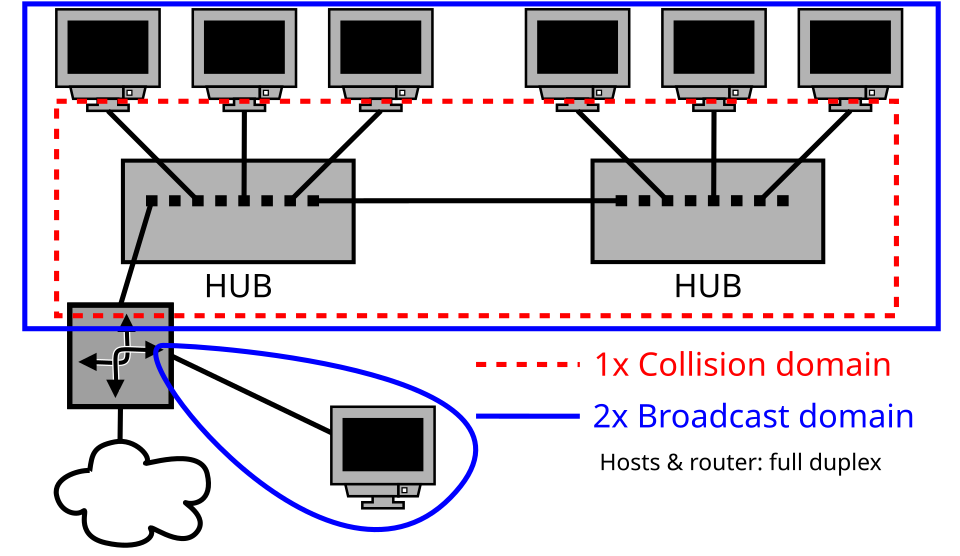 Collisions occur when two devices transmit at once in a shared medium (e.g., old 10 Mbps Ethernet). (Image: Mattias.Campe, CC BY-SA 4.0, via Wikimedia Commons)
2. Contention-Based MAC Protocols
Devices compete for the channel without a central coordinator. Used in Ethernet (CSMA/CD) and Wi-Fi (CSMA/CA).
A. Pure ALOHA and Slotted ALOHA
- Pure ALOHA: Devices transmit anytime; collisions occur if two frames overlap.
- Throughput: (max 18.4% efficiency).
- Example: Early packet radio networks (predecessor to modern IoT).
- Slotted ALOHA: Time divided into slots; transmissions start only at slot boundaries.
- Throughput: (max 36.8% efficiency).
- Worked Example: Suppose 10 devices share a channel with (average 0.5 transmissions/slot). Throughput (30.3% efficiency).
sequenceDiagram
    participant Device1
    participant Device2
    participant Channel
    Device1->>Channel: Transmit (Slot 1)
    Device2->>Channel: Transmit (Slot 1)  # Collision
    Channel-->>Device1: Collision detected
    Channel-->>Device2: Collision detected
    Device1->>Channel: Backoff (random delay)
    Device2->>Channel: Backoff (random delay)
B. CSMA (Carrier Sense Multiple Access)
Devices listen before transmitting to avoid collisions.
- 1-Persistent CSMA: If channel is idle, transmit immediately.
- Non-Persistent CSMA: If busy, wait a random time before retrying.
- p-Persistent CSMA: If idle, transmit with probability ; else wait a slot.
| Feature | CSMA/CD (Ethernet) | CSMA/CA (Wi-Fi) |
|---|---|---|
| Medium | Wired (bus/topology) | Wireless (shared air) |
| Collision Handling | Detects collision → JAM signal | Avoids collision via RTS/CTS |
| Backoff Algorithm | Binary exponential backoff | DIFS/SIFS + random backoff |
| Example | Old 10BASE2 Ethernet | IEEE 802.11 (Wi-Fi) |
C. CSMA/CD (Carrier Sense with Collision Detection)
Used in Ethernet (IEEE 802.3).
- Listen: Sense if channel is idle.
- Transmit: If idle, send data.
- Collision Detection: If two devices transmit simultaneously, detect collision via voltage spikes.
- Backoff: Wait bit times (exponential backoff), then retry.
Worked Example: Ethernet Collision
- Two devices (A and B) transmit at the same time.
- Collision detected after 64 bytes (minimum frame size).
- Both stop transmitting, send a JAM signal, and wait bit times before retrying.
sequenceDiagram
    participant A
    participant B
    participant Channel
    A->>Channel: Transmit Frame
    B->>Channel: Transmit Frame  # Collision
    Channel-->>A: Collision detected
    Channel-->>B: Collision detected
    A->>Channel: JAM signal
    B->>Channel: JAM signal
    A->>Channel: Backoff (e.g., 1024 bit times)
    B->>Channel: Backoff (e.g., 1024 bit times)
Why 64-byte minimum frame?
- Ensures collision detection before transmission completes.
- Formula: bytes (for 10 Mbps Ethernet).
3. Controlled Access MAC Protocols
A central authority or token controls access to prevent collisions.
A. Polling
- A central controller (e.g., hub, switch) polls each device in turn.
- Pros: Simple, no collisions.
- Cons: Inefficient if many devices have little data (e.g., NTC’s old telephone switching systems).
sequenceDiagram
    participant Controller
    participant Device1
    participant Device2
    Controller->>Device1: Poll (Request to send)
    Device1->>Controller: Data (if any)
    Controller->>Device2: Poll
    Device2->>Controller: Data
B. Token Passing
- A token circulates among devices.
- Only the device holding the token can transmit.
- Used in Token Ring (IEEE 802.5) and FDDI.
Example: Token Ring Network
- Devices connected in a ring; token passes sequentially.
- If a device has data, it holds the token until transmission completes.
- Failure Handling: If token is lost, a monitor station regenerates it.
stateDiagram-v2
    [*] --> Idle
    Idle --> TokenSent: Token passed to next device
    TokenSent --> DataTransmit: Device has data
    DataTransmit --> TokenSent: Transmission complete
    TokenSent --> [*]: Token circulates
4. Channel Partitioning MAC Protocols
The channel is divided among users to avoid contention.
A. Frequency Division Multiple Access (FDMA)
- Channel divided by frequency (e.g., FM radio, GSM).
- Each user gets a fixed frequency band.
- Example: GSM cellular networks assign a unique frequency to each call.
B. Time Division Multiple Access (TDMA)
- Channel divided by time slots (e.g., GSM, digital TV).
- Each user gets a time slot in a repeating frame.
- Example: Ncell’s 4G network uses TDMA to assign slots to multiple users.
Worked Example: TDMA in GSM
- A 200 kHz channel is divided into 8 time slots.
- Each slot carries 22.8 kbps → Total bandwidth = 183.2 kbps.
- If 4 users share the channel, each gets 45.6 kbps.
C. Code Division Multiple Access (CDMA)
- Users share the same frequency and time but use unique codes (e.g., 5G, GPS).
- Spread Spectrum: Signal is spread over a wide bandwidth using a pseudo-noise (PN) code.
- Example: Ncell’s 5G uses CDMA to allow multiple users simultaneously.
Comparison Table: FDMA vs. TDMA vs. CDMA
| Feature | FDMA | TDMA | CDMA |
|---|---|---|---|
| Division | Frequency | Time | Code |
| Example | GSM (2G), FM Radio | GSM (2G), Digital TV | 5G, GPS |
| Flexibility | Low (fixed bandwidth) | Medium (dynamic slots) | High (multiple users) |
| Interference | High (adjacent channel) | Low (time-separated) | Low (code-separated) |
| Complexity | Low | Medium | High (spread spectrum) |
5. Random Access vs. Controlled Access vs. Channel Partitioning
classDiagram
    class MACProtocol {
        <<abstract>>
        +accessMethod()
    }
    class ContentionBased {
        +collisionHandling()
    }
    class ControlledAccess {
        +centralCoordination()
    }
    class ChannelPartitioning {
        +resourceDivision()
    }
    MACProtocol <|-- ContentionBased
    MACProtocol <|-- ControlledAccess
    MACProtocol <|-- ChannelPartitioning
    ContentionBased : +ALOHA, CSMA/CD, CSMA/CA
    ControlledAccess : +Polling, Token Passing
    ChannelPartitioning : +FDMA, TDMA, CDMA
In the Real World
Pathao’s Ride-Matching Latency
- Uses CSMA/CA-like contention in its backend servers to assign drivers to requests.
- If two servers try to assign the same driver simultaneously, a collision avoidance mechanism (similar to RTS/CTS in Wi-Fi) resolves it.
- Impact: Faster matching = happier users.
Ncell’s 4G/5G Networks
- TDMA in 4G: Time slots are dynamically allocated to users based on demand (e.g., during peak hours in Kathmandu).
- CDMA in 5G: Allows multiple users to share the same spectrum without interference, improving capacity in crowded areas like Thamel.
- Example: During a concert, Ncell’s 5G CDMA ensures smooth streaming for thousands simultaneously.
Daraz’s Order Fulfillment Queue
- Token Passing Analogy: Orders are processed in a "tokenized" sequence (like a token ring) to ensure fairness.
- FDMA-like Partitioning: High-priority orders (e.g., same-day delivery) get dedicated "frequency bands" (server resources).
Khalti’s Payment Processing
- Uses CSMA/CD-like contention in its microservices to handle simultaneous transactions.
- If two users pay at the exact same millisecond, Khalti’s backend detects the "collision" and retries with backoff.
NTC’s Fiber-Optic Backbone
- WDM (Wavelength Division Multiplexing): A type of FDMA where multiple signals are sent over different wavelengths in a single fiber.
- Example: NTC’s fiber links between Kathmandu and Pokhara use WDM to carry voice, internet, and TV signals simultaneously.
Exam Tip
What Examiners Look For
Definitions with Examples
- Always pair definitions with real-world systems (e.g., "CSMA/CD is used in Ethernet; CSMA/CA in Wi-Fi").
- Example Answer:
"CSMA/CD is a contention-based protocol where devices listen before transmitting. If a collision occurs (e.g., two laptops on a shared Ethernet hub), a JAM signal is sent, and devices wait bit times before retrying."
Performance Metrics
- Memorize formulas for throughput (ALOHA, CSMA) and delay.
- Example:
"For slotted ALOHA with , throughput or 27.6%."
Diagrams and Traces
- Draw sequence diagrams for handshakes (e.g., RTS/CTS in CSMA/CA).
- Show timeline diagrams for TDMA/FDMA.
- Example Question: "Explain the RTS/CTS handshake in CSMA/CA with a diagram."
sequenceDiagram
    participant Sender
    participant Receiver
    participant Channel
    Sender->>Channel: RTS (Request to Send)
    Receiver->>Channel: CTS (Clear to Send)
    Sender->>Channel: Data
    Receiver->>Channel: ACK
Comparison Tables
- Compare CSMA/CD vs. CSMA/CA, FDMA vs. TDMA vs. CDMA, or polling vs. token passing.
- Example Table:
Protocol Collision Handling Medium Example CSMA/CD JAM signal Wired Ethernet CSMA/CA RTS/CTS Wireless Wi-Fi Token Passing Token rotation Ring Token Ring
Worked Numerical Problems
- Solve for throughput, delay, or backoff time.
- Example:
"In a CSMA/CD network with 10 Mbps bandwidth and 200 m cable, what is the minimum frame size to detect collisions within 51.2 µs?" Solution: (Note: Real Ethernet uses 64 bytes for safety margin.)
Real-World Applications
- Link concepts to Nepali tech (e.g., "Ncell’s 5G uses CDMA to handle 10,000 users in a stadium").
- Avoid vague answers like "used in networks"; specify the exact protocol/system.
Common Mistakes to Avoid
- Ignoring the Medium: CSMA/CD is for wired networks; CSMA/CA is for wireless. Always state which applies.
- Forgetting Backoff: In CSMA/CD, backoff is exponential ( bit times).
- Mixing FDMA/TDMA/CDMA: FDMA divides by frequency, TDMA by time, CDMA by code.
- Skipping Units: Always include units in calculations (e.g., "throughput in frames/sec").
Quick Revision Checklist
- Can you draw a CSMA/CD collision scenario?
- Do you know the throughput formula for ALOHA?
- Can you compare polling vs. token passing in a table?
- Can you explain how TDMA works in GSM?
- Can you relate CDMA to 5G in Nepal?
- Can you calculate minimum frame size for Ethernet?
Based on the PU BE Computer (PU) syllabus for Computer Networks, unit 5.
Discussion
Loading…