Network and Cyber SecurityUnit 611 min read
IPsec & TLS: Protocols Securing Data in Transit
Unit 6 of Network and Cyber Security explores IPsec (securing IP packets) and TLS (securing web traffic), covering their architectures, modes, handshakes, and real-world deployment in banking, e-commerce, and VPNs—with visuals of packet formats, protocol flows, and hardware.
TAKEAWAYS:
- IPsec operates at the network layer (Layer 3) using AH (Authentication Header) and ESP (Encapsulating Security Payload) to secure IP packets end-to-end.
- TLS (Transport Layer Security) works at Layer 4/5 (transport/application) and replaces SSL, using symmetric encryption (AES) for bulk data and asymmetric (RSA/ECC) for key exchange.
- IPsec modes: Transport (secures payload only) vs. Tunnel (secures entire packet, used in VPNs).
- TLS handshake: ClientHello → ServerHello → Certificate exchange → Key derivation → Symmetric session setup.
- Real-world use: Ncell’s VPN uses IPsec for secure remote access; eSewa’s HTTPS uses TLS for payment data protection.
- Exam focus: Compare IPsec vs. TLS layers, trace a TLS handshake, and explain how ESP provides confidentiality + integrity.
Core Concepts: IPsec and TLS
1. IPsec (Internet Protocol Security)
IPsec is a suite of protocols designed to secure IPv4/IPv6 communications by authenticating and encrypting packets. It operates at the network layer (Layer 3) and is widely used in VPNs, remote access, and site-to-site encryption.
Key Components of IPsec
IPsec consists of two primary protocols:
- Authentication Header (AH): Provides data integrity and authentication (via HMAC) but no confidentiality.
- Encapsulating Security Payload (ESP): Provides confidentiality (encryption), integrity, and optional authentication. ESP is more commonly used than AH.
IPsec Modes
IPsec operates in two modes, each with distinct use cases:
Transport Mode:
- Secures only the payload (upper-layer data).
- Original IP header remains unencrypted.
- Used for host-to-host communication (e.g., secure email between servers).
- Example: Secure communication between a bank’s database server and a client application.
Tunnel Mode:
- Secures the entire IP packet (original header + payload).
- A new IP header is added for routing.
- Used in VPNs (e.g., Ncell’s secure remote access for employees).
- Example: A user connecting to a corporate network via a VPN uses tunnel mode to encrypt all traffic between their device and the VPN gateway.
IPsec Security Associations (SA)
- An SA is a unilateral relationship between two entities (e.g., a client and server) that defines:
- Security parameters (algorithm, keys, mode).
- Lifetime of the SA (keys must be refreshed periodically).
- Two SAs are required for full security:
- Outbound SA: For data sent from the initiator.
- Inbound SA: For data received by the responder.
IPsec Packet Format (ESP)
- ESP Header:
- Security Parameters Index (SPI): Identifies the SA.
- Sequence Number: Prevents replay attacks.
- Payload Data: Encrypted data (e.g., using AES).
- ESP Trailer:
- Padding: Ensures block cipher alignment.
- Pad Length: Indicates padding size.
- Next Header: Identifies the original protocol (e.g., TCP, UDP).
- Integrity Check Value (ICV): HMAC for integrity.
IPsec Protocols
Internet Key Exchange (IKE):
- Used to negotiate and establish SAs.
- Operates in two phases:
- Phase 1: Establishes a secure channel (ISAKMP).
- Phase 2: Negotiates IPsec SAs for data transfer.
- Example: When you connect to a VPN, IKE negotiates the encryption keys before data is sent.
Internet Security Association and Key Management Protocol (ISAKMP):
- Framework for key exchange and SA management.
Advantages and Disadvantages of IPsec
| Advantages | Disadvantages |
|---|---|
| Works at network layer (transparent to apps). | Complex setup (requires manual SA configuration). |
| Supports both IPv4 and IPv6. | Performance overhead (encryption/decryption). |
| Used in VPNs and site-to-site security. | No built-in key management (relies on IKE). |
| Provides confidentiality, integrity, and authentication. | Not widely used for web traffic (TLS dominates). |
Worked Example: IPsec in a VPN
Scenario: A company in Kathmandu allows remote employees to access internal resources securely using a VPN.
- Employee’s device initiates an IKE handshake with the VPN gateway.
- Phase 1 establishes a secure channel (e.g., using AES-256 and SHA-256).
- Phase 2 negotiates an ESP SA for data transfer.
- All traffic between the employee and the company network is encrypted in tunnel mode.
- The original IP header is hidden, and a new header is added for routing.
Visual:
2. TLS (Transport Layer Security)
TLS is the successor to SSL and is used to secure web traffic (HTTPS), email (SMTPS), and other application-layer protocols. It operates at Layer 4 (Transport) or Layer 5 (Application) and is application-aware (unlike IPsec).
TLS Architecture
TLS provides:
- Server authentication (via digital certificates).
- Client authentication (optional, e.g., client certificates).
- Encrypted communication (symmetric encryption for bulk data).
- Data integrity (via HMAC).
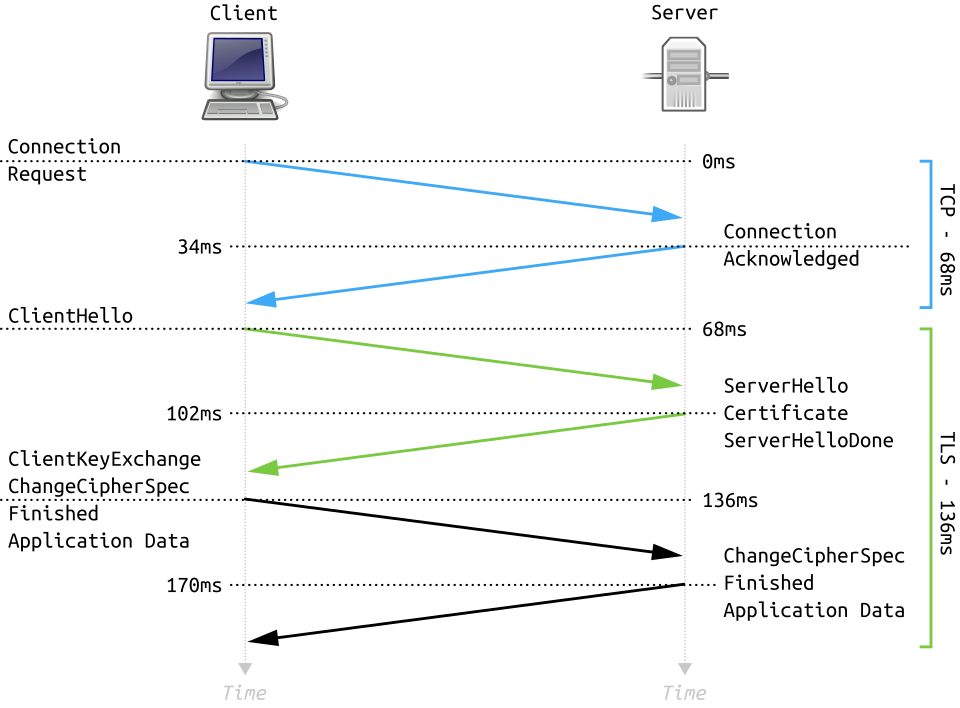
TLS Handshake Process
The TLS handshake establishes a secure session between a client and server. Here’s a step-by-step trace:
sequenceDiagram
    participant Client
    participant Server
    Client->>Server: ClientHello (supported cipher suites, TLS version)
    Server->>Client: ServerHello (selected cipher suite, TLS version)
    Server->>Client: Certificate (server’s public key + CA signature)
    Server->>Client: ServerKeyExchange (if needed, e.g., DH/ECDHE)
    Server->>Client: ServerHelloDone
    Client->>Server: ClientKeyExchange (pre-master secret, encrypted with server’s public key)
    Client->>Server: ChangeCipherSpec
    Client->>Server: Finished (MAC of all handshake messages)
    Server->>Client: ChangeCipherSpec
    Server->>Client: Finished (MAC of all handshake messages)
    Note over Client,Server: Symmetric session keys derived and used for encryption
Key Steps:
- ClientHello: Client sends supported cipher suites (e.g., TLS_ECDHE_RSA_WITH_AES_256_GCM_SHA384) and TLS version.
- ServerHello: Server selects a cipher suite and sends its digital certificate (containing its public key).
- Key Exchange:
- If using RSA, the client encrypts a pre-master secret with the server’s public key.
- If using Ephemeral Diffie-Hellman (DHE/ECDHE), the client and server compute a shared secret without transmitting private keys.
- Finished Messages: Both sides send a MAC of all handshake messages to verify integrity.
- Session Establishment: Symmetric keys (e.g., AES-256) are derived for encryption.
TLS Record Protocol
After the handshake, TLS uses the TLS Record Protocol to:
- Fragment data into records.
- Compress (optional) data.
- Encrypt data using the symmetric key.
- Add MAC for integrity.
TLS Cipher Suites
A cipher suite defines:
- Key exchange algorithm (RSA, DHE, ECDHE).
- Symmetric encryption (AES, ChaCha20).
- MAC algorithm (SHA-256, SHA-384).
- Example:
TLS_AES_256_GCM_SHA384uses AES-256-GCM for encryption and SHA-384 for MAC.
TLS vs. IPsec: Key Differences
| Feature | IPsec | TLS |
|---|---|---|
| Layer | Network (Layer 3) | Transport (Layer 4) / Application (Layer 5) |
| Scope | End-to-end or VPN | Application-specific (e.g., HTTPS) |
| Key Exchange | IKE (pre-shared keys or PKI) | RSA, DHE, ECDHE (PKI or ephemeral) |
| Use Case | VPNs, site-to-site security | Web (HTTPS), email (SMTPS), APIs |
| Transparency | Transparent to applications | Requires app support (e.g., HTTPS) |
| Performance | Higher overhead (per-packet processing) | Optimized for application data streams |
Worked Example: TLS in eSewa Payments
Scenario: A user in Nepal makes a payment via eSewa’s website.
- The user’s browser sends a ClientHello to
https://esewa.com.np. - The server responds with its TLS certificate (issued by a trusted CA like Sectigo).
- The browser verifies the certificate and performs a key exchange (e.g., ECDHE).
- A symmetric session key (e.g., AES-256) is established.
- All subsequent data (login credentials, payment details) is encrypted and sent over HTTPS.
Visual:
## In the real world
Ncell’s VPN Service:
- Uses IPsec in tunnel mode to secure remote access for employees.
- How: IKE negotiates SAs, and ESP encrypts all traffic between the user’s device and Ncell’s network.
eSewa’s HTTPS (TLS):
- Secures payment data (card numbers, UPI IDs) during transactions.
- How: TLS 1.3 with ECDHE key exchange and AES-256-GCM ensures confidentiality and integrity.
Daraz’s Order Processing:
- Uses TLS for secure API calls between the Daraz website and its backend servers.
- How: JSON payloads (e.g., order details) are encrypted during transit to prevent MITM attacks.
Nepal Rastra Bank’s SWIFT Communications:
- Uses IPsec for site-to-site encryption between banks to secure SWIFT messages.
- How: Tunnel mode IPsec encrypts entire SWIFT packets between bank networks.
## Exam Tip
Compare IPsec and TLS:
- Layer: IPsec (Layer 3), TLS (Layer 4/5).
- Use Case: IPsec for VPNs/networks, TLS for apps/web.
- Key Exchange: IPsec uses IKE, TLS uses RSA/DHE/ECDHE.
Trace a TLS Handshake:
- Memorize the 6-step process (ClientHello → ServerHello → Certificate → KeyExchange → Finished).
- Know the difference between RSA and ECDHE key exchange.
IPsec Modes:
- Transport mode = payload only (end-to-end).
- Tunnel mode = entire packet (VPNs).
Packet Formats:
- Draw ESP header/trailer and label fields (SPI, Sequence Number, ICV).
- For TLS, sketch the record protocol layers (fragmentation → compression → encryption → MAC).
Real-World Applications:
- Link IPsec to VPNs (Ncell, corporate networks).
- Link TLS to HTTPS (eSewa, Daraz, banks).
Common Pitfalls:
- AH vs. ESP: AH provides integrity/authentication only; ESP provides confidentiality + integrity.
- TLS 1.2 vs. 1.3: 1.3 removes RSA key exchange and session resumption is simplified.
- IPsec SA: Always remember two SAs (inbound and outbound) are needed.
Visual Summary:
Based on the PU BE Computer (PU) syllabus for Network and Cyber Security (CMP426), unit 6.
Discussion
Loading…