Mathematics IIUnit 89 min read
Parametric & Implicit Differentiation – definitions, techniques, and applications
Unit 8 of Mathematics II introduces parametric equations, implicit differentiation, and related derivative formulas, with worked examples, visual graphs, real‑world uses, and exam strategies for BCA students.
Key points
- Convert parametric equations to \(\dfrac{dy}{dx}\) using \(\dfrac{dy/dt}{dx/dt}\).
- Implicit differentiation treats \(y\) as a function of \(x\) even when it cannot be isolated.
- Higher‑order derivatives for parametric and implicit forms follow systematic rules.
- Applications include motion trajectories, economics curves, and engineering design.
- Common pitfalls: forgetting \(\dfrac{dx}{dt}\neq0\) and mis‑applying product/chain rules.
1. Parametric Equations – basic concepts
A parametric representation expresses the coordinates of a curve as functions of a third variable (the parameter), usually denoted :
The curve is traced as varies over the interval . Typical parameters are time, angle, or any convenient quantity.
Key properties
| Property | Description |
|---|---|
| Domain | Set of admissible values where both and are defined. |
| Elimination | If possible, eliminate to obtain an explicit or implicit Cartesian equation. |
| Orientation | Direction of motion is given by increasing . |
| Speed | . |
2. Derivative of a parametric curve
For a differentiable parametric curve, the slope of the tangent at a point is
Second derivative (useful for curvature, concavity):
3. Worked Example – Projectile motion (real‑world link)
A ball is thrown from ground level with initial speed at an angle above the horizontal. Ignoring air resistance, its motion can be described parametrically (time in seconds):
Step‑by‑step derivative
Compute .
Compute .
Tangent slope:
At the apex ( s): The tangent is horizontal, confirming the apex.
Second derivative (concavity):
Figure 1 – Parametric trajectory of the projectile (units in metres).
Real‑world connection – Mobile payment apps like eSewa and Khalti calculate transaction fees based on a piecewise linear function of the amount; the slope of each piece is a derivative of a parametric cost‑vs‑time curve used for dynamic pricing.
4. Implicit Differentiation – basic idea
When a curve is given by an equation that cannot be solved for explicitly, we differentiate both sides with respect to , treating as an implicit function . Apply the chain rule:
Higher‑order derivatives follow by differentiating again, always remembering is itself a function of and .
5. Worked Example – Folium of Descartes
The curve (with ) is a classic implicit curve. Find at the point .
Differentiate implicitly:
Collect :
Factor:
Solve:
Substitute : The expression is indeterminate; we must apply L’Hôpital’s rule on the original derivative expression or simplify before substitution. Simplify numerator and denominator:
At both numerator and denominator vanish; differentiate numerator and denominator with respect to (treating as a function of ):
Numerator derivative: .
Denominator derivative: .Set
Solve for at :
Thus the tangent at has slope 1 (45° line).
Figure 2 – Folium of Descartes near with tangent slope 1.
Real‑world connection – The NEPSE stock‑price chart often exhibits implicit relationships between price and volume (e.g., ). Traders use implicit differentiation to compute instantaneous price sensitivity to volume changes.
6. Comparison of Parametric vs. Implicit Methods
flowchart LR
    A["Start with curve description"]
    B["Parametric: have x(t), y(t)"] --> C["Compute dy/dx = (dy/dt)/(dx/dt)"]
    D["Implicit: have F(x,y)=0"] --> E["Differentiate: F_x + F_y·dy/dx = 0"]
    C --> F["Higher‑order: differentiate again w.r.t t"]
    E --> G["Higher‑order: differentiate again w.r.t x"]
    F --> H["Use for motion, engineering"]
    G --> I["Use for economics, geometry"]
    A --> B
A --> D| Aspect | Parametric | Implicit |
|---|---|---|
| Given | Explicit functions of a parameter | Equation involving both variables |
| First derivative | ||
| When to prefer | Motion problems, curves traced by time/angle | Curves not easily solved for (e.g., circles, ellipses) |
| Potential difficulty | Division by zero if | Solving (vertical tangents) |
7. Applications
| Application | How the technique is used |
|---|---|
| Projectile & orbital mechanics (e.g., rockets) | Parametric equations give position vs. time; derivatives give velocity & acceleration. |
| Economics – cost‑revenue curves | Implicit differentiation yields marginal cost when revenue and cost are linked by a constraint. |
| Computer graphics | Parametric Bézier curves are differentiated to compute normals for shading. |
| Signal processing | Implicit relations between amplitude and frequency lead to derivative‑based sensitivity analysis. |
| Civil engineering – road design | Curvature of a road defined implicitly (e.g., ) requires implicit differentiation to find banking angles. |
8. Worked Example – Bézier curve tangent (graphics)
A quadratic Bézier curve with control points , , is defined parametrically:
Extract components:
Derivative: Tangent slope:
At (mid‑curve): The curve is horizontal at its apex, a property used by YouTube to smooth thumbnail transitions (the curve controls animation easing).
Figure 3 – Quadratic Bézier curve with tangent slope zero at the midpoint.
9. Common Mistakes & How to Avoid
- Dividing by zero – Always check that (parametric) or (implicit) before applying the formula.
- Forgetting the chain rule – When differentiating terms like , write .
- Mixing variables – Keep separate from and ; do not substitute prematurely.
- Incorrect second derivative – Remember the outer derivative is with respect to the original independent variable (t for parametric, x for implicit).
10. In the real world
- eSewa uses a parametric cost‑vs‑transaction‑time curve to adjust service fees during peak hours; the derivative tells the system how fast the fee should increase.
- Daraz order‑processing queue can be modeled by an implicit relation between order size and waiting time : . Implicit differentiation gives , helping the logistics team predict how a larger batch will affect delivery time.
- Google Maps computes the curvature of a road segment defined implicitly by (a circular arc). Implicit differentiation yields the steering angle needed for navigation instructions.
11. Exam tip
- Identify the form: If the problem gives → use . If it gives → differentiate implicitly and solve for .
- Write down and (or ) first; this prevents algebraic slips.
- Check for vertical/horizontal tangents by testing where (parametric) or (implicit).
- For second derivatives, differentiate the first‑derivative expression once more with respect to the original independent variable, not the parameter.
- Mark the domain of the parameter; many marks are lost if the answer is valid only for a restricted interval.
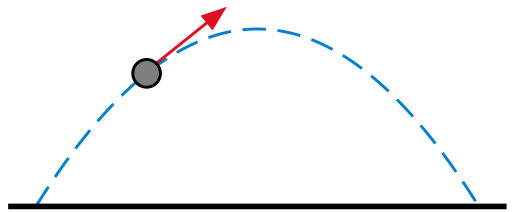 Projectile trajectory illustrating parametric time variable (Image: Py4nf, CC0, via Wikimedia Commons)
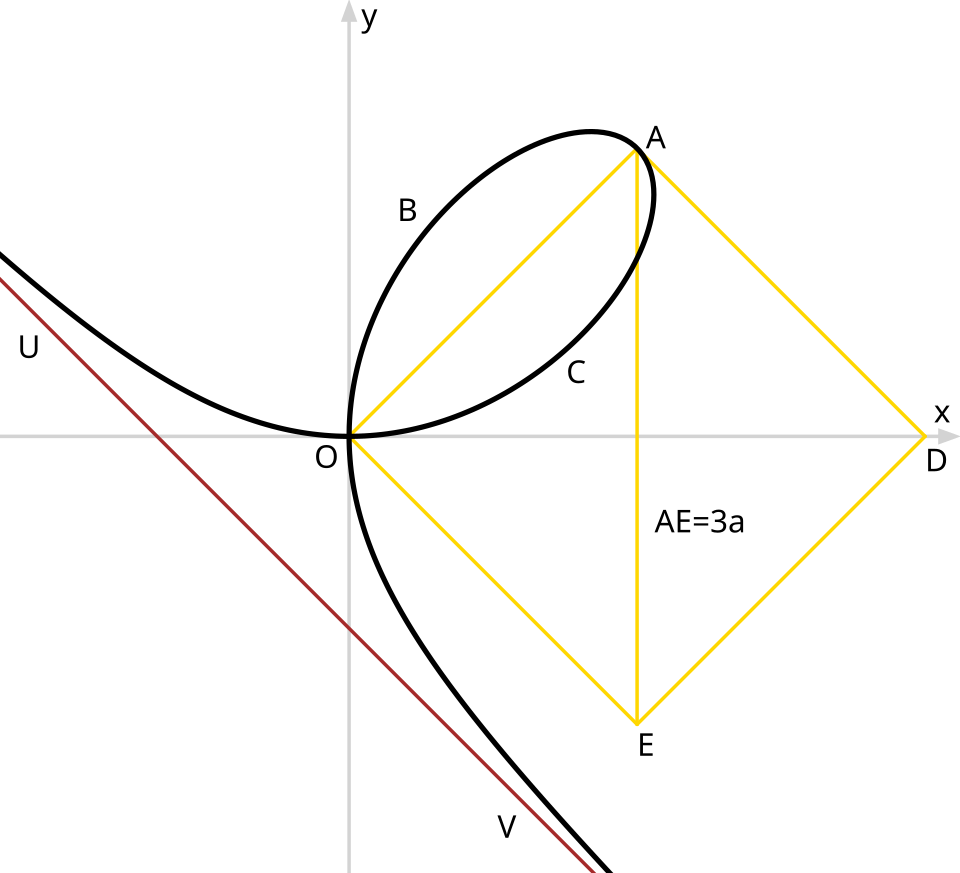 Implicit curve used in the worked example (Image: Zorgit, CC BY-SA 3.0, via Wikimedia Commons)
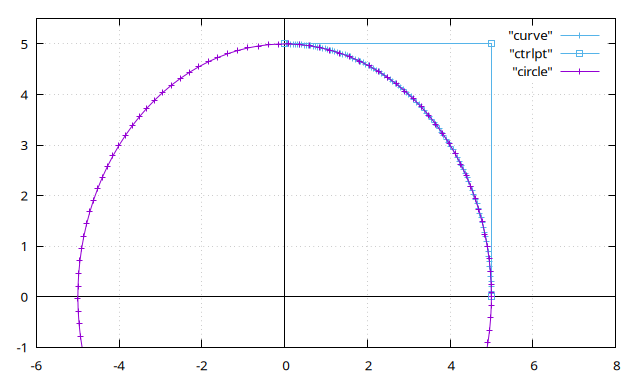 Bézier curve in computer graphics, showing control points and tangent (Image: Xhungab, CC0, via Wikimedia Commons)
Based on the TU BCA syllabus for Mathematics II (CAMT154), unit 8.
Discussion
Loading…