Food And Beverage Service IUnit 318 min read
Breakfast Service & Menu Planning: Types, Layouts & Real-World Applications
Unit 3 of Food And Beverage Service I covers breakfast service styles (English, Continental, American, etc.), menu planning principles, TDH menu formats, and practical layout design for hotel breakfast service, with real-world examples from Nepali hotels and global brands.
TAKEAWAYS:
- Breakfast menus vary globally (English, Continental, American, etc.) and must align with hotel standards and guest expectations.
- TDH (Table d’Hôte) menus offer fixed multi-course options with clear pricing, ideal for buffet and à la carte service.
- Gueridon service (table-side plating) is rare today due to labor costs but excels in high-end dining.
- Menu layout design must balance aesthetics, readability, and operational efficiency for staff.
- Real-world applications include Ncell’s breakfast promotions, Daraz’s hotel partnerships, and Kathmandu’s café culture.
- Exam success requires combining theoretical knowledge with practical menu compilation and layout design.
1. Types of Breakfast Service
Breakfast service styles differ by region, guest preferences, and hotel standards. Below are the most common types taught in TU’s BHM curriculum, with their key features and real-world applications in Nepali hotels.
A. English Breakfast (Full Breakfast)
Definition: A hearty, multi-course meal traditionally served in the UK, featuring hot and cold dishes to fuel a full day. Common in 5-star hotels and business hotels catering to international guests.
Courses Served (Typical Menu):
| Course | Example Items | Purpose |
|---|---|---|
| Hot Beverage | Tea/coffee with milk, orange juice, fresh fruit juice | Hydration and digestion kickstart |
| Cold Dishes | Fresh fruit platter, cereal with milk, yogurt, toast with butter/jam | Light, easy-to-digest start |
| Hot Dishes | Fried eggs, bacon, sausages, baked beans, grilled tomatoes, mushrooms | Protein and energy for the day |
| Bread & Spreads | Toast, muffins, croissants, jam, honey, marmalade | Carbohydrates for sustained energy |
| Cheese & Cold Cuts | Cheese platter, ham, salami, pickles | Protein and flavor variety |
Real-World Example:
- Hotel Yak & Yeti (Kathmandu): Offers a "Royal English Breakfast" with locally sourced bacon and eggs, marketed to trekkers and business travelers needing high-energy meals.
- Ncell’s "Breakfast Combo" Promotions: Partnering with hotels like Radisson and Himalaya, Ncell offers breakfast vouchers for prepaid users, often featuring English breakfast options.
B. Continental Breakfast
Definition: A lighter, more refined breakfast compared to English, focusing on bread, pastries, cold cuts, and light beverages. Popular in European hotels and luxury resorts.
Courses Served (Typical Menu):
| Course | Example Items | Purpose |
|---|---|---|
| Beverages | Espresso, cappuccino, tea, fresh fruit juice, mineral water | Hydration and caffeine boost |
| Bread & Pastries | Croissants, baguettes, brioche, butter, jam, honey | Quick energy without heaviness |
| Cold Cuts | Ham, turkey, cheese, olives, pickles | Protein and flavor variety |
| Fresh Fruit | Seasonal fruit platter, sliced melon, grapes | Vitamins and natural sweetness |
| Yogurt & Cereals | Flavored yogurt, granola, muesli with nuts | Probiotic and fiber-rich start |
Real-World Example:
- Kathmandu’s Café Coffee Day (CCD): While not a hotel, CCD’s "Continental Breakfast Platter" (available during weekends) mirrors this style, with pastries, fruit, and coffee.
- Hotel Himalaya (Kathmandu): Their "Continental Breakfast" is a favorite among diplomats and tourists, often paired with Nepali chai for a local twist.
C. American Breakfast
Definition: A customizable, buffet-style breakfast where guests self-serve from a variety of hot and cold items. Common in casual hotels, motels, and cruise ships.
Courses Served (Typical Menu):
| Course | Example Items | Purpose |
|---|---|---|
| Hot Beverages | Coffee, tea, hot chocolate, orange juice | Hydration and warmth |
| Cold Dishes | Cereal, milk, yogurt, fresh fruit, pastries | Quick, no-cook options |
| Hot Dishes | Scrambled eggs, omelets, pancakes, waffles, bacon, sausages, hash browns | High-protein, energy-dense options |
| Bread & Spreads | Toast, English muffins, butter, syrup, jam | Customizable carbs |
| Extras | Juice bar, coffee station, condiments (salt, pepper, ketchup) | Guest convenience and variety |
Real-World Example:
- Hotel Annapurna (Pokhara): Their "American Breakfast Buffet" is popular among backpackers and families, offering pancakes with local honey and Nepali-style parathas as a fusion option.
- Daraz’s Hotel Partnerships: Many budget hotels listed on Daraz (e.g., Hotel Greenlands) offer American-style breakfast buffets as a cost-effective guest perk.
D. Buffet vs. À La Carte Breakfast
| Feature | Buffet Breakfast | À La Carte Breakfast |
|---|---|---|
| Service Style | Self-service; guests serve themselves from a spread | Ordered individually; served by staff |
| Cost | Lower per-guest cost (bulk purchasing) | Higher per-guest cost (individual plating) |
| Guest Experience | Casual, social, variety-focused | Personalized, upscale, controlled portions |
| Hotel Type | Budget to mid-range hotels, cruise ships, resorts | Luxury hotels, fine dining establishments |
| Example in Nepal | Hotel Malla (Kathmandu), Hotel Himalaya’s buffet section | Hotel Yak & Yeti’s à la carte breakfast, Dwarikas’ fine dining |
2. Menu Planning for Breakfast Service
Menu planning ensures guest satisfaction, operational efficiency, and cost control. Key principles include:
- Guest Demographics: Business travelers vs. leisure guests.
- Seasonality: Fresh fruits, local produce (e.g., Nepali apples in winter).
- Dietary Restrictions: Vegetarian, vegan, gluten-free, halal options.
- Hotel Standards: 3-star vs. 5-star expectations.
A. Types of Menus
À La Carte Menu
- Definition: Individual items priced separately.
- Example:
Breakfast À La Carte ------------------- 1. Fresh Fruit Platter – NPR 250 2. Scrambled Eggs (2) – NPR 300 3. Toast with Jam – NPR 100 4. Cappuccino – NPR 150 - Use Case: Luxury hotels (e.g., Hotel Yak & Yeti) where guests prefer customization.
Table d’Hôte (TDH) Menu
- Definition: A fixed-price, multi-course menu with limited choices per course.
- Example (3-Course Continental TDH):
Continental Breakfast TDH (NPR 850) ----------------------------------- Course 1: Fresh Fruit & Yogurt Course 2: Croissant with Jam & Cappuccino Course 3: Cheese & Cold Cuts Platter - Advantages:
- Simplifies ordering for staff.
- Encourages guests to try multiple items.
- Easier inventory control.
- Disadvantages:
- Less flexibility for guests.
- May not cater to all dietary needs.
Buffet Menu
- Definition: All-you-can-eat spread with no fixed pricing per item.
- Example Layout:
Breakfast Buffet --------------- [Station 1] Beverages (Coffee, Tea, Juice) [Station 2] Bread & Pastries [Station 3] Hot Dishes (Eggs, Pancakes) [Station 4] Cold Cuts & Cheese [Station 5] Fresh Fruit - Use Case: Budget hotels (e.g., Hotel Greenlands) and resorts.
B. Menu Cover Layout Design
A well-designed menu cover attracts guests and communicates the hotel’s brand. Key elements:
- Hotel Logo & Name (Top-center or top-left).
- Menu Type (e.g., "Continental Breakfast TDH").
- Price (Clearly stated).
- Courses Listed (Bullet points or numbered).
- Aesthetic Appeal (Use of colors, fonts, and images).
Example of a 3-Course Continental TDH Menu Cover:
-------------------------------------------
| HOTEL HIMALAYA                     ☕     |
|                                     |
|   CONTINENTAL BREAKFAST TDH       |
|   NPR 850                          |
|                                     |
|   COURSE 1: Fresh Fruit & Yogurt   |
|   COURSE 2: Croissant & Cappuccino |
|   COURSE 3: Cheese & Cold Cuts     |
|                                     |
|   Served: 7:00 AM – 10:30 AM       |
-------------------------------------------
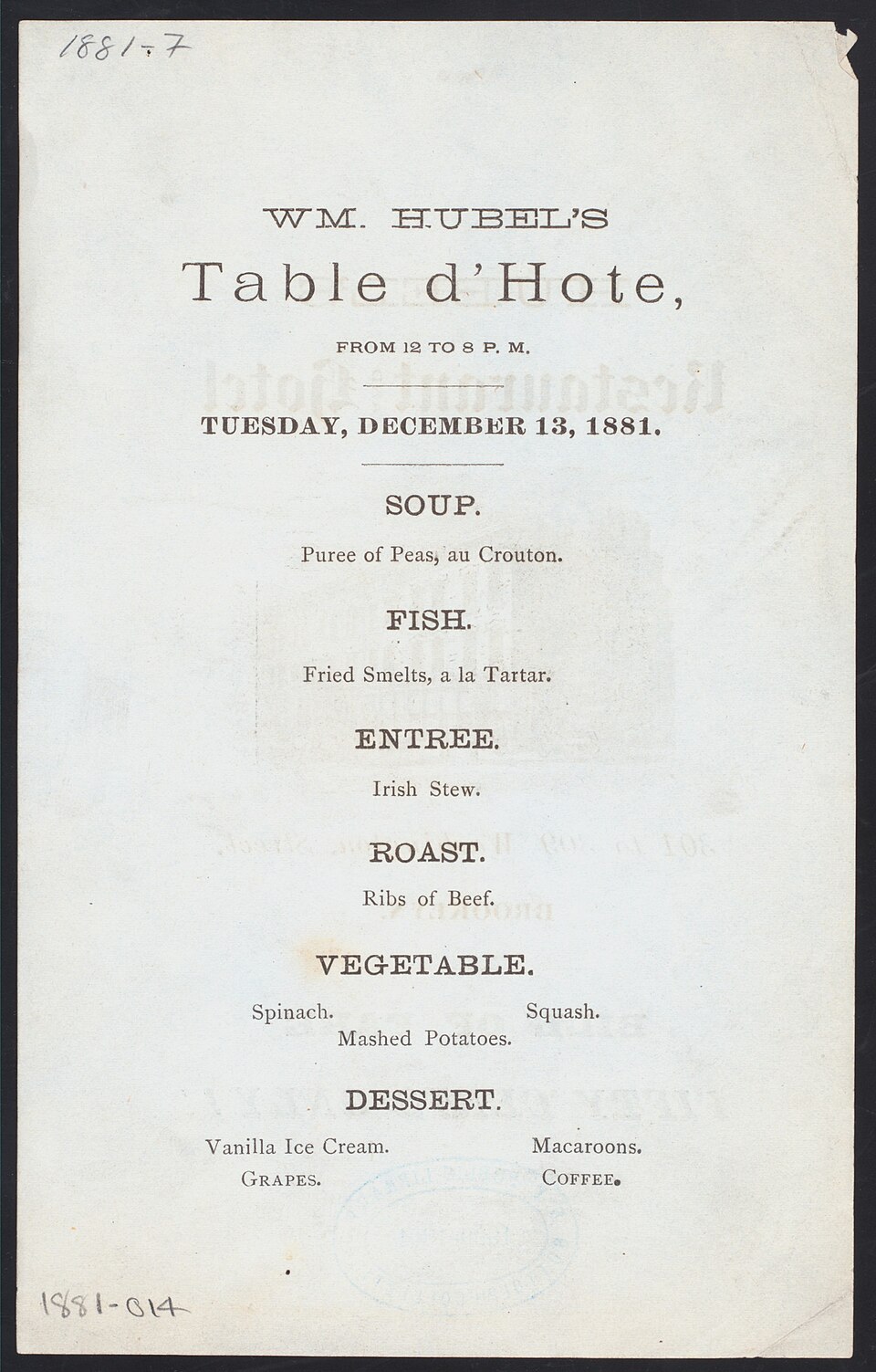 A professionally designed menu cover with labeled sections. (Image: Scan by NYPL, Public domain, via Wikimedia Commons)
Real-World Example:
- Hotel Annapurna (Pokhara): Their breakfast menu covers feature local artwork (e.g., Himalayan landscapes) to appeal to tourists.
- Kathmandu’s Café Coffee Day: Even non-hotel cafés use bold typography and images of pastries to attract breakfast crowds.
3. Gueridon Service: A Rare but Elegant Method
Definition: A table-side plating service where food is prepared and served at the guest’s table using a gueridon cart. The cart holds ingredients, utensils, and cooking equipment.
How It Works:
- The gueridon chef sets up the cart near the guest’s table.
- Ingredients (e.g., eggs, bacon, mushrooms) are prepared fresh in front of the guest.
- The dish is plated and served immediately.
Advantages:
- Theatrical experience (entertains guests).
- Freshness (food is cooked to order).
- Customization (guests can request modifications).
Disadvantages:
- Labor-intensive (requires skilled chefs).
- Slow service (not ideal for high-volume breakfast service).
- High cost (extra staff and equipment needed).
Why It’s Unpopular Today:
- Cost: Hotels prefer buffet or à la carte for efficiency.
- Speed: Breakfast service requires quick turnover.
- Staff Shortages: Nepal’s hospitality industry struggles with skilled gueridon chefs.
Real-World Example:
- Hotel Yak & Yeti (Kathmandu): Occasionally offers gueridon-style omelets during brunch service for VIP guests.
- Fine Dining Restaurants (e.g., Bhojan Griha): Use gueridon for special occasions, but not for standard breakfast.
4. Breakfast Service in Nepali Context
Nepal’s breakfast service blends local and international trends, influenced by:
- Tourism: Hotels cater to foreign guests (e.g., trekkers, business travelers).
- Local Preferences: Nepali parathas, mo:mo, and chai are often included.
- Budget Constraints: Many hotels use buffet-style service to reduce costs.
Example: Breakfast at a 4-Star Hotel (e.g., Hotel Malla, Kathmandu)
Breakfast Buffet (7:00 AM – 10:30 AM)
--------------------------------------
[Station 1] Beverages: Nepali chai, coffee, fresh juice
[Station 2] Bread: Toast, parathas, croissants
[Station 3] Hot Dishes: Scrambled eggs, omelets, pancakes
[Station 4] Cold Cuts: Ham, cheese, pickles
[Station 5] Local Specialties: Mo:mo, sel roti, yogurt
[Station 6] Fresh Fruit: Seasonal Nepali fruits (e.g., apple, orange)
Why This Works:
- Cultural Appeal: Includes Nepali staples alongside international options.
- Cost-Effective: Buffet reduces per-guest costs.
- Tourist-Friendly: Offers familiar and exotic choices.
In the Real World
Breakfast service principles are used daily by Nepali and global brands in unexpected ways:
Ncell & Khalti Breakfast Promotions
- How It Works: Ncell and Khalti partner with hotels (e.g., Radisson, Hotel Himalaya) to offer breakfast vouchers for prepaid users.
- Menu Planning Impact: Hotels must ensure high-quality, standardized breakfast to meet promotional standards.
- Example: A "Ncell Breakfast Combo" at Hotel Yak & Yeti includes:
- 2 scrambled eggs
- Toast with jam
- Cappuccino
- Fresh fruit juice
Daraz Hotel Partnerships
- How It Works: Budget hotels listed on Daraz (e.g., Hotel Greenlands, Hotel Malla) offer breakfast as a free or discounted add-on to attract bookings.
- Menu Planning Impact: Hotels use buffet-style service to minimize costs while maintaining variety.
- Example: A Daraz-exclusive breakfast package at Hotel Annapurna (Pokhara) includes:
- Paratha with curd
- Scrambled eggs
- Nepali chai
- Fresh fruit
Pathao & Food Delivery Apps
- How It Works: Apps like Pathao, Swipe, and Foodmandu now offer breakfast delivery from hotels and cafés.
- Menu Planning Impact: Hotels must design delivery-friendly menus (e.g., parathas, omelets, fruit platters).
- Example: Café Coffee Day’s "Breakfast Box" (delivered via Pathao) includes:
- Croissant
- Cappuccino
- Fresh fruit
- Jam
Nepal Rastra Bank (NRB) & Corporate Breakfasts
- How It Works: Banks like Nepal Bank, Global IME host client breakfasts during business hours.
- Menu Planning Impact: Formal, à la carte breakfasts are served to impress clients.
- Example: A Nepal Bank client breakfast might feature:
- Fresh fruit platter
- Smoked salmon & cream cheese toast
- Espresso martini (for a modern twist)
Exam Tip
Based on past TU exam questions, here’s how to score full marks on this unit:
1. Menu Compilation (6-8 Marks)
- Structure: Use a clear, professional layout (see example above).
- Courses: List 3-4 courses with realistic examples (e.g., "Croissant with Jam" not just "Pastry").
- Pricing: Include NPR prices (e.g., "NPR 850" for TDH).
- Visual: Draw a neat menu cover (use bold fonts, borders, and alignment).
Example Answer for "Compile a 3-Course Continental TDH Menu":
-------------------------------------------
| HOTEL ANNAPURNA                     ☕     |
|                                     |
|   CONTINENTAL BREAKFAST TDH       |
|   NPR 750                          |
|                                     |
|   COURSE 1: Fresh Fruit Salad      |
|   COURSE 2: Croissant with Butter & Jam |
|   COURSE 3: Cheese & Cold Cuts Platter |
|                                     |
|   Served: 7:00 AM – 10:30 AM       |
-------------------------------------------
2. Gueridon Service (4-5 Marks)
- Definition: Start with a clear, concise definition (1 mark).
- Advantages/Disadvantages: List 2-3 of each (2 marks).
- Unpopularity Reasons: Mention cost, speed, and staff shortages (2 marks).
Example Answer for "Define Gueridon Service and List Disadvantages":
Gueridon service is a table-side plating method where food is prepared and served using a mobile gueridon cart. It offers a theatrical dining experience but is labor-intensive and slow. Disadvantages:
- Requires skilled chefs, increasing labor costs.
- Slower service, unsuitable for high-volume breakfast.
- High equipment costs (specialized carts and tools).
3. Menu Layout Design (5-6 Marks)
- Neatness: Use boxes, borders, and alignment.
- Realism: Include prices, hotel name, and course details.
- Creativity: Add small visuals (e.g., ☕ for coffee, 🍓 for fruit).
Example Answer for "Draw a Neat Cover Layout for a 3-Course Continental TDH Menu":
+-------------------------------------------+
| HOTEL HIMALAYA          ☕               |
|                                   [Logo]  |
+-------------------------------------------+
|   CONTINENTAL BREAKFAST TDH          |
|   NPR 850                           |
+---------------------------------------+
|   COURSE 1: 🍓 Fresh Fruit Platter     |
|   COURSE 2: 🥐 Croissant & Cappuccino|
|   COURSE 3: 🧀 Cheese & Cold Cuts      |
+---------------------------------------+
|   Served: 7:00 AM – 10:30 AM         |
+---------------------------------------+
4. Organizational Charts (5 Marks)
- Structure: Use a clear hierarchy (e.g., F&B Manager → Breakfast Supervisor → Waitstaff).
- Labels: Include job titles and roles (e.g., "Breakfast Chef," "Buffet Attendant").
- Neatness: Draw boxes and arrows (or describe clearly if handwritten).
Example Answer for "Draw an Organizational Chart of F&B Service Department":
Final Checklist for Full Marks
✅ Definitions are clear and concise. ✅ Examples are realistic and relevant (e.g., Nepali hotels). ✅ Diagrams are neat and labeled. ✅ Menu layouts include prices, courses, and hotel branding. ✅ Answers tie to real-world applications (e.g., Ncell, Daraz, Pathao).
Based on the TU BHM syllabus for Food And Beverage Service I (BHM311), unit 3.
Discussion
Loading…