Food And Beverage Service IUnit 817 min read
Service Terminology & Customer Behavior: Methods, Roles & Psychology
Unit 8 of Food and Beverage Service I covers the specialized vocabulary of F&B service (e.g., gueridon, buffet, à la carte) alongside psychological principles of customer behavior, including expectations, complaints, and service recovery techniques—essential for TU exams and real-world hospitality scenarios.
TAKEAWAYS:
- Master service methods (plated, buffet, gueridon, Russian, family-style) and their applications in hotels/restaurants, including advantages/disadvantages.
- Understand customer behavior models (expectancy theory, Maslow’s hierarchy) and how they shape dining experiences, with real-world examples from eSewa, Daraz, and Ncell.
- Learn service terminology (e.g., mise en place, cover, turnover time) and how they appear in exam questions and job descriptions.
- Analyze ancillary sections of F&B (e.g., room service, banquet, bar) and their organizational structures via labeled diagrams.
- Apply complaint handling techniques using the SERVQUAL gap model and service recovery paradox with case studies.
- Trace service procedures for specific items (e.g., cigar service) and link them to staff roles/responsibilities in exams.
1. Service Methods: Definitions, Types, and Applications
Service methods determine how food and beverages are presented, served, and consumed. Each method has unique workflows, equipment needs, and customer interactions. Below are the five primary service methods taught in TU syllabi, with visual distinctions and real-world ties.
1.1 Plated Service (À la Carte)
Definition: Food is pre-plated in the kitchen and served directly to guests at their tables. Each guest receives a customized plate. How it works:
- Orders are taken by waitstaff.
- Kitchen prepares dishes to order (or pre-plates for efficiency).
- Waiters deliver plates to tables, often with garnishes or sauces added tableside.
- Beverages are served alongside or after the main course.
Worked Example: Ncell’s "Customized Plan" Service
- Analogy: Like à la carte, Ncell offers tailored mobile plans (e.g., data-only, call-only) based on customer needs.
- Key Idea: Customization (plating dishes vs. plan options) enhances perceived value.
- Exam Link: Compare plated service to family-style (where dishes are served communally) in a table.
| Plated Service | Family-Style Service |
|---|---|
| Individual plates, customizable | Shared dishes, communal serving |
| Higher labor cost (plating) | Lower labor cost (bulk prep) |
| Used in fine dining (e.g., Radisson) | Casual dining (e.g., local thali restaurants) |
| Slower service for large groups | Faster for groups (e.g., conferences) |
Advantages:
- High perceived quality (customization).
- Control over presentation (garnishes, plating).
- Easier to upsell premium items (e.g., truffle pasta).
Disadvantages:
- Higher labor/kitchen costs.
- Slower for large groups (e.g., banquets).
- Less interactive for guests.
1.2 Buffet Service
Definition: Guests serve themselves from a pre-arranged display of food and beverages. Common in banquets, conferences, and casual dining. How it works:
- Food is pre-plated or arranged on chafing dishes/tables.
- Guests line up, take portions, and return for seconds.
- Beverages may be self-served (e.g., coffee stations) or attended (e.g., wine pourers).
Real-World Tie: Daraz’s "Grab-and-Go" Model
- Analogy: Like a buffet, Daraz’s "Express Delivery" lets customers self-select items (no waiter needed).
- Key Idea: Self-service reduces labor costs but requires clear signage (like buffet instructions).
- Exam Question: "Why is buffet service unpopular in fine dining?" → Answer: Loss of personalization, hygiene risks (shared utensils), and slower pacing.
Advantages:
- Cost-effective for large groups.
- Flexible portion sizes (guests control intake).
- Faster turnover (ideal for events).
Disadvantages:
- Lower perceived value (less personalization).
- Hygiene risks (shared serving utensils).
- Waste if portions are overestimated.
1.3 Gueridon Service
Definition: Food is prepared and cooked tableside using portable equipment (e.g., grills, chafing dishes). A signature of luxury dining. How it works:
- A gueridon cart (with burners, utensils) is rolled to the table.
- The waiter demonstrates the dish’s preparation (e.g., flambéing, grilling).
- Food is cooked/plated in front of the guest and served immediately.
Worked Example: Kathmandu Traffic’s "Dynamic Routing"
- Analogy: Like gueridon, real-time adjustments (e.g., rerouting due to jams) create a memorable experience.
- Key Idea: Theatricality (flambéing) = customer engagement, but requires skilled staff.
- Exam Question: "Why is gueridon service unpopular today?"
- Answers:
- High labor cost (specialized training for waitstaff).
- Safety risks (open flames, hot surfaces).
- Space constraints (carts block aisles in modern restaurants).
- Customer expectations (prefer speed over spectacle).
- Answers:
Advantages:
- Theatrical appeal (entertains guests).
- Freshness (food cooked to order).
- Upselling potential (premium pricing for "show" dishes).
Disadvantages:
- Expensive (equipment, training, insurance).
- Slow (not scalable for large groups).
- Hazardous (fire risks, burns).
1.4 Russian Service
Definition: Food is pre-plated in the kitchen but served in courses (starter → main → dessert) with multiple waiters per table. Common in high-end restaurants. How it works:
- Waiters carry covered platters to the table.
- The head waiter announces each course.
- Platters are uncovered tableside, and portions are served to guests.
- Used for multi-course tasting menus.
Real-World Tie: WhatsApp’s "Group Chat" Flow
- Analogy: Like Russian service, sequential delivery (messages in order) ensures cohesive storytelling.
- Key Idea: Structured pacing (courses = messages) enhances the dining experience.
- Exam Link: Contrast with family-style (where all dishes arrive at once).
Advantages:
- Precision timing (courses flow smoothly).
- High perceived value (multi-course menus justify premium prices).
- Efficient for large tables (multiple waiters share workload).
Disadvantages:
- Requires coordination (waiters must sync).
- Expensive (staffing, china/platters).
- Less interactive than gueridon.
1.5 Family-Style Service
Definition: Large dishes (e.g., roasts, pasta) are served communally to the table, and guests share using serving utensils. How it works:
- Dishes are brought to the table uncovered.
- Guests serve themselves using tongs/spoons.
- Common in casual dining, buffets, and group settings.
Worked Example: eSewa’s "Group Payment" Feature
- Analogy: Like family-style, shared responsibility (e.g., splitting bills) builds community.
- Key Idea: Reduces individual burden (e.g., splitting a large pizza vs. ordering separately).
- Exam Question: "When would a hotel use family-style vs. plated service?"
- Family-style: Banquets, conferences, budget hotels.
- Plated: Fine dining, à la carte restaurants.
Advantages:
- Cost-effective (bulk cooking).
- Encourages socializing (shared experience).
- Faster for groups.
Disadvantages:
- Hygiene concerns (shared utensils).
- Less customization.
- Portion control issues (over/under-serving).
2. Ancillary Sections of F&B Service
Beyond the main dining room, F&B departments include specialized sections. Below is a Mermaid organizational chart of a typical hotel’s F&B structure, followed by key roles.
Key Ancillary Sections:
Room Service:
- Order Taker: Receives requests via phone/app (e.g., like Pathao’s order system).
- Delivery Runner: Transports food (must navigate hotel layout efficiently).
- Example: At Radisson Hotel Kathmandu, room service uses digital menus to reduce errors.
Banquet Service:
- Manages large-group events (e.g., weddings, conferences).
- Uses buffet/gueridon methods for efficiency.
Bar Service:
- Sommelier: Expert in wine pairings (like a Nepal Stock Exchange analyst for investments).
- Mixologist: Crafts cocktails (e.g., Khalti’s "limited-time offers" for promotions).
3. Customer Behavior: Psychological Principles
Customers’ expectations, perceptions, and complaints drive service success. Below are three key models used in TU exams.
3.1 Expectancy Theory (Disconfirmation Paradigm)
Definition: Customers compare expected service (based on past experiences) with actual service. If actual > expected, they’re satisfied; if actual < expected, they’re dissatisfied. How it applies:
- Example: A guest expects Ncell’s 4G speed but gets 2G → negative disconfirmation.
- F&B Example: A hotel promises "24-hour room service" but delivers food in 45 minutes → complaint.
Exam Tip: Always link customer expectations to service standards in answers.
3.2 Maslow’s Hierarchy in Dining
Definition: Customers’ needs follow a pyramid:
- Physiological (hunger/thirst).
- Safety (food hygiene, cleanliness).
- Social (company, ambiance).
- Esteem (status, recognition).
- Self-Actualization (unique experiences).
Real-World Tie: YouTube’s "Algorithm"
- Analogy: Like Maslow’s hierarchy, YouTube prioritizes needs:
- Physiological: Short videos (quick dopamine hits).
- Social: Comments/likes (esteem).
- Self-Actualization: Niche content (e.g., "How to plate like a Michelin chef").
F&B Application:
- Budget hotels focus on physiological/safety (clean food, basic service).
- Luxury hotels target esteem/self-actualization (gueridon service, sommeliers).
3.3 Service Recovery Paradox
Definition: If a company resolves a complaint exceptionally well, customers may become more loyal than if there’d been no issue. How it works:
- Problem: Guest complains about cold soup.
- Recovery: Waiter replaces it immediately, offers a free dessert, and apologizes sincerely.
- Outcome: Guest feels valued and returns.
Worked Example: NEPSE’s "Investor Grievance Cell"
- Analogy: Like service recovery, addressing complaints publicly (e.g., via social media) can boost trust.
- Key Idea: Speed + empathy > perfection.
Exam Question: "How would you apply the service recovery paradox to a guest who burns their mouth on hot coffee?"
- Answer:
- Acknowledge: "I’m so sorry for the inconvenience."
- Act fast: Replace coffee + offer iced tea.
- Follow up: "We’ll train staff on temperature checks."
4. Service Terminology: Key Definitions for Exams
Memorize these high-frequency terms that appear in TU questions:
| Term | Definition | Exam Example |
|---|---|---|
| Cover | A seated guest (used to calculate staffing needs). | "A restaurant has 50 covers at peak time." |
| Turnover Time | Time from guest arrival to table readiness for the next guest. | "Calculate turnover time if a table takes 90 mins and 4 guests arrive hourly." |
| Mise en Place | French term: "everything in its place" (prepped ingredients/equipment). | "The chef’s mise en place includes chopped veggies and measured spices." |
| Garnish | Decorative food (e.g., parsley, citrus twists) added tableside. | "A gueridon service requires garnishes to be added live." |
| Banquet Event Order | A detailed plan for large-group events (menu, staff, timeline). | "Draft a banquet event order for a 100-person wedding." |
| POS System | Point-of-Sale: Electronic ordering/payment (e.g., Khalti’s QR menus). | "Describe how a POS system improves F&B efficiency." |
| Par Stock | Minimum inventory levels (e.g., 50 wine glasses per shift). | "Calculate par stock for a 50-cover restaurant." |
| Service Style | Method of delivering food (e.g., plated, buffet). | "Compare Russian and family-style service." |
5. Staff Roles and Responsibilities in Service
Exams often ask for job descriptions or organizational charts. Below is a Mermaid flowchart for a waiter’s duties, followed by a room service order taker’s role.
Room Service Order Taker’s Duties (Exam-Focused):
- Receive orders: Via phone/app (e.g., like Pathao’s order system).
- Verify details: Check dietary restrictions, room numbers.
- Transmit to kitchen: Use POS system (e.g., eSewa’s payment integration).
- Track delivery: Ensure turnover time (e.g., 30 mins max).
- Handle complaints: Apply service recovery paradox.
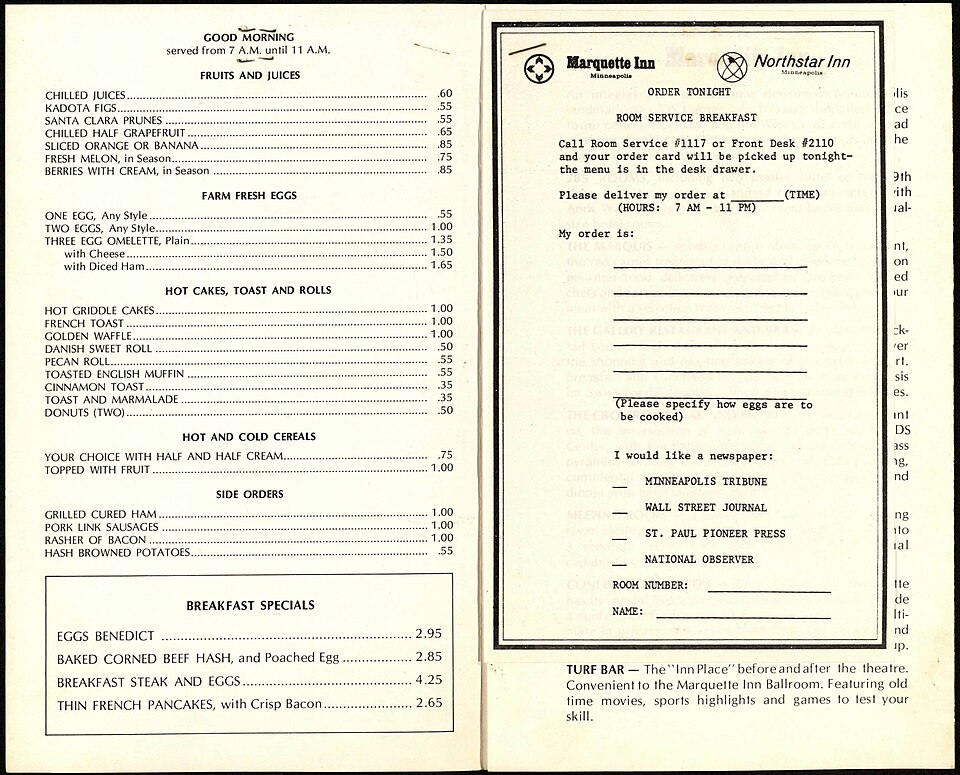 Shows a form with sections for guest name, room, order items, and special requests. (Image: Public domain, via Wikimedia Commons)
6. Complaint Handling: Step-by-Step Process
Use the SERVQUAL model (gap analysis) to resolve complaints:
- Listen actively: Let the guest vent (e.g., "I’m sorry you had to wait 45 minutes").
- Apologize sincerely: Avoid excuses ("The kitchen was busy" → "We’ll improve").
- Offer solutions:
- Immediate: Replace food, offer discounts.
- Long-term: Train staff, update menus.
- Follow up: Call later to check satisfaction (like Ncell’s post-complaint call).
Worked Example: Daraz’s "Return Policy"
- Analogy: Like complaint handling, clear policies (e.g., 7-day returns) reduce friction.
- Key Idea: Transparency builds trust.
In the Real World
eSewa’s "Digital Menu" for Room Service
- Idea Used: POS System + Service Terminology
- How: Hotels like Radisson use eSewa’s platform to let guests order via app, reducing order taker errors and improving turnover time.
Khalti’s "Limited-Time Offers" (Promotions)
- Idea Used: Maslow’s Hierarchy (Esteem Needs)
- How: Like a sommelier’s wine pairing, Khalti’s "Buy 1, Get 1 Free" taps into the social/esteem need for exclusivity.
Pathao’s "Dynamic Routing" for Delivery
- Idea Used: Family-Style Service (Shared Responsibility)
- How: Pathao’s group order feature (e.g., splitting a pizza among friends) mirrors family-style dining, where shared dishes reduce individual burden.
Ncell’s "Customer Care" for Bill Complaints
- Idea Used: Service Recovery Paradox
- How: If a customer complains about a wrong bill, Ncell’s immediate refund + follow-up call turns dissatisfaction into loyalty—just like replacing a burnt dish in F&B.
Exam Tip
For definitions (e.g., gueridon service):
- Structure: Definition → How it works → Advantages/Disadvantages → Real-world example.
- Example Answer:
"Gueridon service is a tableside cooking method where food is prepared using a portable gueridon cart. It involves flambéing, grilling, or assembling dishes in front of guests. Advantages: Creates theatricality, ensures freshness. Disadvantages: High labor cost, safety risks. Example: Used in luxury hotels like The Himalayan Hotel for special occasions."
For organizational charts:
- Draw a Mermaid diagram (as above) and label 3 key roles (e.g., waiter, sommelier, order taker).
- Add a job description for one role (e.g., "A waiter must greet guests within 30 seconds and handle complaints using the SERVQUAL model").
For customer behavior:
- Link to models: Always tie answers to expectancy theory or Maslow’s hierarchy.
- Example: "Guests at a buffet (family-style) prioritize physiological needs (hunger) but may complain if safety needs (hygiene) are unmet."
For service methods:
- Compare two methods in a table (as shown earlier).
- Example Question: "Why would a banquet use buffet over plated service?"
- Answer: "Buffet is cost-effective for large groups and faster for turnover, while plated service is too labor-intensive for 200 guests."
For complaint handling:
- Use the 4-step process (listen → apologize → solve → follow up).
- Example: "A guest complains about cold soup. Solution: Replace soup, offer free dessert, and note the issue in the shift report for the chef."
Final Visual Summary
Based on the TU BHM syllabus for Food And Beverage Service I (BHM311), unit 8.
Discussion
Loading…