Principles of ManagementUnit 215 min read
Evolution of Management Thought: Schools, Theories & Contributors
Unit 2 of Principles of Management explores the historical development of management theories—from classical to contemporary schools—highlighting key thinkers (Taylor, Fayol, Weber), their contributions, and how these ideas shape modern organizations like Nabil Bank, Daraz, and NTC.
The Evolution of Management Thought: A Journey from Classical to Contemporary Schools
Management is not a static discipline; it has evolved over centuries, shaped by economic needs, technological advancements, and social changes. This unit traces the four major schools of management thought:
- Classical School (Scientific, Administrative, Bureaucratic)
- Neoclassical/Human Relations School
- Behavioral/Contingency School
- Modern/Contemporary School
Each school addressed gaps in the previous one, leading to today’s integrated management approaches. Below, we explore these schools with real-world applications, comparisons, and visual frameworks to help you grasp their relevance in Nepali and global businesses.
1. Classical School of Management
The foundation of modern management, this school emerged in the late 19th and early 20th centuries to improve efficiency and productivity in industrial settings. It is divided into three sub-schools:
A. Scientific Management (Frederick Winslow Taylor, 1856–1915)
Definition: A systematic approach to improving worker productivity by standardizing work methods, selecting the right workers, and providing incentives.
Key Principles of Scientific Management
mindmap
  root((Scientific Management))
    Principle 1["Develop a science for each job"]
    Principle 2["Scientifically select & train workers"]
    Principle 3["Cooperate with workers"]
    Principle 4["Divide work & responsibility"]
    Example["Assembly line in Toyota"]
How It Works: The "One Best Way"
Taylor believed in time-and-motion studies to find the most efficient way to perform a task. For example:
- Work Study: Breaking a task into smaller steps (e.g., how long it takes to assemble a Daraz order).
- Differential Piece Rate: Paying workers more for exceeding a set standard.
Worked Example: NTC’s Call Center Efficiency
NTC uses scientific management to train call center agents:
- Standardized scripts for common queries (e.g., "How to check my bill?").
- Time tracking to ensure calls are handled in ≤2 minutes.
- Incentives for agents who resolve issues quickly.
Advantages: ✔ Increases productivity and reduces costs. ✔ Helps in repetitive tasks (e.g., factory assembly lines).
Disadvantages: ✖ Ignores human factors (fatigue, motivation). ✖ Can lead to worker dissatisfaction (e.g., assembly line boredom).
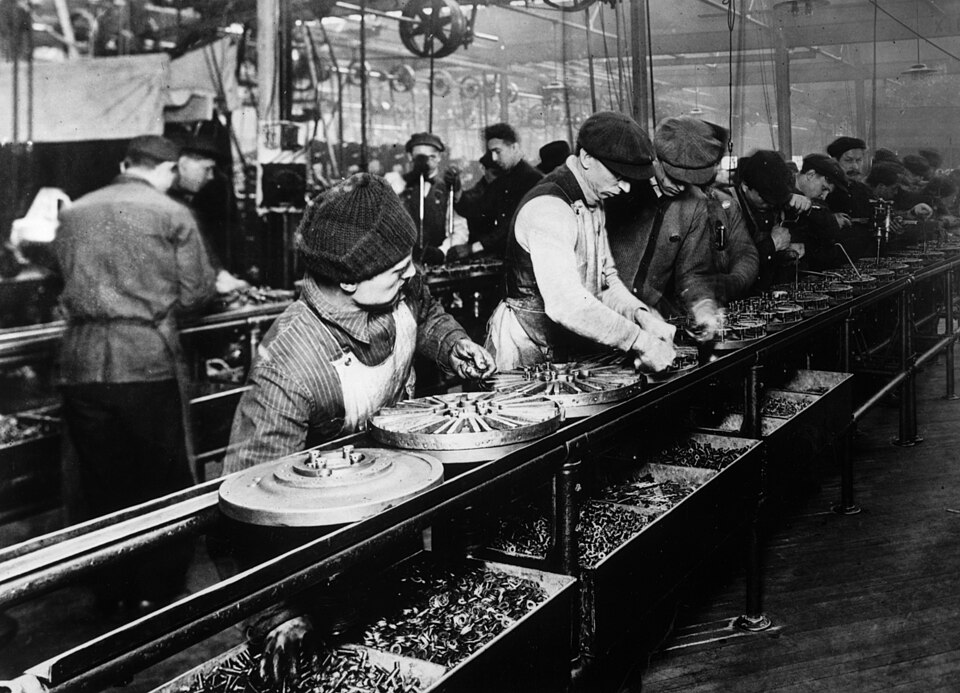 Frederick Taylor’s scientific management in action at a Ford factory (1913). (Image: Public domain, via Wikimedia Commons)
B. Administrative Management (Henri Fayol, 1841–1925)
Definition: Focuses on managing the entire organization, not just workers. Fayol identified 14 principles of management and 5 functions (POLC: Planning, Organizing, Leading, Controlling).
Fayol’s 14 Principles of Management
| Principle | Meaning | Example in Nepal |
|---|---|---|
| Division of Work | Specialization increases efficiency. | Nabil Bank’s HR vs. Finance vs. Operations. |
| Authority & Responsibility | Managers must have authority to give orders. | Hotel manager assigning room service tasks. |
| Discipline | Employees must obey rules. | Uniform dress code in Himalayan Java. |
| Unity of Command | One boss per employee to avoid confusion. | Daraz warehouse supervisor overseeing workers. |
| Unity of Direction | One plan per group of activities. | NTC’s unified billing system. |
| Subordination of Individual | Team goals > personal goals. | Pathao drivers following safety protocols. |
| Remuneration | Fair pay motivates workers. | NEPSE stockbrokers paid per trade. |
| Centralization | Balance between centralized and decentralized authority. | Chaudhary Group’s HQ vs. regional branches. |
| Scalar Chain | Clear communication chain (e.g., CEO → Manager → Supervisor → Worker). | Kathmandu’s traffic police hierarchy. |
| Order | Materials and people in the right place. | Hospitality kitchens (Mise en Place). |
| Equity | Kindness and fairness in treatment. | Fair wage negotiations in unions. |
| Stability of Tenure | Low employee turnover improves efficiency. | Long-term staff in luxury hotels. |
| Initiative | Encourage employees to contribute ideas. | Google’s "20% time" for innovation. |
| Esprit de Corps | Team spirit fosters unity. | Football teams in Nepali clubs. |
Fayol’s 5 Functions of Management (POLC + Controlling)
flowchart TD
  A["Planning"] --> B["Organizing"]
  B --> C["Leading"]
  C --> D["Controlling"]
  D -->|"Feedback"| A
Worked Example: Managing a 5-Star Hotel (e.g., Dwarikas Hotel)
- Planning: Deciding on a luxury experience (e.g., spa packages).
- Organizing: Assigning chefs, housekeeping, and front desk teams.
- Leading: Training staff on customer service excellence.
- Controlling: Monitoring guest satisfaction scores and adjusting services.
Advantages: ✔ Provides a structured framework for organizations. ✔ Helps in large-scale operations (e.g., NTC, Ncell).
Disadvantages: ✖ Too rigid for dynamic environments (e.g., startups). ✖ Ignores employee morale (like Scientific Management).
C. Bureaucratic Management (Max Weber, 1864–1920)
Definition: A rational, rule-based system to ensure order, efficiency, and fairness in large organizations.
Key Features of Bureaucracy
mindmap
  root((Bureaucratic Management))
    Feature 1["Clear hierarchy of authority"]
    Feature 2["Formal rules & procedures"]
    Feature 3["Impersonality (no favoritism)"]
    Feature 4["Merit-based promotions"]
    Feature 5["Specialization of roles"]
    Example["Nepal Government Offices"]
How It Works: The "Ideal Type" Bureaucracy
Weber’s model includes:
- Division of Labor: Each employee has a specific job description.
- Hierarchy: Clear chain of command (e.g., Minister → Secretary → Deputy → Clerk).
- Rules & Regulations: Standardized procedures (e.g., Nepali civil service exams).
- Impersonality: Decisions based on rules, not relationships.
- Meritocracy: Promotions based on skills and performance.
Worked Example: Nepal Government (e.g., NTC, Ncell)
- NTC Employees follow strict SOPs for bill generation.
- Ncell uses bureaucratic rules for SIM registration (ID verification, KYC).
- Civil Service Exams: Merit-based recruitment (e.g., Nepal Police, Army).
Advantages: ✔ Ensures consistency and fairness. ✔ Works well in large, stable organizations (e.g., banks, government).
Disadvantages: ✖ Slow decision-making (e.g., Nepal’s bureaucracy delays). ✖ Lacks flexibility (hard to adapt to change).
2. Neoclassical/Human Relations School
Criticism of Classical School: Ignored human needs, motivation, and group dynamics. Key Thinkers: Elton Mayo, Mary Parker Follett, Chester Barnard.
A. Hawthorne Studies (Elton Mayo, 1924–1932)
Definition: A series of experiments at Hawthorne Works (Western Electric) that proved worker productivity depends on social factors, not just physical conditions.
Key Findings
mindmap
  root((Hawthorne Studies))
    Finding 1["Workers perform better when managers show interest"]
    Finding 2["Informal groups influence behavior"]
    Finding 3["Money is not the only motivator"]
    Finding 4["Social needs matter (belonging, recognition)"]
    Example["Team-building in Daraz"]
Worked Example: Pathao Drivers in Kathmandu
- Social Recognition: Pathao rewards top drivers with bonuses.
- Team Incentives: Groups of drivers get group discounts on bike maintenance.
- Manager Interaction: Supervisors check in daily, boosting morale.
Advantages: ✔ Improves employee satisfaction. ✔ Reduces absenteeism and turnover.
Disadvantages: ✖ Hard to measure social factors quantitatively. ✖ Requires more management attention.
B. Mary Parker Follett’s Contributions
Key Ideas:
- Integration vs. Conflict: Managers should integrate conflicting interests (not just dominate).
- Power with People: Leaders should share power (not command-and-control).
- Continuous Coordination: Teams should self-organize (like agile teams).
Worked Example: Himalayan Java’s Team Meetings
- No strict hierarchy: Baristas and managers discuss menu ideas together.
- Conflict resolution: If two employees disagree on a recipe, they compromise.
3. Behavioral/Contingency School
Focus: How human behavior affects management and that no single theory fits all situations.
A. Maslow’s Hierarchy of Needs (1943)
Definition: A pyramid of human needs that motivates behavior.
mindmap
  root((Maslow's Hierarchy))
    Level 1["Physiological (Food, Shelter)"]
    Level 2["Safety (Job Security)"]
    Level 3["Social (Belonging, Friendship)"]
    Level 4["Esteem (Respect, Status)"]
    Level 5["Self-Actualization (Fulfillment)"]
    Example["Nabil Bank employee benefits"]
Worked Example: Nabil Bank Employees
| Need Level | How Nabil Bank Fulfills It |
|---|---|
| Physiological | Meal allowances, health insurance. |
| Safety | Job security, pension plans. |
| Social | Team lunches, employee clubs. |
| Esteem | Promotions, "Employee of the Month" awards. |
| Self-Actualization | Leadership training, career growth programs. |
B. Herzberg’s Two-Factor Theory (1966)
Definition: Hygiene factors (job dissatisfaction) vs. Motivators (job satisfaction).
| Hygiene Factors (Dissatisfiers) | Motivators (Satisfiers) |
|---|---|
| Salary, company policy, supervision | Achievement, recognition, growth |
| Working conditions, security | Responsibility, meaningful work |
Worked Example: Daraz Warehouse Workers
- Hygiene: Proper salary, safety gear, breaks.
- Motivator: Performance bonuses, skill training.
C. Contingency Theory (Fred Fiedler, 1960s)
Definition: No single best way to manage; the right approach depends on the situation.
Fiedler’s Leadership Styles
| Situation | Best Leadership Style |
|---|---|
| High control, clear tasks | Task-oriented |
| Low control, ambiguous tasks | Relationship-oriented |
Worked Example: Kathmandu Traffic Management
- High control (e.g., airport security): Strict rules, task-focused.
- Low control (e.g., festival crowds): Flexible, people-focused.
4. Modern/Contemporary School
Focus: Adaptability, innovation, and global challenges.
A. Systems Theory (Ludwig von Bertalanffy)
Definition: Organizations are interconnected systems (inputs → processes → outputs → feedback).
flowchart TD
  A["Inputs: Resources, People, Money"] --> B["Processes: Planning, Organizing"]
  B --> C["Outputs: Products, Services"]
  C --> D["Feedback: Customer Reviews, Sales Data"]
  D -->|"Improvement"| A
Worked Example: Google’s Search Algorithm
- Inputs: User queries, server data.
- Processes: Ranking algorithms (PageRank).
- Outputs: Search results.
- Feedback: User clicks, updates to improve rankings.
B. Chaos Theory & Complexity Management
Definition: Organizations are dynamic and unpredictable; managers must adapt quickly.
Worked Example: COVID-19 Response by NTC
- Unpredictable demand: Sudden spike in internet usage.
- Quick adaptation: Increased server capacity, remote work policies.
## In the Real World
Management theories are not just academic—they shape how Nepali and global companies operate. Here’s how:
Nabil Bank (Classical + Behavioral)
- Uses Fayol’s principles for hierarchy and SOPs.
- Applies Maslow’s needs in employee benefits (health insurance, career growth).
- Contingency approach: Different leadership styles for loan officers (task-focused) vs. HR (relationship-focused).
Daraz (Scientific + Systems Theory)
- Scientific Management: Warehouse picking efficiency (time studies for order fulfillment).
- Systems Theory: Supply chain inputs → logistics → customer delivery → feedback (reviews).
- Behavioral: Team bonuses for high sales teams.
Pathao (Human Relations + Contingency)
- Hawthorne effect: Drivers perform better when supervisors check in.
- Contingency: Strict rules for safety (task-oriented) but flexible payment models (relationship-oriented).
NTC (Bureaucratic + Modern Adaptation)
- Weber’s bureaucracy: Strict SOPs for bill generation.
- Modern adaptation: Digital transformation (online bill payments) to handle unpredictable demand.
Himalayan Java (Follett’s Integration)
- No rigid hierarchy: Baristas and managers collaborate on menu changes.
- Conflict resolution: If two employees disagree on a coffee blend, they compromise.
## Exam Tip
This unit is heavily tested in TU exams through:
- Definitions & Comparisons (e.g., "Differentiate between Taylor’s Scientific Management and Fayol’s Administrative Principles").
- Case Studies (e.g., "How does Nabil Bank apply Maslow’s Hierarchy?").
- Diagrams (e.g., draw Fayol’s 14 principles or Maslow’s pyramid).
- Scenario-Based Questions (e.g., "A hotel manager faces low staff morale. Which theory explains this, and how would you apply it?").
How to Score Full Marks
✅ Memorize key thinkers and their contributions (Taylor, Fayol, Weber, Mayo, Maslow). ✅ Use real-world examples (Nabil Bank, Daraz, NTC) to explain theories. ✅ Draw diagrams (e.g., Fayol’s hierarchy, Maslow’s pyramid). ✅ Compare theories in tables (e.g., Classical vs. Behavioral schools). ✅ Apply theories to hospitality (e.g., "How would you motivate staff in a 5-star hotel?").
Common Mistakes to Avoid
❌ Mixing up Taylor and Fayol (Taylor = workers; Fayol = whole organization). ❌ Ignoring real-world applications (exams love Nepali company examples). ❌ Overcomplicating answers—stick to key points with examples.
Final Thought: Management is not a one-size-fits-all discipline. Taylor’s efficiency works in factories, Fayol’s structure suits banks, and Mayo’s human relations fit tech startups. Understand the context, and you’ll master this unit!
Based on the TU BHM syllabus for Principles of Management (MGT311), unit 2.
Discussion
Loading…