Food Production OperationsUnit 510 min read
Bakery & Confectionery: Techniques, Bulk Production & Quality
Unit 5 of Food Production Operations covers bakery and confectionery production systems, bulk food production features, objectives, and quality control methods—essential for hotel kitchens and commercial bakeries.
TAKEAWAYS:
- Bulk food production in bakeries uses standardized recipes, mechanized processes, and quality control to meet large-scale demand efficiently.
- Confectionery production requires precise temperature control, ingredient ratios, and specialized equipment like mixers, moulds, and enrobers.
- Key bakery techniques include fermentation, proofing, baking, and cooling, each critical for texture and flavor development.
- Quality control in bakery/confectionery involves HACCP principles, sensory evaluation, and shelf-life testing to ensure food safety and consistency.
- Modern kitchen techniques like sous-vide for pastries and molecular gastronomy in desserts are transforming traditional methods.
- Understanding cost control, waste management, and energy efficiency is vital for sustainable bakery operations.
Core Concepts: Bakery and Confectionery Production
1. Definitions and Scope
Bakery production refers to the art and science of making bread, pastries, cakes, and other baked goods using flour, water, yeast, and other ingredients. Confectionery production involves sugar-based desserts, chocolates, candies, and pastries that require precise techniques and equipment.
Confectionery can be further classified into:
- Chocolate confectionery (e.g., truffles, pralines)
- Sugar confectionery (e.g., lollipops, toffees)
- Gum and jelly confectionery (e.g., gummies, marshmallows)
- Biscuits and cookies (e.g., digestive biscuits, shortbread)
classDiagram
    class Bakery {
        +Bread
        +Pastries
        +Cakes
        +Fermentation
        +Baking
    }
    class Confectionery {
        +Chocolates
        +Candies
        +Gummies
        +Enrobing
        +Tempering
    }
    Bakery --> "Uses" Equipment: Mixer~Oven~Proofer
    Confectionery --> "Uses" Equipment: Enrober~Moulder~Conche
2. Bulk Food Production in Bakeries
Bulk food production is a large-scale, efficient method used in commercial bakeries to produce standardized products in high quantities. It ensures consistency, cost-effectiveness, and hygiene compliance.
Key Features of Bulk Food Production
| Feature | Description |
|---|---|
| Standardized Recipes | Pre-measured ingredients for uniformity. |
| Mechanized Processes | Use of mixers, dough sheeters, and automated ovens. |
| Quality Control | HACCP (Hazard Analysis Critical Control Point) and sensory evaluation. |
| Energy Efficiency | Optimized baking cycles and waste reduction. |
| Storage and Distribution | Controlled environments (humidity, temperature) to maintain freshness. |
Objectives of Bulk Food Production
- Efficiency: Reduce labor costs and increase output.
- Consistency: Ensure every product meets quality standards.
- Hygiene: Prevent cross-contamination and foodborne illnesses.
- Cost Control: Minimize waste and optimize ingredient usage.
- Shelf-Life Extension: Use preservatives and packaging to extend freshness.
Worked Example: Bulk Bread Production in a Hotel Bakery
- Input: 50 kg flour, 10 kg yeast, 20 L water, 5 kg sugar, 10 kg butter.
- Process:
- Mixing (dough mixer) → 2. Kneading (30 min) → 3. Proofing (2 hours at 28°C) → 4. Shaping (automated moulder) → 5. Baking (20 min at 220°C) → 6. Cooling (1 hour).
- Output: 100 loaves of uniform bread.
- Quality Check: Sensory test (crust color, aroma, texture) and weight verification.
3. Bakery Production Techniques
A. Dough Preparation
- Fermentation: Yeast converts sugars into CO₂, causing dough to rise.
- Bulk Fermentation: Dough rests in a proofer (2–4 hours).
- Proofing: Final rise before baking (30 min–2 hours).
- Kneading: Develops gluten for elasticity.
- Machine Kneading: Faster and more consistent than hand-kneading.
B. Baking
- Oven Types:
- Deck Oven: Traditional, uses steam for crust formation.
- Convection Oven: Faster baking with even heat distribution.
- Rotary Oven: High-volume production (e.g., breadsticks).
- Temperature Control:
- Initial High Heat (250°C): Crust formation.
- Final Lower Heat (180°C): Even cooking.
C. Cooling and Storage
- Rapid Cooling: Prevents condensation (which softens crust).
- Storage Conditions:
- Bread: 15–20°C, 60–70% humidity.
- Pastries: 5–10°C to retain moisture.
4. Confectionery Production Techniques
Confectionery requires precision in temperature, mixing, and shaping. Key processes include:
A. Chocolate Production
- Conching: Refining chocolate for smooth texture (hours to days).
- Tempering: Controlled heating/cooling to stabilize cocoa butter.
- Worked Example: Tempering Dark Chocolate
- Heat to 45°C → Cool to 27°C → Reheat to 31°C.
- Result: Glossy finish and snap.
- Worked Example: Tempering Dark Chocolate
- Enrobing: Coating candies or fruits in chocolate.
- Equipment: Enrober machine (spins chocolate over centers).
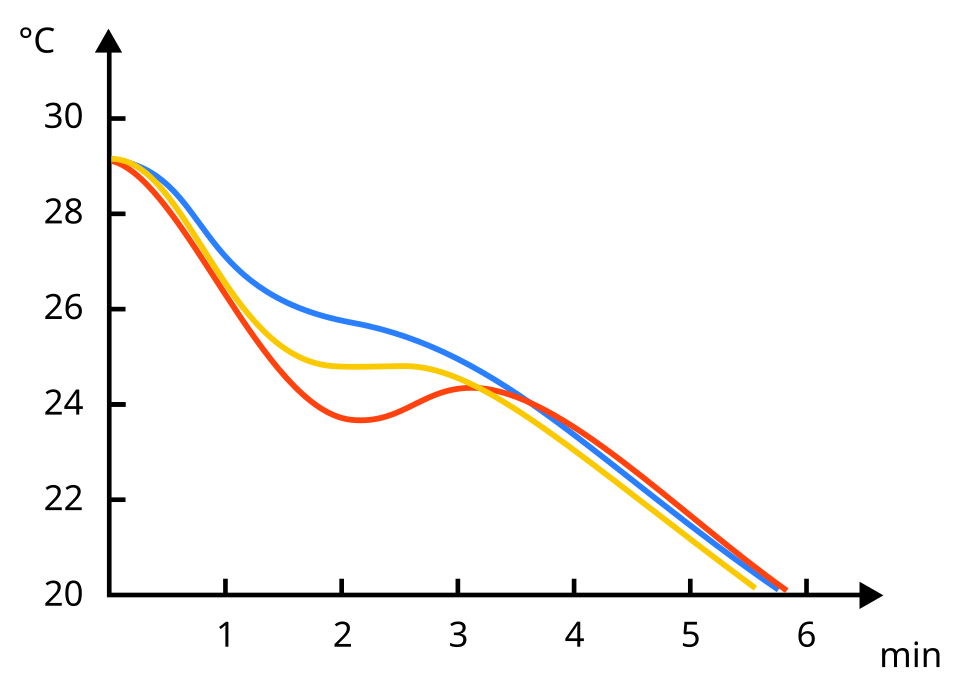 Temperature vs. time for proper tempering (Image: SKopp, CC BY-SA 4.0, via Wikimedia Commons)
B. Sugar Confectionery
- Boiling Syrup: Controlled heating to achieve specific stages (e.g., soft-ball, hard-crack).
- Pull Test: Determines sugar concentration (e.g., 115°C for caramel).
C. Gum and Jelly Confectionery
- Gelatinization: Mixing gelatin with sugar syrup.
- Setting: Cooling in moulds (e.g., gummy bears).
5. Quality Control in Bakery and Confectionery
A. HACCP (Hazard Analysis Critical Control Point)
A 7-step system to ensure food safety:
- Hazard Identification: Biological (mold), chemical (allergens), physical (glass).
- Critical Control Points (CCPs): Mixing, proofing, baking, storage.
- Critical Limits: pH < 4.6 for yeast inhibition, baking temp > 180°C.
- Monitoring: Temperature logs, sensory checks.
- Corrective Actions: Rework or discard if limits breached.
- Verification: Audits and testing.
- Record-Keeping: Documentation for traceability.
B. Sensory Evaluation
- Attributes Tested:
- Appearance: Color, shape, uniformity.
- Texture: Crust (crispness), crumb (softness).
- Flavor: Sweetness, acidity, aftertaste.
- Aroma: Freshness indicators (e.g., yeasty smell in bread).
C. Shelf-Life Testing
- Accelerated Testing: Store at 30°C to simulate aging.
- Microbiological Tests: Check for mold/yield growth.
- Moisture Content: Use hygrometers to prevent staling.
In the Real World
eSewa and Online Bakery Orders (e.g., Bakery Nepal)
- Idea Used: Bulk production + standardized recipes
- How: Bakeries pre-mix dough and bake in large batches to fulfill hundreds of online orders daily. Proofing times are tightly controlled to ensure all bread loaves are ready simultaneously for delivery.
Khalti’s Payment System for Confectionery Shops
- Idea Used: Inventory management + shelf-life tracking
- How: Small confectionery shops use Khalti to track sales data and restock chocolates/candies before they expire. For example, a shop in Thamel might sell 50 kg of chocolates weekly and use Khalti’s analytics to predict demand, reducing waste.
NTC’s Food Safety Standards in Hotel Bakeries
- Idea Used: HACCP and temperature control
- How: Hotels like The Dwarikas Hotel in Kathmandu follow NTC’s guidelines for bakery operations. Their pastry section uses proofing cabinets with digital temperature logs to ensure yeast activity is optimal, and metal detectors to prevent foreign objects in pastries served to guests.
Daraz’s Bakery Product Logistics
- Idea Used: Packaging and storage conditions
- How: When Daraz delivers bakery items (e.g., cakes, cookies), they use insulated packaging to maintain temperature during transit. For example, a cake ordered in Pokhara is packed in a box with gel packs to keep it fresh until delivery, preventing texture loss.
Exam Tip
How This Unit is Examined
Short Answer Questions (SAQs):
- Expect definitions (e.g., "What is bulk food production?").
- Example: "List three objectives of bulk food production in bakeries." (Answer: Efficiency, consistency, hygiene).
Descriptive Questions:
- Process tracing: "Explain the steps in bread production with a diagram."
- Quality control: "How would you apply HACCP in a bakery?" (Answer: Identify CCPs like proofing temperature and monitor with thermometers.)
Case Studies:
- Scenario-based: "A hotel bakery reports moldy croissants. Apply HACCP to solve this." (Answer: Check proofing temperature, storage humidity, and ingredient freshness.)
Diagrams:
- Labelled diagrams: Always draw dough fermentation stages or chocolate tempering curve if asked.
- Flowcharts: Show bakery production line (mixing → proofing → baking → cooling).
Marks Distribution
| Section | Weightage | Focus Areas |
|---|---|---|
| Definitions | 10% | Bulk production, fermentation, tempering |
| Techniques | 30% | Dough preparation, baking, enrobing |
| Quality Control | 30% | HACCP, sensory evaluation, shelf-life |
| Real-World Applications | 20% | Hotel bakery operations, food safety |
| Diagrams | 10% | Labelled equipment, process flowcharts |
Pro Tip: Always relate answers to hotel/kitchen operations. For example:
- "In a 5-star hotel bakery, how would you ensure 100 croissants are ready by 7 AM?" Answer: Use bulk fermentation overnight, automated proofing cabinets, and convection ovens with pre-set timers. Conduct a sensory check before service to confirm texture and aroma.
Final Reminder: Practice drawing labelled diagrams of bakery equipment and writing step-by-step processes (e.g., cake baking). Use real-world examples like eSewa orders or NTC standards to make answers vivid!
Based on the TU BHM syllabus for Food Production Operations (BHM303), unit 5.
Discussion
Loading…