Nepalese Society And PoliticsUnit 47 min read
Nepal’s Biodiversity, Geography & Natural Resources: Types, Uses & Challenges
Unit 4 of Nepalese Society And Politics explores Nepal’s geographical diversity (Himalayas to Terai), natural resource classification (renewable/non-renewable), biodiversity hotspots (Chitwan, Annapurna), and their role in tourism, agriculture, and hospitality. Includes real-world applications in eco-tourism, hydropowe
Core Concepts: What Are Natural Resources?
Natural resources are materials or substances found in nature that humans use for survival, economic growth, or development. They are classified based on origin, renewability, and usage.
1. Classification by Renewability
graph TD
    A["Natural Resources"] --> B["Renewable"]
    A --> C["Non-Renewable"]
    B --> D["Solar Energy (1.5% of total electricity)"]
    B --> E["Hydropower (90%+ of electricity)"]
    B --> F["Forest Products (timber, bamboo, medicinal plants)"]
    C --> G["Fossil Fuels (minimal reserves, mostly coal)"]
    C --> H["Minerals (limestone, dolomite, salt)"]
    C --> I["Metals (copper, iron ore, graphite)"]
Key Definitions:
- Renewable resources: Can be replenished naturally (e.g., forests, water, wind).
- Non-renewable resources: Finite and take millions of years to form (e.g., coal, oil, iron ore).
2. Nepal’s Geographical Diversity: A Resource Powerhouse
Nepal’s three ecological zones—Himalayas, Hills, and Terai—dictate its natural resources. Each zone offers unique assets critical for tourism, agriculture, and energy.
Geographical Zones & Their Resources
| Zone | Elevation | Key Natural Resources | Economic Role |
|---|---|---|---|
| Himalayas | 3,000–8,848m | Water (glaciers, rivers), hydropower, timber | Tourism (Trekking), electricity generation |
| Hills | 600–3,000m | Forests (sal, pine), medicinal plants, agriculture | Timber, eco-tourism, organic farming |
| Terai | <600m | Fertile soil, oil/gas reserves, wildlife | Agriculture (rice, sugarcane), biodiversity |
Worked Example: Hydropower in Nepal
- Nepal generates ~70% of its electricity from hydropower (e.g., West Seti, Budhi Gandaki projects).
- Why? The Himalayas provide year-round water flow, making Nepal a global leader in hydropower potential per capita.
- Challenge: Dams disrupt river ecosystems (e.g., fish migration in the Koshi River).
3. Biodiversity: Nepal’s Global Significance
Nepal is a biodiversity hotspot, hosting 1,818 flowering plants, 840 birds, and 190 mammals. Key protected areas:
- Chitwan National Park (Rhinos, Bengal tigers)
- Annapurna Conservation Area (Endemic flora/fauna)
- Sagarmatha National Park (High-altitude species)
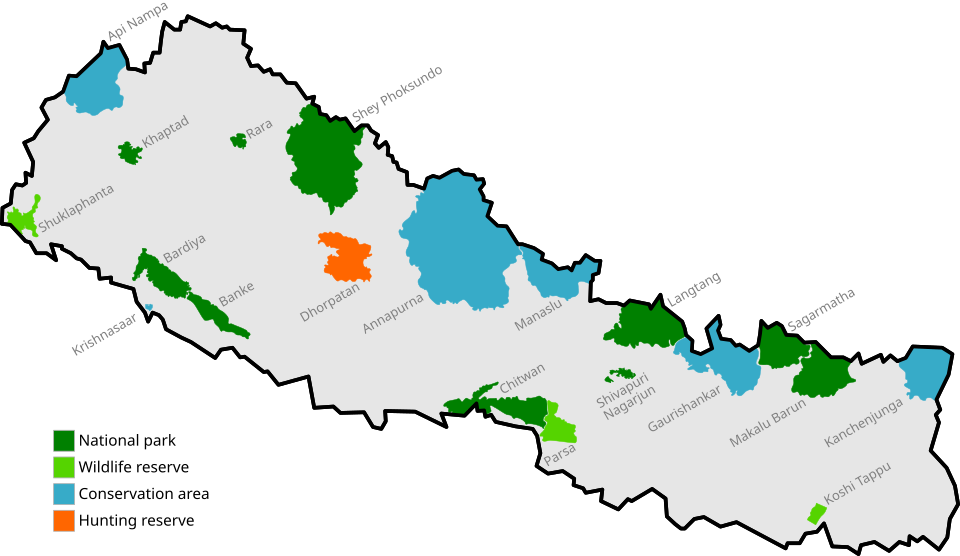 A map marking Chitwan, Annapurna, and Sagarmatha with their flagship species. (Image: CrlNvl, CC BY-SA 4.0, via Wikimedia Commons)
Why Biodiversity Matters for Hospitality
- Eco-tourism revenue: Trekking permits in the Annapurna region generate $100M/year.
- Cultural tourism: Lumbini (Buddhist heritage) and Kathmandu Valley (UNESCO) rely on intact ecosystems.
- Threats: Deforestation (for fuel/agriculture), poaching, and climate change (melting glaciers).
Real-World Link: Daraz & Sustainable Sourcing
- Daraz (Nepal’s Amazon) now partners with organic farmers in the Terai to promote sustainable agriculture.
- How? By sourcing rice, honey, and herbs from community-managed forests, reducing deforestation.
4. Natural Resources in Action: Case Studies
Case 1: Kathmandu’s Traffic & Air Pollution (Terai’s Role)
- Problem: Vehicles from the Terai (industrial hubs like Birgunj) emit PM2.5, worsening Kathmandu’s air quality.
- Solution: Electric buses (piloted by Metro Bus) using hydropower (renewable energy).
- Lesson: Urban planning must integrate resource management (e.g., green belts along highways).
Case 2: NTC’s Hydropower Expansion
- Nepal Transmission Company (NTC) is building transmission lines to connect remote hydropower plants (e.g., Pancheshwar Dam) to cities.
- Impact:
- Pros: Reduces reliance on imported fuel, cuts CO₂ emissions.
- Cons: Displaces communities (e.g., Indravati Dam protests).
5. Challenges & Sustainable Solutions
| Challenge | Cause | Solution |
|---|---|---|
| Deforestation | Fuelwood demand, agriculture | Community forestry programs (e.g., CFUGs) |
| Glacier retreat | Climate change | Glacier monitoring (ICIMOD) |
| Water scarcity | Poor infrastructure | Rainwater harvesting (e.g., Pokhara’s rooftop systems) |
| Mineral exploitation | Illegal mining (e.g., Lumle) | Strict licensing (DoM) |
In the Real World
eSewa & Digital Payments
- Idea Used: Renewable energy for data centers.
- How? eSewa’s servers in Lalitpur run on solar power to reduce carbon footprint during peak transactions (e.g., Dashain/Tihar).
Pathao’s Electric Fleet
- Idea Used: Hydropower-charged vehicles.
- How? Pathao partners with Nepal Electric Vehicle Association to deploy e-rickshaws in Kathmandu, cutting fuel costs by 40%.
Nepal Stock Exchange (NEPSE) & Green Bonds
- Idea Used: Biodiversity as an investment.
- How? NEPSE lists eco-friendly companies (e.g., Green Power Development Company) that fund reforestation projects.
Exam Tip
- Define with Examples:
- "Natural resources are materials from nature used by humans. In Nepal, hydropower (renewable) and iron ore (non-renewable) are key examples."
- Link to Hospitality:
- Always connect resources to tourism, agriculture, or infrastructure. Example: "Chitwan’s biodiversity attracts luxury eco-lodges, generating $50M/year in revenue."
- Compare Zones:
- Use a table (like above) to contrast Himalayas vs. Terai resources.
- Critical Analysis:
- Examiners love pros/cons of resource use. Example: "While hydropower reduces fuel imports, dams like West Seti displace local communities."
- Real-World Applications:
- Mention NTC, Daraz, or Pathao to show how theory applies to Nepal’s economy.
Key Formula to Remember: (Example: Annapurna’s biodiversity = $100M trekking income + clean water for Pokhara – $20M deforestation loss.)
Based on the TU BHM syllabus for Nepalese Society And Politics (SOC312), unit 4.
Discussion
Loading…