Entrepreneurship for HospitalityUnit 28 min read
Entrepreneurial Traits, Motivation & Hospitality Success
Unit 2 of Entrepreneurship for Hospitality explores the psychological and behavioral foundations of successful hospitality entrepreneurs, covering key traits (innovation, risk-taking, resilience), motivation theories (Maslow, Herzberg), and how these drive startups like boutique hotels or food trucks in Nepal’s competi
Key Entrepreneurial Traits in Hospitality
Entrepreneurs in hospitality (e.g., hoteliers, restaurateurs) need a unique blend of personal and behavioral traits to thrive. Research shows that innovation, risk-taking, resilience, and customer focus are critical. Below is a comparison of traits between traditional managers and hospitality entrepreneurs:
mindmap
  root((Entrepreneurial Traits in Hospitality))
    Innovation["Creates unique guest experiences (e.g., themed cafes, eco-lodges)"]
    Risk-Taking["Invests in untested concepts (e.g., pop-up restaurants, fusion cuisine)"]
    Resilience["Recovers from failures (e.g., COVID-19 closures, supply chain disruptions)"]
    Customer Focus["Prioritizes guest satisfaction over profit margins"]
    Leadership["Motivates teams without formal authority (e.g., family-run dhabas)"]
    Adaptability["Pivots quickly (e.g., switching to delivery-only during lockdowns)"]
Why these traits matter in hospitality?
- Innovation: Guests seek memorable experiences (e.g., Thamel’s rooftop bars or Pokhara’s adventure lodges).
- Risk-taking: Opening a boutique hotel in Kathmandu requires betting on niche markets (e.g., digital nomads).
- Resilience: Nepal’s tourism fluctuations (earthquakes, political strikes) demand quick recovery strategies.
Motivation Theories for Hospitality Entrepreneurs
Motivation drives entrepreneurs to start, sustain, and grow their businesses. Two key theories apply:
1. Maslow’s Hierarchy of Needs
Entrepreneurs must fulfill personal needs before focusing on business growth. For hospitality, this means:
- Physiological: Ensuring stable income (e.g., dhabas in highway towns).
- Safety: Securing permits, insurance (e.g., Nepal Tourism Board registrations).
- Social: Building a guest community (e.g., co-working cafes like The Social in Thamel).
- Esteem: Brand reputation (e.g., Michelin-recognized Nepali chefs).
- Self-actualization: Creating a legacy (e.g., family-owned heritage hotels).
mindmap
  root((Maslow’s Hierarchy in Hospitality))
    Physiological["Stable income (e.g., daily wage for street food vendors)"]
    Safety["Business licenses, employee contracts"]
    Social["Guest loyalty programs, social media engagement"]
    Esteem["Awards (e.g., ‘Best Café in Kathmandu’)"]
    Self-Actualization["Building a brand legacy (e.g., Himalayan Java’s expansion)"]
2. Herzberg’s Two-Factor Theory
- Hygiene Factors (dissatisfiers if missing):
- Salary, work conditions, company policies (e.g., fair wages for hotel staff).
- Motivators (satisfiers that drive growth):
- Achievement, recognition, growth opportunities (e.g., promoting a chef to head of kitchen).
Example: A family-run guesthouse in Pokhara may start with basic needs (hygiene factors) but grows when owners recognize staff achievements (motivators).
In the Real World
Himalayan Java (Nepal)
- Trait: Innovation + Customer Focus
- How: Started as a single café in Thamel, now a chain by offering local coffee blends and co-working spaces—tapping into digital nomads and students.
- Motivation: Founder’s self-actualization (building a brand) and social need (creating a community hub).
Daraz (Nepal)
- Trait: Risk-taking + Adaptability
- How: Entered Nepal’s e-commerce market during COVID-19, pivoting from physical stores to hyperlocal delivery.
- Motivation: Esteem (market leadership) and growth (expanding to food delivery via Daraz Mart).
Nabil Bank’s SME Loans (Nepal)
- Trait: Resilience + Leadership
- How: Provides low-interest loans to small hospitality businesses (e.g., restaurants, lodges) to recover from natural disasters or economic downturns.
- Motivation: Social impact (supporting local economies) aligns with bank’s corporate social responsibility (CSR).
Worked Example: Motivation in a Kathmandu Café
Scenario: Raju owns a small café in Thamel struggling with low footfall. How can he use motivation theories to improve?
| Problem | Maslow’s Solution | Herzberg’s Solution |
|---|---|---|
| Low income (Physiological) | Offer affordable meals (e.g., Nepali thali for Rs. 250). | Increase wages for staff to retain talent. |
| No brand recognition | Create a loyalty program (e.g., buy 10 coffees, get 1 free). | Reward top-selling staff (e.g., monthly bonuses). |
| High competition | Innovate (e.g., live music nights). | Train staff in customer service. |
| Guest complaints | Safety: Ensure cleanliness, hygiene. | Recognize staff who handle complaints well. |
Outcome: Within 3 months, Raju’s café sees a 20% increase in customers due to better staff motivation and guest engagement.
Comparing Entrepreneurial Traits: Success vs. Failure
Not all entrepreneurs succeed. The difference often lies in traits and motivation alignment. Below is a comparison:
| Trait | Successful Hospitality Entrepreneur | Unsuccessful Hospitality Entrepreneur |
|---|---|---|
| Innovation | Opens a vegan café in Kathmandu (tapping into health trends). | Copies a Thai restaurant without differentiation. |
| Risk-taking | Invests in sustainable tourism (e.g., eco-lodges in Annapurna). | Avoids new trends (e.g., ignores delivery apps). |
| Resilience | Recovers from earthquake damage by offering discounts to affected guests. | Closes permanently after one setback. |
| Customer Focus | Personalizes guest experiences (e.g., remembering regulars’ orders). | Treats guests as just transactions. |
| Motivation | Driven by passion for hospitality (self-actualization). | Only in it for quick profits. |
Case Study: The Social Café (Thamel, Kathmandu)
Business: A co-working café targeting digital nomads, students, and remote workers. Key Traits & Motivation:
- Innovation:
- Hybrid model: Café + workspace (rare in Nepal).
- Tech integration: Free Wi-Fi, charging stations, and printing services.
- Customer Focus:
- Guest feedback drives menu changes (e.g., adding gluten-free options).
- Resilience:
- Survived COVID-19 by offering takeaway work kits (laptop + coffee combo).
- Motivation:
- Founder’s vision: Create a "third place" (home, work, café) for global travelers.
- Staff motivation: Flexible hours, skill development (e.g., barista training).
Result: 30% year-on-year growth and featured in Lonely Planet.
Exam Tip
How This Unit is Tested
Definitions & Differences (5-10 marks):
- Expect questions like:
- "Distinguish between innovation and risk-taking in hospitality with examples."
- "How does Maslow’s hierarchy apply to a Pokhara lodge owner?"
- Answer tip: Use real Nepali examples (e.g., Himalayan Java for innovation, local dhabas for physiological needs).
- Expect questions like:
Scenario-Based Questions (10-15 marks):
- "A new hotel in Chitwan is struggling with staff turnover. Apply Herzberg’s theory to suggest solutions."
- Answer tip: Break into hygiene factors (salary, policies) and motivators (recognition, growth).
Case Study Analysis (10-20 marks):
- "Analyze how Nabil Bank’s SME loans support hospitality entrepreneurs using motivation theories."
- Answer tip: Link to safety needs (loans = financial security) and self-actualization (business growth).
Comparison Tables (5-10 marks):
- "Compare entrepreneurial traits of successful vs. failed hospitality businesses in Nepal."
- Answer tip: Use Daraz (success) vs. a closed-down café (failure).
Marks Boosters
- Use real examples (e.g., Himalayan Java, The Social Café).
- Relate to Nepal’s context (e.g., tourism fluctuations, local competition).
- Draw diagrams (e.g., Maslow’s hierarchy for a guesthouse owner).
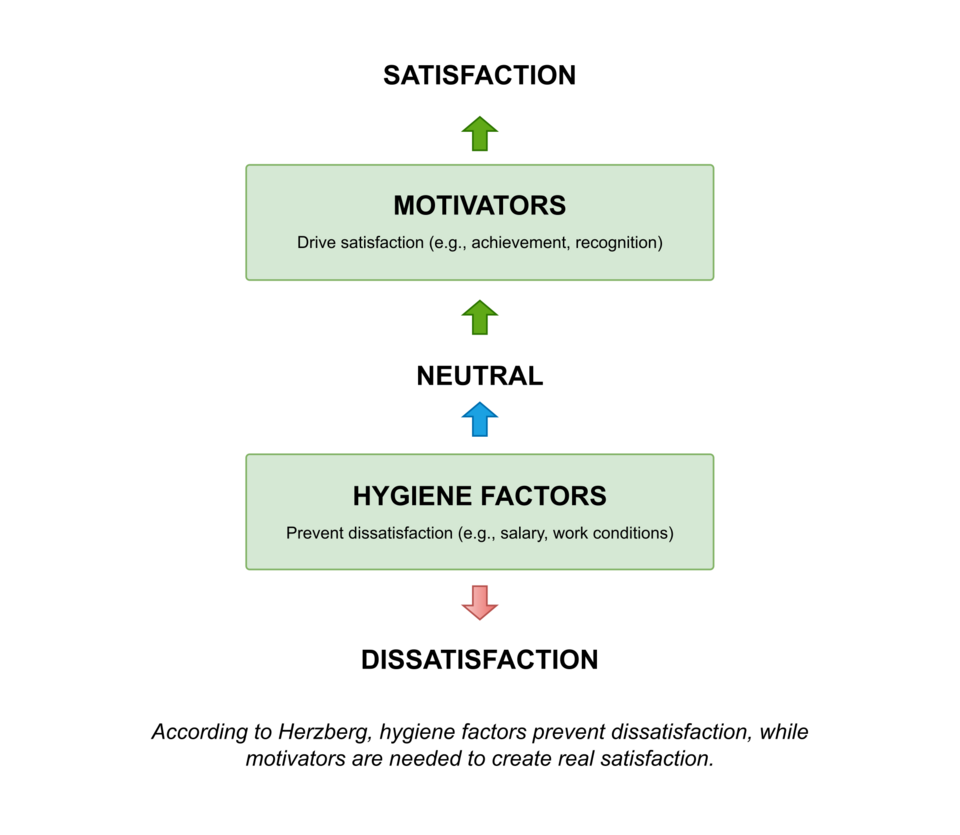 Motivators vs. hygiene factors with café/restaurant applications. (Image: Mdaudabello, CC BY 4.0, via Wikimedia Commons)
Based on the TU BHM syllabus for Entrepreneurship for Hospitality (BHM329), unit 2.
Discussion
Loading…