Strategic ManagementUnit 611 min read
Corporate-Level Strategies: Growth, Diversification & Synergy
Unit 6 of Strategic Management explores how companies expand beyond their core business to create value through diversification, vertical integration, and strategic alliances. Learn Porter’s corporate strategies, BCG matrix, and real-world applications in Nepal’s hospitality and global firms.
TAKEAWAYS:
- Corporate-level strategies focus on how a company competes across multiple businesses, not just what business it’s in.
- Diversification (related/unrelated) and vertical integration (backward/forward) are key growth tools, but each has trade-offs.
- The BCG matrix helps allocate resources to cash cows, stars, question marks, and dogs based on market growth and share.
- Synergy (1+1=3) is the core benefit of corporate strategies, but realizing it requires strong integration and management.
- Nepal’s hotel chains (e.g., Hotel Yak & Yeti) and global brands (e.g., Marriott, Accor) use these strategies to dominate markets.
- Exam questions often ask how a hotel group (e.g., Himalayan Java) could diversify or integrate vertically—link theory to real cases.
1. What Are Corporate-Level Strategies?
Corporate-level strategies determine which industries a company should compete in and how it should manage its portfolio of businesses. Unlike business-level strategies (e.g., cost leadership in a single hotel), corporate strategies address:
- Scope: Should the company stay in one business (e.g., only luxury hotels) or expand into unrelated areas (e.g., real estate, travel agencies)?
- Synergy: Can combining businesses create shared resources, economies of scale, or competitive advantages?
- Risk: How does diversification affect financial stability (e.g., a hotel chain adding a casino vs. a spa)?
How It Differs from Business-Level Strategies
| Aspect | Business-Level Strategy | Corporate-Level Strategy |
|---|---|---|
| Focus | How to compete within one industry (e.g., low-cost vs. premium pricing in hotels). | How to compete across multiple industries (e.g., a hotel group adding a restaurant chain). |
| Tools | Porter’s generic strategies (cost leadership, differentiation). | Diversification, vertical integration, mergers/acquisitions. |
| Example | Hotel Yak & Yeti offering unique Himalayan cuisine to differentiate. | Hotel Yak & Yeti acquiring a travel agency to bundle bookings. |
2. Types of Corporate-Level Strategies
A. Diversification Strategies
Diversification means entering new markets or industries. It can be:
Related Diversification
- Definition: Expanding into businesses that share similar resources, technologies, or customers with the core business.
- Example: A luxury hotel chain (e.g., Himalayan Java) adding a high-end restaurant or spa services to leverage its brand and customer base.
- Advantages:
- Shared marketing, distribution, or R&D costs.
- Easier to manage due to synergies.
- Disadvantages:
- Limited growth if the new business is too similar.
- Risk of overstretching resources.
flowchart TD
  A["Core Business: Luxury Hotels"] --> B["Related Diversification"]
  B --> C["High-End Restaurants"]
  B --> D["Spa & Wellness Centers"]
  B --> E["Private Tour Operators"]
  C --> F["Synergy: Cross-promotion"]
  D --> F
  E --> F
Unrelated Diversification (Conglomerate Strategy)
- Definition: Entering businesses with no obvious link to the core business (e.g., a hotel group buying a pharmaceutical company).
- Example: Chaudhary Group (Nepal) owns hotels, banks, and retail stores—no direct synergy but spreads risk.
- Advantages:
- Risk reduction (if one business fails, others may compensate).
- Access to new markets/capital.
- Disadvantages:
- High management complexity.
- No cost or resource sharing.
- Harder to create synergy.
B. Vertical Integration
Vertical integration means controlling upstream (suppliers) or downstream (distributors) parts of the supply chain.
Backward Vertical Integration
- Definition: Acquiring or developing suppliers to ensure a steady, high-quality input.
- Example: A hotel chain (e.g., Hotel Yak & Yeti) starting its own organic farm to supply fresh produce to restaurants.
- Advantages:
- Secure supply chain (no dependency on external suppliers).
- Higher quality control.
- Disadvantages:
- High initial investment.
- Risk of overproduction if demand drops.
Forward Vertical Integration
- Definition: Moving closer to the customer (e.g., a hotel chain opening its own travel agency).
- Example: Marriott International owns Marriott Vacation Club (timeshare properties) to directly sell long-term stays.
- Advantages:
- Higher profit margins (cutting out middlemen).
- Better customer loyalty.
- Disadvantages:
- Complexity in managing new business functions.
- Higher operational costs.
flowchart TD
  A["Raw Materials"] --> B["Suppliers"]
  B --> C["Hotel Chain"]
  C --> D["Customers"]
  subgraph Backward Integration
    C -->|"Acquires"| B
  end
  subgraph Forward Integration
    C -->|"Acquires"| D
  end
C. Strategic Alliances & Joint Ventures
- Definition: Partnering with another company to share resources, risks, and rewards without full ownership.
- Example:
- Nabil Bank partnering with Hotel Yak & Yeti to offer exclusive credit cards for hotel bookings.
- Accor Hotels (global) collaborating with local Nepali tour operators for package deals.
- Advantages:
- Shared costs and risks.
- Access to new markets or technologies.
- Disadvantages:
- Loss of control.
- Potential conflicts with partners.
3. The BCG Matrix: Managing a Business Portfolio
The Boston Consulting Group (BCG) Matrix helps companies allocate resources based on:
- Market Growth Rate (high/low).
- Relative Market Share (high/low).
| Quadrant | Market Growth | Market Share | Example (Hotel Industry) | Strategy |
|---|---|---|---|---|
| Stars | High | High | Five-star hotels in Kathmandu | Invest heavily to maintain growth. |
| Cash Cows | Low | High | Established 3-star hotels | Generate cash to fund other businesses. |
| Question Marks | High | Low | New boutique hotels in Pokhara | Decide: invest to grow or divest. |
| Dogs | Low | Low | Old, low-demand hotels | Divest or liquidate. |
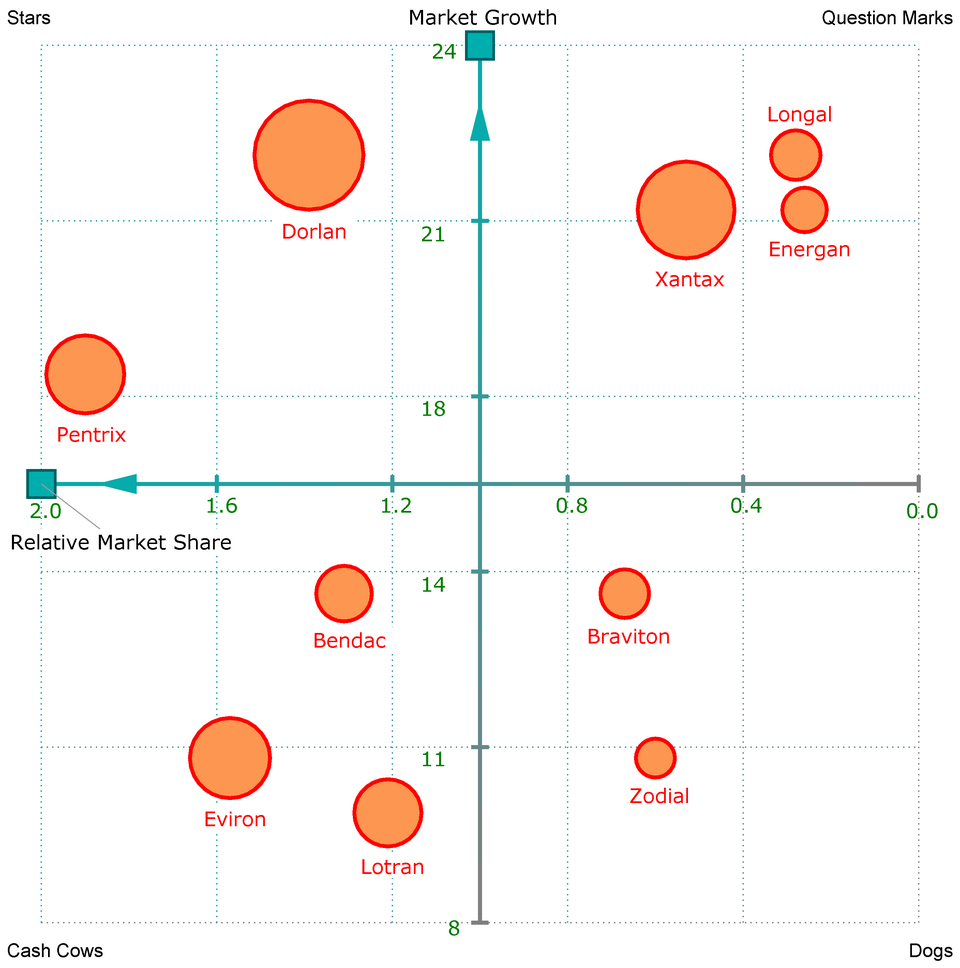 A labeled BCG matrix showing hotel industry examples. (Image: Ericmelse, CC BY 3.0, via Wikimedia Commons)
Worked Example: Himalayan Java’s Portfolio
- Stars: New luxury hotels in Thamel (high growth, high share).
- Cash Cows: Established hotels in Pokhara (steady revenue, low growth).
- Question Marks: A new wellness retreat in Chitwan (high growth but low share—needs marketing).
- Dogs: An old hotel in Biratnagar (low demand, high costs—consider selling).
4. Synergy: The Key to Corporate Strategy Success
Synergy occurs when the combined value of businesses is greater than the sum of their parts (1+1=3). Types:
- Operational Synergy
- Sharing resources (e.g., a hotel chain using the same PMS software across all properties).
- Financial Synergy
- Tax benefits, cost savings (e.g., a hotel group using bulk purchasing power for linens).
- Managerial Synergy
- Cross-training staff (e.g., chefs from one hotel managing a new restaurant).
Example: Marriott’s Synergy
- Operational: Standardized room service menus across all hotels.
- Financial: Bulk discounts on global supplier contracts.
- Managerial: Training programs for global and local staff.
5. Real-World Applications in Nepal & Globally
In the Real World
Himalayan Java (Nepal)
- Strategy: Related diversification (hotels + restaurants + spas).
- How: Their Himalayan Java Café in Thamel leverages the hotel’s customer base for breakfast/lunch.
- Synergy: Cross-promotion (e.g., "Stay at our hotel, get 20% off at our café").
Nabil Bank (Nepal)
- Strategy: Unrelated diversification (banking + insurance + microfinance).
- How: Offers Nabil Card with hotel booking perks, even though hotels aren’t their core business.
- Synergy: Customer loyalty (bank customers get discounts at partner hotels).
Accor Hotels (Global)
- Strategy: Vertical integration (owning hotels + timeshares + management contracts).
- How: Accor Vacations (timeshares) ensures repeat bookings for their hotels.
- Synergy: Data sharing (e.g., knowing which guests prefer timeshares helps tailor marketing).
Case Study: Daraz (Nepal’s Amazon) and Corporate Strategies
Scenario: Daraz wants to expand beyond e-commerce.
- Option 1: Related Diversification
- Add Daraz Logistics (like Amazon’s delivery network) to control the last-mile delivery.
- Synergy: Faster deliveries → happier customers → more sales.
- Option 2: Vertical Integration (Backward)
- Start a Daraz Warehouse Solutions to rent storage space to other businesses.
- Synergy: Additional revenue stream; better inventory control.
- Option 3: Strategic Alliance
- Partner with Nepal Post for rural deliveries.
- Synergy: Expands reach without heavy investment.
6. Advantages and Disadvantages of Corporate Strategies
| Strategy | Advantages | Disadvantages |
|---|---|---|
| Related Diversification | Shared resources, easier management. | Limited growth if markets are saturated. |
| Unrelated Diversification | Risk spreading, new revenue streams. | High complexity, no synergies. |
| Vertical Integration | Control over supply chain, higher margins. | High costs, operational complexity. |
| Strategic Alliances | Shared risks, access to new markets. | Loss of control, potential conflicts. |
Exam Tip
- Link Theory to Cases: Exams often ask:
- "How could Hotel Yak & Yeti use diversification to enter new markets?"
- Answer: Related diversification (add a restaurant) or vertical integration (own a farm for organic produce).
- BCG Matrix Questions:
- "Classify these businesses in a BCG matrix and suggest strategies."
- Tip: Always justify your classification with market growth and share data.
- Synergy is Key:
- If asked "Why did Marriott acquire Accor’s timeshare business?", answer:
- Synergy: Cross-selling (hotel guests → timeshare buyers).
- Financial: Higher customer lifetime value.
- If asked "Why did Marriott acquire Accor’s timeshare business?", answer:
- Nepal Focus:
- Expect questions on local companies (e.g., Himalayan Java, Nabil Bank, Daraz).
- Example: "How could a Nepali hotel chain use vertical integration to reduce costs?"
- Answer: Start a laundry service for all hotels → lower costs than outsourcing.
Summary Checklist for Exam Preparation
- Can you define diversification, vertical integration, and strategic alliances?
- Can you draw a BCG matrix and classify 4 businesses (e.g., 2 stars, 1 cash cow, 1 dog)?
- Can you give 2 Nepali examples of each corporate strategy (e.g., Himalayan Java’s related diversification)?
- Can you explain synergy with a real-world example (e.g., Nabil Bank + hotels)?
- Can you compare related vs. unrelated diversification in a table?
Based on the TU BHM syllabus for Strategic Management (MGT312), unit 6.
Discussion
Loading…