Strategic ManagementUnit 19 min read
Strategic Management: Definitions, Importance, Process & Types
Unit 1 of Strategic Management introduces core concepts like definitions, levels of strategy, the strategic management process, and types of strategies, with real-world examples from Nepalese and global businesses to illustrate how theory applies in practice.
Key Concepts and Definitions
What is Strategic Management?
Strategic management is the art and science of formulating, implementing, and evaluating cross-functional decisions that enable an organization to achieve its objectives. It involves long-term planning and resource allocation to gain a competitive advantage.
Importance of Strategic Management
Strategic management is crucial for organizations because it:
- Provides direction by aligning goals with resources.
- Enhances competitiveness through sustainable advantages.
- Improves decision-making with structured analysis.
- Ensures adaptability to changing environments.
- Maximizes stakeholder value (employees, customers, investors).
Levels of Strategy
Strategic management operates at three levels within an organization:
| Level | Scope | Example (Nepal) | Example (Global) |
|---|---|---|---|
| Corporate | Entire organization | Chaudhary Group’s expansion into retail | Toyota’s global automotive strategy |
| Business | Individual business units | Nabil Bank’s digital banking strategy | Google’s YouTube ad revenue model |
| Functional | Departments (HR, Marketing, etc.) | Himalayan Java’s supply chain optimization | Starbucks’ barista training program |
The Strategic Management Process
The process consists of five key phases:
flowchart LR
  A["1. Environmental Scanning"] --> B["2. Strategy Formulation"]
  B --> C["3. Strategy Implementation"]
  C --> D["4. Evaluation & Control"]
  D -->|"Feedback"| A
- Environmental Scanning: Analyzing internal and external factors (PESTEL, SWOT).
- Strategy Formulation: Developing long-term objectives and strategies.
- Strategy Implementation: Executing plans through policies and actions.
- Evaluation & Control: Monitoring performance and adjusting strategies.
Worked Example: Daraz’s Growth Strategy
- Scanning: Identified Nepal’s e-commerce boom and competition from local players.
- Formulation: Partnered with Alibaba for global supply chains and localized customer service.
- Implementation: Expanded delivery networks and digital payment options (Khalti, eSewa).
- Evaluation: Tracked customer acquisition costs and market share growth.
Types of Strategies
Strategies can be classified based on scope, time horizon, and competitive approach:
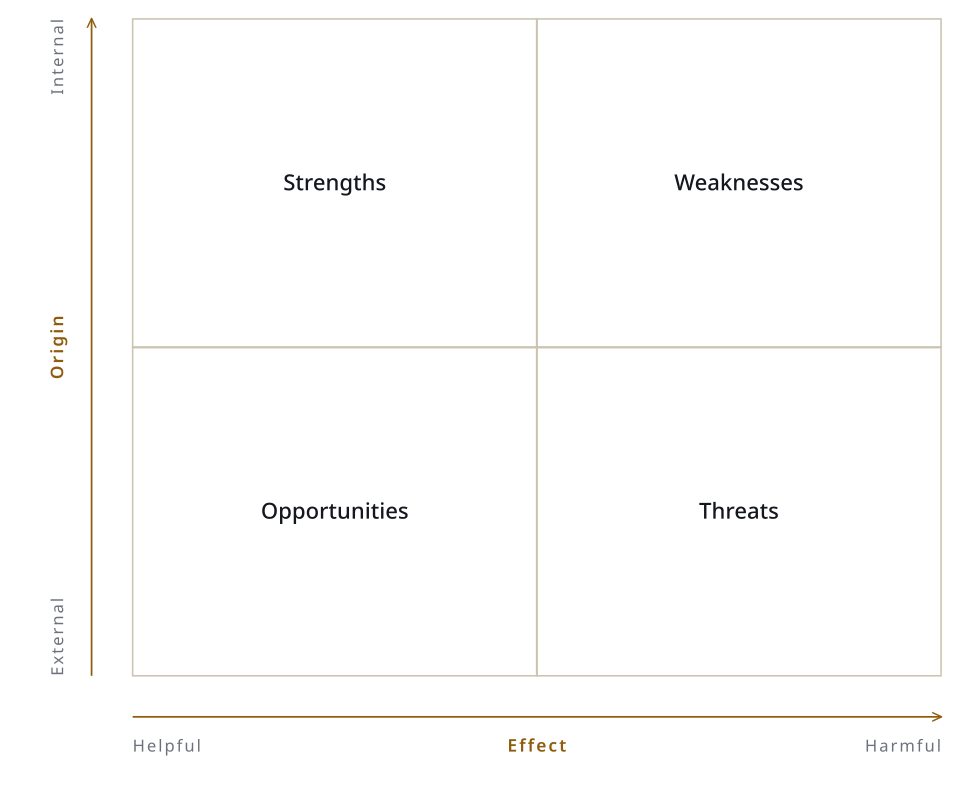 Visual representation of Strategic Analysis Tools (Image: Peter Gladdish, CC BY 4.0, via Wikimedia Commons)
1. By Scope
| Type | Description | Example |
|---|---|---|
| Corporate | Overall direction of the organization | NTC’s expansion into fiber optics |
| Business | Competitive moves for a business unit | Pathao’s ride-hailing dominance |
| Functional | Department-specific actions | Nabil Bank’s customer loyalty programs |
2. By Time Horizon
| Type | Duration | Example |
|---|---|---|
| Long-term | 3–5+ years | NEPSE’s infrastructure upgrades |
| Medium-term | 1–3 years | Daraz’s seasonal sales promotions |
| Short-term | <1 year | Hotel management’s daily staffing |
3. By Competitive Approach
| Type | Description | Example |
|---|---|---|
| Cost Leadership | Lowest cost in the industry | BigMart’s bulk discounts |
| Differentiation | Unique products/services | Himalayan Java’s organic coffee |
| Focus | Niche market specialization | Local boutique hotels in Pokhara |
In the Real World
eSewa & Khalti (Digital Payments)
- Idea Used: Strategy Implementation
- How: Both platforms leveraged Nepal’s mobile penetration to simplify transactions. eSewa’s partnership with banks and Khalti’s focus on micro-transactions (e.g., bus fares, utility bills) reflect functional-level strategies tailored to user needs.
Nabil Bank (Customer-Centric Banking)
- Idea Used: Business-Level Strategy (Differentiation)
- How: Nabil’s "Nabil eBanking" and "Nabil Mitra" (customer service) strategies differentiate it from competitors like Global IME by offering 24/7 digital support and personalized loan products. Their SWOT analysis identified Nepal’s growing digital literacy as an opportunity.
Daraz (Corporate-Level Strategy)
- Idea Used: Environmental Scanning + Implementation
- How: Daraz’s entry into Nepal was driven by scanning:
- External: Rising smartphone usage (90%+ penetration) and government push for digital economy.
- Internal: Alibaba’s global logistics expertise.
- Implementation: Launched "Daraz Cash on Delivery" to address Nepal’s cash-preference culture, later adding Khalti/eSewa payments.
Case Study: Toyota’s Global Strategy
Toyota’s "Toyota Way" exemplifies strategic management at multiple levels:
mindmap
  root((Toyota’s Strategy))
    Corporate Level
      "Global expansion via local partnerships"
      "Sustainability goals (e.g., hydrogen cars)"
    Business Level
      "Cost leadership in hybrid vehicles"
      "Differentiation in safety tech (e.g., Toyota Safety Sense)"
    Functional Level
      "Just-in-Time (JIT) inventory management"
      "Employee empowerment (e.g., kaizen culture)"
    Key Outcomes
      "Market leadership in hybrids"
      "Resilience during supply chain crises"
Why It Works in Nepal?
- Adaptability: Toyota’s Fortuner and Hilux dominate Nepal’s rugged terrain, showing business-level differentiation.
- Partnerships: Collaborations with Nepal Automobiles for local assembly reflect corporate-level strategy.
Advantages and Disadvantages of Strategic Management
| Advantages | Disadvantages |
|---|---|
| ✔ Clear direction for all stakeholders | ❌ Time-consuming (analysis, planning) |
| ✔ Competitive edge through innovation | ❌ Rigid if not flexible |
| ✔ Resource optimization | ❌ High initial costs (consultants, tech) |
| ✔ Better risk management | ❌ Resistance to change from employees |
| ✔ Stakeholder alignment |
Exam Tip
- Definitions Matter: Memorize key terms like "strategic management," "corporate strategy," and "SWOT analysis"—examiners often test these in short-answer questions.
- Link Theory to Examples:
- For levels of strategy, use Nabil Bank (business-level) or Chaudhary Group (corporate-level).
- For process phases, trace Daraz’s growth or NTC’s fiber expansion.
- Diagrams = Easy Marks:
- Draw the strategic management process flowchart or levels of strategy hierarchy.
- Label all components (e.g., "Environmental Scanning → Formulation").
- Case Study Ready:
- Be prepared to analyze Toyota, Daraz, or Nabil Bank in 10–15 minutes. Focus on:
- What strategy type? (Cost leadership? Differentiation?)
- How was it implemented? (Partnerships? Tech?)
- Results? (Market share? Customer satisfaction?)
- Be prepared to analyze Toyota, Daraz, or Nabil Bank in 10–15 minutes. Focus on:
- Common Pitfalls:
- ❌ Confusing strategic management with operational management (short-term vs. long-term).
- ❌ Ignoring Nepal-specific examples (e.g., NTC’s monopoly vs. Ncell’s competition).
- ❌ Overlooking functional strategies (e.g., HR training at Himalayan Java).
Based on the TU BHM syllabus for Strategic Management (MGT312), unit 1.
Discussion
Loading…