Digital LogicUnit 810 min read
Karnaugh Maps: Minimization, Simplification & Real-World Logic Design
Unit 8 of Digital Logic covers Karnaugh Maps (K-Maps) for simplifying Boolean expressions, including 2-, 3-, and 4-variable maps, group formation rules, and practical applications in digital circuit design. Learn how to minimize logic functions efficiently for cost-effective hardware implementation.
TAKEAWAYS:
- K-Maps visually simplify Boolean expressions by grouping adjacent 1s, reducing the number of logic gates needed in circuits.
- The 2^n rule (where n is the number of variables) determines the size of K-Maps, ensuring all possible combinations are represented.
- Octal and hexadecimal grouping in 4-variable maps reduces complexity by merging larger blocks of 1s.
- Don’t-care conditions (X’s) can be strategically used to simplify expressions further, optimizing circuit design.
- K-Maps are widely used in FPGA/CPLD design, encoder/decoder circuits, and state machine optimization in real-world digital systems.
- Mastering K-Maps leads to faster, cheaper, and more efficient digital circuit implementations.
1. Introduction to Karnaugh Maps (K-Maps)
Karnaugh Maps (K-Maps) are graphical tools used to simplify Boolean expressions by grouping adjacent 1s. Unlike algebraic methods (e.g., Boolean algebra laws), K-Maps provide a visual and systematic approach to minimization, reducing the number of logic gates in a circuit.
Why Use K-Maps?
- Easier to visualize than algebraic simplification.
- Guarantees minimal SOP (Sum of Products) or POS (Product of Sums) forms.
- Reduces hardware complexity, lowering cost and power consumption.
Key Terms
| Term | Definition |
|---|---|
| Minterm | A product term where all variables appear (e.g., ). |
| Maxterm | A sum term where all variables appear (e.g., ). |
| Adjacent Cells | Cells that differ by one variable (horizontally or vertically, not diagonally). |
| Grouping | Combining adjacent 1s to form larger powers of 2 (2, 4, 8, 16). |
| Don’t-Care (X) | Input combinations that are irrelevant (can be treated as 0 or 1 for simplification). |
2. Structure of K-Maps
K-Maps are 2D grids where:
- Rows and columns represent variable combinations.
- Adjacent cells differ by one bit (no diagonal adjacency).
- Size depends on the number of variables:
- 2 variables → 4 cells (2×2)
- 3 variables → 8 cells (2×4)
- 4 variables → 16 cells (4×4)
Example: 3-Variable K-Map
graph TD
    subgraph K-Map for 3 Variables (A, B, C)
        A[""] --> B["00"] --> C["01"] --> D["11"] --> E["10"]
        F[""] --> G["00"] --> H["01"] --> I["11"] --> J["10"]
        K[""] --> L["00"] --> M["01"] --> N["11"] --> O["10"]
        P[""] --> Q["00"] --> R["01"] --> S["11"] --> T["10"]
    end
    label A["AB\\C"] --> label B["00"] --> label C["01"] --> label D["11"] --> label E["10"]
    label F["0"] --> label G["00"] --> label H["01"] --> label I["11"] --> label J["10"]
    label K["1"] --> label L["00"] --> label M["01"] --> label N["11"] --> label O["10"]
    label P[""] --> label Q["00"] --> label R["01"] --> label S["11"] --> label T["10"]
Note: The above is a placeholder. The actual 3-variable K-Map is a 2×4 grid (rows for A, columns for BC).
Real Picture of a K-Map
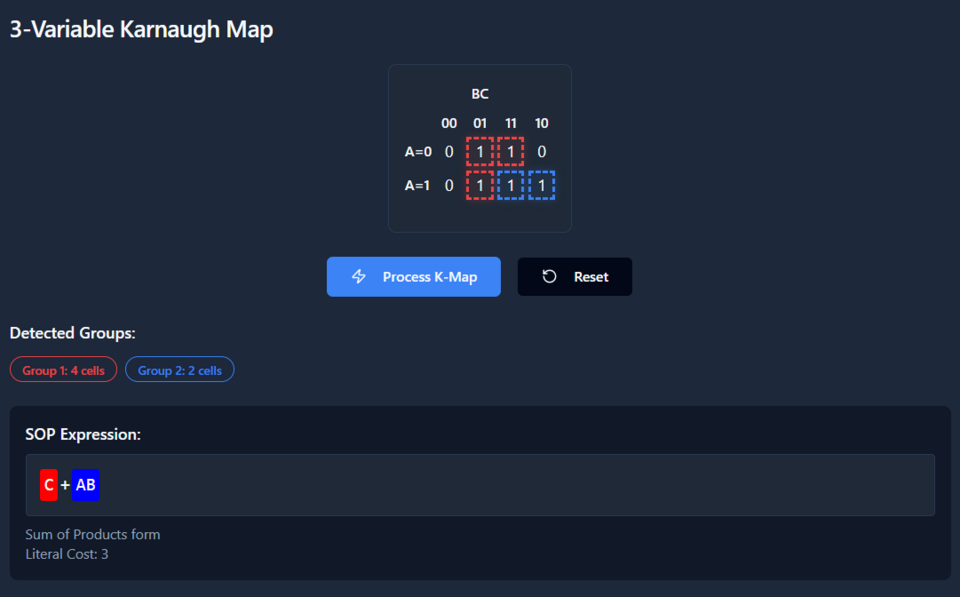 A labeled 3-variable K-Map showing rows for A and columns for BC. (Image: LearnToRaise, CC BY 4.0, via Wikimedia Commons)
3. Rules for Grouping in K-Maps
- Group only 1s (ignore 0s unless using don’t-cares).
- Groups must be powers of 2 (2, 4, 8, 16).
- Larger groups take precedence (e.g., a group of 8 over two groups of 4).
- Wrap-around allowed (top and bottom rows, left and right columns are adjacent).
- No overlapping groups (each 1 must belong to only one group).
Example: 3-Variable K-Map Grouping
Consider the Boolean function:
| AB\C | 00 | 01 | 11 | 10 |
|---|---|---|---|---|
| 0 | 1 | 1 | 0 | 1 |
| 1 | 1 | 0 | 1 | 0 |
Step-by-Step Grouping:
- Group of 4: The 1s at (0,0), (0,1), (1,0), (1,1) → (since A=0 for all).
- Group of 2: The 1s at (0,3) and (1,2) → (B=1, C=0 in both).
Simplified Expression:
4. 4-Variable K-Maps (Octal and Hexadecimal Grouping)
For 4 variables (A, B, C, D), the K-Map is 4×4. Grouping can be done in:
- Octal (8-cell groups)
- Quartets (4-cell groups)
- Duets (2-cell groups)
Example: 4-Variable K-Map
Consider:
| AB\CD | 00 | 01 | 11 | 10 |
|---|---|---|---|---|
| 00 | 1 | X | 1 | 1 |
| 01 | 1 | 1 | 1 | 1 |
| 11 | 1 | 1 | 1 | 1 |
| 10 | 1 | 1 | X | 1 |
Grouping:
- Group of 8: All 1s except (1,3) and (3,1) → 1 (always true).
- Don’t-cares (X) can be used to complete groups if needed.
Simplified Expression: (since all outputs are 1 or can be covered by don’t-cares).
5. Don’t-Care Conditions (X’s)
Don’t-cares can be treated as 0 or 1 to simplify the expression further.
Example: Using Don’t-Cares
Consider:
| AB\C | 00 | 01 | 11 | 10 |
|---|---|---|---|---|
| 0 | 1 | 1 | 0 | 0 |
| 1 | 1 | X | X | 0 |
Solution:
- Treat (4,5) as 1s to form a group of 4: .
- Remaining 1s: (0,0) and (0,1) → .
Simplified Expression:
6. K-Maps vs. Boolean Algebra
| Feature | K-Maps | Boolean Algebra |
|---|---|---|
| Method | Visual (graphical) | Algebraic (symbolic) |
| Ease of Use | Easier for 4-5 variables | Better for complex expressions |
| Minimization | Guarantees minimal SOP/POS | Requires experience |
| Don’t-Cares | Easy to handle | Requires substitution |
| Applications | Hardware design (FPGAs, PLDs) | Software, theoretical proofs |
7. Practical Applications of K-Maps
In the Real World
eSewa & Khalti (Digital Payment Systems)
- Idea Used: State Machine Optimization
- How? K-Maps help simplify the logic for transaction validation (e.g., checking user input, processing payments). Minimized logic reduces processing time and errors in high-frequency transactions.
Daraz (E-Commerce Order Processing)
- Idea Used: Priority Encoder Circuits
- How? K-Maps simplify the logic for order prioritization (e.g., high-value orders vs. bulk orders). A minimized circuit ensures faster order routing in Daraz’s backend systems.
NTC & Ncell (Network Traffic Management)
- Idea Used: Decoder Circuits for Routing
- How? K-Maps optimize the logic for packet routing in switches. For example, a 4-variable K-Map can simplify the decision logic for forwarding data packets to different Ncell towers based on signal strength.
Bank Loan Approval Systems
- Idea Used: Minimized Logic for Decision Trees
- How? Suppose a bank’s loan approval depends on:
- Credit score (A)
- Income level (B)
- Loan amount (C)
- A K-Map can simplify the Boolean logic for approval rules, reducing the number of gates in the decision circuit.
Worked Example: Traffic Light Controller (Kathmandu Traffic)
Assume a simplified traffic light system with:
- Inputs: Pedestrian button (P), Vehicle sensor (V), Time delay (T).
- Output: Green (G), Yellow (Y), Red (R).
Boolean Function (Simplified):
K-Map for Green Light (G):
| PV\T | 0 | 1 |
|---|---|---|
| 00 | 1 | 0 |
| 01 | 1 | 0 |
| 11 | 0 | 0 |
| 10 | 0 | 0 |
Grouping:
- Group of 2: (0,0) and (0,1) → .
Simplified Expression:
This minimized logic reduces the number of gates in the traffic controller circuit, making it faster and more reliable.
8. Step-by-Step K-Map Minimization Process
- List all minterms and don’t-cares.
- Draw the K-Map (2×2, 2×4, or 4×4).
- Fill in 1s, 0s, and X’s.
- Start grouping from the largest possible group (8, 4, 2).
- Ensure no overlapping groups.
- Write the simplified expression.
- Verify with a truth table.
Example: Minimizing
| AB\C | 00 | 01 | 11 | 10 |
|---|---|---|---|---|
| 0 | 1 | 0 | 0 | 1 |
| 1 | 1 | 1 | 1 | 0 |
Grouping:
- Group of 4: (0,0), (0,3), (1,0), (1,3) → (since B=0 for first two, B=1 for last two; C=0 for first and last).
- Group of 2: (0,2) and (1,2) → .
Simplified Expression:
9. Common Mistakes to Avoid
- Diagonal Grouping → Only horizontal/vertical adjacency counts.
- Overlapping Groups → Each 1 must belong to only one group.
- Ignoring Don’t-Cares → Can lead to suboptimal simplification.
- Incorrect Wrap-Around → Top/bottom and left/right edges are adjacent.
- Forgetting to Include All Minterms → Leads to incorrect simplification.
10. Exam Tip
- Always start with the largest possible group (8 > 4 > 2).
- Use don’t-cares to complete groups if needed.
- Double-check adjacency (no diagonals!).
- Practice with 4-variable maps (most exam questions focus here).
- Show all steps in the exam (grouping, simplification, final expression).
- Memorize the K-Map sizes:
- 2 variables → 2×2
- 3 variables → 2×4
- 4 variables → 4×4
Common Exam Questions:
- Simplify using K-Maps: .
- Design a circuit using minimized K-Map output.
- Explain how don’t-cares affect simplification.
- Compare K-Maps and Boolean algebra for minimization.
Final Note: K-Maps are a powerful tool for digital logic simplification. Mastering them will help you design efficient, cost-effective, and high-performance digital circuits—essential for exams and real-world applications like FPGA programming, encoder/decoder design, and state machine optimization. Practice with different variable counts and don’t-cares to build confidence!
Based on the TU BIM syllabus for Digital Logic (IT233), unit 8.
Discussion
Loading…