PsychologyUnit 717 min read
Intelligence: Theories, Measurement, and Applications
Unit 7 of Psychology explores the nature of intelligence—its definitions, theories (e.g., Spearman’s g-factor, Gardner’s multiple intelligences), measurement tools (IQ tests, aptitude tests), and real-world applications in education, technology, and workplace settings. It also covers cultural biases, emotional intellig
TAKEAWAYS:
- Intelligence is a multidimensional construct—not just IQ—encompassing cognitive abilities, emotional intelligence, and domain-specific skills like creativity or social awareness.
- Theories like Spearman’s g-factor, Gardner’s multiple intelligences, and Sternberg’s triarchic model explain intelligence differently, emphasizing either general ability, specialized skills, or practical problem-solving.
- IQ tests measure fluid and crystallized intelligence, but they are culturally biased and limited in assessing non-cognitive abilities like emotional intelligence.
- Emotional intelligence (EQ)—self-awareness, empathy, and relationship management—is critical for leadership, teamwork, and personal success.
- Real-world applications include hiring (Google’s structured interviews), education (personalized learning in eSewa’s digital platforms), and mental health (Nepal’s Ncell’s customer service training).
- Controversies (e.g., nature vs. nurture, genetic vs. environmental influences) highlight the need for ethical and inclusive approaches in intelligence research.
What is Intelligence?
Intelligence is the ability to acquire, process, and apply knowledge to solve problems, adapt to new situations, and learn from experience. It is not a single trait but a collection of cognitive skills, including reasoning, memory, creativity, and problem-solving. Psychologists debate whether intelligence is:
- General (one underlying ability, e.g., Spearman’s g-factor)
- Domain-specific (multiple independent intelligences, e.g., Gardner’s theory)
- Context-dependent (adaptive to real-world challenges, e.g., Sternberg’s triarchic model)
Key Definitions
| Term | Definition | Example |
|---|---|---|
| General Intelligence (g-factor) | A single, overarching cognitive ability that influences performance across tasks. | A student who excels in math, language, and logic may have high g-factor. |
| Fluid Intelligence | Ability to think logically, solve novel problems, and adapt to new situations. | Solving a complex puzzle or learning a new programming language quickly. |
| Crystallized Intelligence | Accumulated knowledge and skills from experience and education. | Recalling historical dates or using grammar rules in writing. |
| Emotional Intelligence (EQ) | Ability to recognize, understand, and manage emotions in oneself and others. | A manager who calms a stressed team member during a crisis. |
Theories of Intelligence
Different theories explain intelligence in unique ways. Below are the three most influential models:
1. Spearman’s Two-Factor Theory (g-factor)
- Proposed by: Charles Spearman (1904)
- Core Idea: Intelligence consists of:
- General Intelligence (g-factor): A single, underlying ability that influences performance across all cognitive tasks.
- Specific Abilities (s-factor): Unique skills for specific tasks (e.g., musical ability, spatial reasoning).
- Visualization:
- Strengths:
- Explains why people who perform well in one area (e.g., math) often do well in others.
- Provides a foundation for IQ testing.
- Weaknesses:
- Overlooks domain-specific intelligences (e.g., artistic or interpersonal skills).
- Ignores emotional and social intelligence.
2. Gardner’s Theory of Multiple Intelligences (1983)
Proposed by: Howard Gardner
Core Idea: Intelligence is not a single trait but eight independent intelligences, each with its own strengths and weaknesses.
The Eight Intelligences:
- Linguistic: Sensitivity to spoken and written language (e.g., poets, writers).
- Logical-Mathematical: Ability to think logically and solve mathematical problems (e.g., scientists, engineers).
- Spatial: Ability to perceive and manipulate visual-spatial information (e.g., architects, pilots).
- Musical: Sensitivity to rhythm, pitch, and tone (e.g., musicians, composers).
- Bodily-Kinesthetic: Ability to use the body skillfully (e.g., athletes, dancers).
- Interpersonal: Understanding and interacting with others (e.g., teachers, politicians).
- Intrapersonal: Self-awareness and understanding one’s emotions (e.g., philosophers, therapists).
- Naturalist: Ability to recognize and classify plants, animals, and natural patterns (e.g., biologists, gardeners).
Visualization:
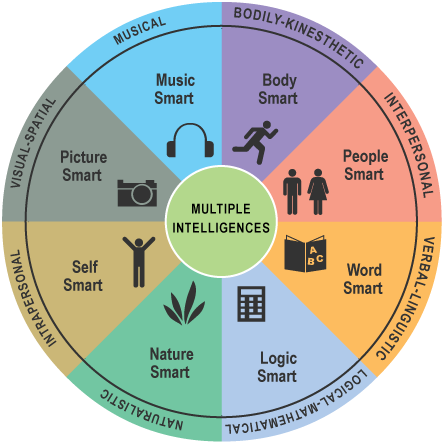 Gardner’s eight intelligences with real-world examples. (Image: Howard, CC BY-SA 4.0, via Wikimedia Commons)
Strengths:
- Inclusive: Recognizes intelligences beyond academic skills.
- Educational Applications: Helps tailor teaching methods (e.g., kinesthetic learners benefit from hands-on activities).
Weaknesses:
- Lack of empirical evidence: Some intelligences (e.g., spiritual) are subjective.
- Overlap with personality traits: Some "intelligences" may just be skills or talents.
3. Sternberg’s Triarchic Theory (1985)
Proposed by: Robert Sternberg
Core Idea: Intelligence is three interconnected components:
- Analytical Intelligence: Problem-solving and logical reasoning (e.g., IQ tests).
- Creative Intelligence: Ability to generate novel ideas and adapt to new situations (e.g., inventors, artists).
- Practical Intelligence: Street smarts—applying knowledge in real-world contexts (e.g., business leaders, mechanics).
Visualization:
mindmap
  root((Intelligence))
    Analytical["Analytical: Logic & Problem-Solving"]
    Creative["Creative: Innovation & Adaptability"]
    Practical["Practical: Real-World Application"]
Strengths:
- Balanced view: Includes both academic and real-world skills.
- Useful for careers: Explains why some people succeed in school but struggle in jobs (and vice versa).
Weaknesses:
- Hard to measure: Practical intelligence is difficult to test objectively.
Measuring Intelligence: IQ Tests and Beyond
Intelligence is often measured using standardized tests, but these have limitations and controversies.
1. Intelligence Quotient (IQ) Tests
What they measure:
- Verbal Comprehension: Vocabulary, analogies.
- Perceptual Reasoning: Pattern recognition, spatial puzzles.
- Working Memory: Recall and manipulation of information.
- Processing Speed: Quick responses to stimuli.
Example Tests:
- Stanford-Binet Intelligence Scale
- Wechsler Adult Intelligence Scale (WAIS)
- Raven’s Progressive Matrices (non-verbal test)
How IQ is Calculated:
- Mental Age: Performance level compared to peers.
- Chronological Age: Actual age.
Visualization:
Limitations of IQ Tests:
- Cultural Bias: Favor those with formal education (e.g., Western vocabulary tests disadvantage rural Nepali students).
- Narrow Focus: Ignore emotional intelligence, creativity, and practical skills.
- Static View: Treat intelligence as fixed, ignoring growth through learning.
2. Alternative Measures of Intelligence
| Measure | What It Tests | Example |
|---|---|---|
| Emotional Intelligence (EQ) | Self-awareness, empathy, relationship management | Google’s "Googley" traits in hiring. |
| Creativity Tests | Divergent thinking, originality | Designing a new app feature (e.g., Pathao’s ride-sharing algorithm). |
| Aptitude Tests | Potential to learn specific skills | Ncell’s technical training for customer service agents. |
| Achievement Tests | Knowledge in a specific domain | NEB’s board exams for school students. |
Emotional Intelligence (EQ): The Missing Piece
While IQ predicts academic success, Emotional Intelligence (EQ) predicts real-world success, especially in leadership and relationships.
Components of EQ (Daniel Goleman’s Model)
- Self-Awareness: Recognizing one’s emotions and strengths/weaknesses.
- Self-Regulation: Managing emotions and impulses.
- Motivation: Goal-setting and persistence.
- Empathy: Understanding others’ emotions.
- Social Skills: Building relationships and teamwork.
Real-World Example:
- Nepal’s Ncell trains customer service agents in active listening and empathy to handle angry customers effectively.
- Pathao drivers with high EQ resolve conflicts with passengers better than those with low EQ.
Visualization:
Intelligence in the Real World
Intelligence theories and measurements are not just academic—they shape how companies hire, how schools teach, and how individuals succeed.
1. Hiring and Workplace Success
- Google’s Hiring Process:
- Uses structured interviews to assess analytical intelligence (logic puzzles) and EQ (teamwork scenarios).
- Rejects traditional IQ tests because they don’t predict job performance as well as behavioral assessments.
- Nepal’s Banks (e.g., NMB, Global IME):
- Test numerical ability (IQ) for tellers but prioritize interpersonal intelligence (EQ) for relationship managers.
- Example: A loan officer with high EQ can negotiate better with borrowers, increasing repayment rates.
2. Education and Personalized Learning
- eSewa’s Digital Platforms:
- Uses adaptive learning algorithms to assess students’ spatial and logical intelligence (e.g., coding exercises).
- Struggles with Gardner’s bodily-kinesthetic learners, who may prefer hands-on labs over online quizzes.
- Nepal’s NEB Exams:
- Focus on crystallized intelligence (memorization of facts) but fail to test creative intelligence (e.g., designing solutions to real-world problems).
3. Everyday Life: Traffic Management in Kathmandu
- Problem: Kathmandu’s traffic is chaotic, with low spatial intelligence in road planning and poor practical intelligence in driver behavior.
- Solution:
- NTC (Nepal Telecommunications) and Ncell could use data analytics (analytical intelligence) to optimize traffic light timings.
- Bodily-kinesthetic intelligence is needed for traffic police to manage crowds effectively.
- Emotional intelligence helps reduce road rage through public awareness campaigns.
Controversies and Ethical Issues
Intelligence research is not without debate. Key controversies include:
1. Nature vs. Nurture: Is Intelligence Fixed or Can It Grow?
- Fixed Mindset (Entity Theory): Intelligence is genetic and cannot be changed (e.g., "You’re either smart or you’re not").
- Growth Mindset (Incremental Theory): Intelligence can be developed through effort and learning (Carol Dweck’s research).
- Real-World Impact:
- Schools in Nepal often reinforce fixed mindsets by labeling students as "bright" or "slow."
- Solution: Growth mindset training (e.g., praising effort over innate ability) improves motivation.
2. Cultural Bias in IQ Tests
- Example: The Stanford-Binet test was normed on Western populations, leading to lower scores for Nepali students unfamiliar with Western culture.
- Impact:
- Underrepresentation of minority groups in STEM fields.
- Misdiagnosis of learning disabilities in non-native English speakers.
3. Eugenics and Intelligence Testing Abuses
- Historical Example: In the early 20th century, IQ tests were misused to justify racism and immigration restrictions (e.g., U.S. excluding "low-IQ" immigrants).
- Modern Concern: Genetic determinism (e.g., claims that certain ethnic groups are "naturally" less intelligent) is pseudoscientific and harmful.
Applications in Nepal’s Context
How can intelligence theories be applied in Nepal to improve education, workplaces, and society?
1. Education Reform
- Problem: NEB’s exam system rewards memorization (crystallized intelligence) but ignores creativity and practical skills.
- Solution:
- Introduce project-based learning to assess Gardner’s multiple intelligences (e.g., building a solar panel for spatial intelligence).
- Train teachers to identify and nurture different intelligences in students.
2. Workplace Training
- Problem: Many Nepali companies (e.g., Daraz, F1Soft) hire based on degrees (IQ proxies) but fail to assess EQ or practical intelligence.
- Solution:
- Ncell’s customer service training could include EQ workshops to improve conflict resolution.
- Pathao’s driver training should cover spatial intelligence (navigating complex routes) and interpersonal intelligence (handling passenger complaints).
3. Mental Health and Well-being
- Problem: Low self-esteem in students with low IQ test scores leads to school dropout rates.
- Solution:
- Promote growth mindset in schools to reduce fear of failure.
- Use strengths-based assessments (e.g., identifying a student’s musical or bodily-kinesthetic intelligence) to boost confidence.
Exam Tip
This unit is highly theoretical but also practical. Expect questions on:
- Definitions and Comparisons:
- Differentiate between Spearman’s g-factor, Gardner’s multiple intelligences, and Sternberg’s triarchic theory.
- Compare IQ tests vs. EQ assessments (advantages/disadvantages).
- Real-World Applications:
- How does Gardner’s theory explain why a musician might struggle in school but excel in performance?
- Why do Nepali banks prefer EQ over IQ in customer service roles?
- Critiques and Controversies:
- Discuss cultural bias in IQ tests with an example from Nepal.
- Explain why fixed mindset beliefs harm education in Nepali schools.
- Case Studies:
- Worked Example: A student scores high on an IQ test but fails in real-life problem-solving. Which theory (Spearman, Gardner, or Sternberg) best explains this?
- Answer: Sternberg’s practical intelligence is low despite high analytical IQ.
- Worked Example: Why does Pathao’s success depend on drivers with high spatial and interpersonal intelligence?
- Answer: Spatial intelligence helps with navigation, while interpersonal intelligence reduces passenger conflicts.
- Worked Example: A student scores high on an IQ test but fails in real-life problem-solving. Which theory (Spearman, Gardner, or Sternberg) best explains this?
Common Mistakes to Avoid:
- Overgeneralizing: Don’t say "IQ determines success"—always mention EQ and practical intelligence.
- Ignoring Culture: Never assume IQ tests are universally valid without discussing biases.
- Mixing Theories: Spearman’s g-factor ≠ Gardner’s multiple intelligences—they are not the same!
Summary Table: Key Theories at a Glance
| Theory | Key Idea | Strengths | Weaknesses | Real-World Example |
|---|---|---|---|---|
| Spearman’s g-factor | Single general intelligence (g) | Explains correlation between abilities | Ignores domain-specific skills | IQ tests predicting academic success |
| Gardner’s Multiple Intelligences | 8 independent intelligences | Inclusive, useful for education | Lack of empirical support | Musician excelling outside school |
| Sternberg’s Triarchic | Analytical, creative, practical | Balanced view of intelligence | Hard to measure practically | Entrepreneur succeeding despite low IQ |
Final Thought: Intelligence is Multifaceted
Intelligence is not just about IQ—it’s about how you think, adapt, and connect with the world. Whether you’re preparing for NEB exams, working at Ncell, or managing traffic in Kathmandu, understanding different types of intelligence helps you succeed.
Remember:
- School may test IQ, but life rewards EQ and practical intelligence.
- Nepal’s challenges (traffic, education gaps, workplace biases) can be solved by applying intelligence theories creatively.
- Your strengths may lie outside traditional IQ—embrace them!
Based on the TU BIT syllabus for Psychology (PSY359), unit 7.
Discussion
Loading…