PhysicsUnit 412 min read
Quantum Mechanics & Wave-Particle Duality: Photons, Electrons, and Schrodinger's Equation
Unit 4 of Physics covers the revolutionary ideas of quantum mechanics—wave-particle duality, the photoelectric effect, de Broglie waves, Heisenberg’s uncertainty principle, and the Schrödinger equation—explaining how particles like electrons and photons behave as both waves and particles, and how quantum theory describ
TAKEAWAYS:
- Wave-particle duality explains why light and matter exhibit both wave-like and particle-like properties, a cornerstone of quantum mechanics.
- Quantum numbers (n, l, m, mₛ) describe the discrete energy states of electrons in atoms, derived from solving the Schrödinger equation.
- Heisenberg’s uncertainty principle states that certain pairs of physical properties (e.g., position and momentum) cannot both be precisely known simultaneously.
- The Schrödinger equation is the fundamental equation of quantum mechanics, predicting the wavefunction (ψ) and energy levels of quantum systems.
- Blackbody radiation and the photoelectric effect provided experimental evidence that forced the development of quantum theory.
- Applications range from semiconductor devices (transistors, LEDs) to medical imaging (MRI) and cryptography (quantum encryption).
1. Wave-Particle Duality: The Dual Nature of Light and Matter
Quantum mechanics begins with the shocking idea that light and matter can behave as both waves and particles, depending on how we observe them. This duality was first hinted at by experiments that classical physics could not explain.
1.1 Light as a Particle: The Photoelectric Effect
In 1905, Einstein explained the photoelectric effect (where light ejects electrons from metals) by proposing that light consists of discrete packets of energy called photons. Key observations:
- Threshold frequency (ν₀): Light below a certain frequency fails to eject electrons, no matter how intense.
- Instantaneous emission: Electrons are ejected immediately, even at low light intensity.
- Kinetic energy of ejected electrons (KE): Depends on the frequency (ν) of light, not its intensity.
Einstein’s Equation: where:
- (Planck’s constant),
- = work function of the metal (minimum energy to remove an electron).
Worked Example (Exam-Style): A metal has a work function . Calculate the maximum kinetic energy of ejected electrons when illuminated by light of wavelength . Solution:
- Convert to frequency:
- Calculate photon energy:
- Apply Einstein’s equation: Answer: .
1.2 Matter as a Wave: de Broglie Hypothesis
In 1924, Louis de Broglie proposed that particles (e.g., electrons) also have wave-like properties. The de Broglie wavelength (λ) of a particle is given by: where is the momentum of the particle.
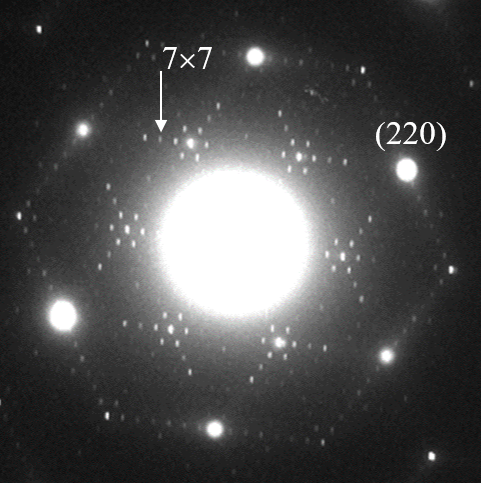 Shows electrons passing through a crystal lattice, producing an interference pattern (like X-rays). (Image: Ldm1954, CC BY-SA 4.0, via Wikimedia Commons)
Worked Example (Exam-Style): An electron moves with a velocity . Calculate its de Broglie wavelength. Solution:
- Mass of electron .
- Momentum .
- De Broglie wavelength: Answer: .
Real-World Connection:
- Electron microscopes (used in medical and material science labs) rely on the wave nature of electrons to achieve higher resolution than light microscopes. For example, Nepal’s Tribhuvan University’s Central Department of Physics uses electron microscopes to study nanostructures in research.
2. Heisenberg’s Uncertainty Principle
Werner Heisenberg (1927) showed that certain pairs of physical properties cannot both be precisely measured simultaneously. Mathematically: where:
- = uncertainty in position,
- = uncertainty in momentum ().
Implications:
- Electrons in atoms cannot have perfectly defined orbits (unlike planets). Instead, they exist as probability clouds (orbitals).
- Macroscopic objects (e.g., a baseball) have negligible uncertainty because their mass is large.
Worked Example (Exam-Style): A particle has a mass . If its speed is uncertain by , what is the minimum uncertainty in its position? Solution:
- Uncertainty in momentum:
- Apply Heisenberg’s principle: Answer: .
Real-World Connection:
- Quantum cryptography (used by banks like Nabil Bank for secure transactions) relies on the uncertainty principle to detect eavesdropping. Any measurement of a quantum state (e.g., photon polarization) disturbs it, revealing intrusion.
3. Quantum Mechanics: The Schrödinger Equation
The Schrödinger equation is the fundamental equation of quantum mechanics, describing how the wavefunction (ψ) of a quantum system evolves over time.
3.1 Time-Independent Schrödinger Equation
For a particle in a potential : where:
- ,
- = energy of the system,
- = wavefunction (probability amplitude).
3.2 Solving for the Hydrogen Atom
For the hydrogen atom (a single electron in a Coulomb potential), we use spherical coordinates (r, θ, φ). The Schrödinger equation separates into:
- Radial part (depends on ),
- Angular part (depends on and ).
Quantum Numbers:
| Quantum Number | Symbol | Possible Values | Physical Meaning |
|---|---|---|---|
| Principal | Energy level (shell) | ||
| Azimuthal | to | Orbital angular momentum (subshell: s, p, d, f) | |
| Magnetic | to | Orientation of orbital in space | |
| Spin | Electron spin |
Worked Example (Exam-Style): How many atomic states are there in hydrogen for ? How are they distributed among subshells? Label each state with quantum numbers . Solution: For :
- (s, p, d subshells).
- Number of states per subshell:
- : → 1 state × 2 spin states = 2 states.
- : → 3 states × 2 = 6 states.
- : → 5 states × 2 = 10 states.
- Total states = 2 + 6 + 10 = 18.
Labelled States:
| Subshell | State (n, l, m_l, m_s) | |||
|---|---|---|---|---|
| 3s | 0 | 0 | ±1/2 | (3, 0, 0, +1/2), (3, 0, 0, -1/2) |
| 3p | 1 | -1, 0, +1 | ±1/2 | (3, 1, -1, ±1/2), ... |
| 3d | 2 | -2, -1, 0, +1, +2 | ±1/2 | (3, 2, -2, ±1/2), ... |
 Shows 1s, 2s, 2p, 3s, 3p, and 3d orbitals with their shapes and quantum numbers. (Image: Jacopo Bertolotti, CC0, via Wikimedia Commons)
3.3 Probability Density and Orbitals
The probability density gives the likelihood of finding an electron in a region of space. For example:
- 1s orbital: Spherical, highest probability at the nucleus.
- 2p orbital: Dumbbell-shaped, with a node at the nucleus.
Real-World Connection:
- Semiconductor devices (e.g., transistors in smartphones) rely on quantum mechanics. The band structure of silicon (how electrons occupy energy levels) is determined by solving the Schrödinger equation for solids. Companies like Intel and Samsung use these principles to design faster processors.
4. Blackbody Radiation and Quantum Theory
Classical physics failed to explain blackbody radiation (how objects emit light at different temperatures). Quantum mechanics resolved this by introducing:
- Energy quantization: Light is emitted/absorbed in discrete packets (quanta).
- Planck’s law: The energy of a photon is .
Worked Example (Exam-Style): A blackbody at temperature has its peak emission wavelength at . Use Wien’s displacement law to find . Solution: Wien’s law: Answer: (yellow light).
Real-World Connection:
- Khalti and eSewa use infrared thermography (based on blackbody radiation) to detect overheating in servers or electrical components, preventing failures.
- NTC (Nepal Telecommunications Corporation) uses quantum mechanics in fiber-optic cables, where light (photons) transmits data with minimal loss due to its wave-particle nature.
5. Electromagnetic Waves and Quantum Fields
Electromagnetic waves (e.g., light, radio waves) are quantized as photons. The Poynting vector (S) describes the energy flux of an electromagnetic wave: where = electric field, = magnetic field, = permeability of free space.
Real-World Connection:
- YouTube/Google use quantum dots (nanoscale semiconductors with quantized energy levels) in high-definition displays to produce pure colors.
- Pathao’s GPS tracking relies on microwave signals (electromagnetic waves) to determine location, with quantum principles ensuring signal stability.
Exam Tip
Memorize key equations:
- Photoelectric effect: .
- de Broglie wavelength: .
- Heisenberg’s uncertainty: .
- Schrödinger equation (time-independent): .
Quantum numbers:
- For hydrogen, , to , to , .
- Total states in a shell: .
Problem-solving strategy:
- Photoelectric effect: Always convert wavelength to frequency/energy first.
- de Broglie wavelength: Ensure units are consistent (kg, m/s for momentum).
- Schrödinger equation: Recognize when separation of variables is needed (e.g., hydrogen atom).
Common pitfalls:
- Forgetting to multiply by 2 for spin states when counting atomic states.
- Mixing up and values.
- Ignoring units in uncertainty principle calculations.
Diagrams are worth marks!
- Always draw energy level diagrams for hydrogen-like atoms.
- Label photoelectric effect setups with incident light, work function, and ejected electrons.
- Sketch probability density plots for orbitals (e.g., 1s, 2p).
Final Note: Quantum mechanics is not just theory—it powers the technology around you. From the semiconductors in your phone to the secure transactions on Khalti, these principles are the backbone of modern science. Master the math, understand the concepts, and you’ll ace the exam!
Based on the TU BSc CSIT syllabus for Physics (PHY118), unit 4.
Discussion
Loading…