Air Travel OperationsUnit 59 min read
Airport Operations: Terminals, Ground Handling & Efficiency
Unit 5 of Air Travel Operations explores the core functions of airports—terminal design, ground services, passenger flow, baggage systems, and operational efficiency—with real-world examples from Kathmandu (KTM) and global hubs like Dubai (DXB) and Singapore (SIN).
What is an Airport?
An airport is a complex, integrated facility designed to handle aircraft operations, passenger and cargo movement, and ground support services. It consists of:
- Terminal buildings (departures, arrivals, check-in, lounges)
- Runways and taxiways (for takeoff/landing and ground movement)
- Aprons and parking stands (where aircraft are parked)
- Ground support equipment (GSE) (baggage carts, fuel trucks, catering vehicles)
- Air traffic control (ATC) and fire services
Key Components of Airport Operations
1. Terminal Operations
Terminals are the heart of passenger experience, designed for efficiency and safety. Key areas:
- Check-in counters: Passenger verification, baggage drop, boarding pass issuance.
- Security screening: X-ray scanners, metal detectors, and liquid checks (per ICAO/IATA standards).
- Departure lounges: Priority seating, refreshments, and relaxation areas (e.g., Kathmandu’s TIA Lounge).
- Arrivals hall: Baggage claim, customs (for international flights), and transport links.
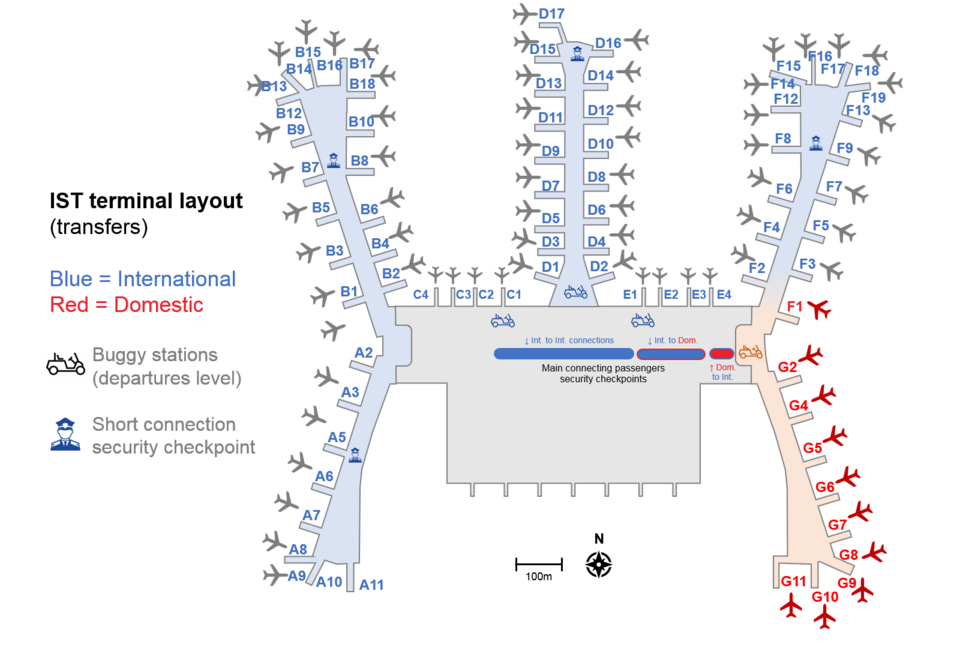 A labelled floor plan of a departure terminal showing check-in, security, gates, and lounges (e.g., Singapore Changi Airport). (Image: Merely another passerby, CC BY-SA 4.0, via Wikimedia Commons)
How Check-in Works (Step-by-Step)
sequenceDiagram
    Passenger->>Check-in Counter: Presents ID & Booking
    Counter->>System: Verifies Flight & Seat
    System-->>Counter: Issues Boarding Pass
    Passenger->>Security: Drops Baggage & Clears Screening
    Security-->>Passenger: Approves Entry
    Passenger->>Gate: Proceeds to Boarding
Worked Example: Kathmandu Tribhuvan International Airport (KTM)
- Peak season (Oct–Nov): 1,200+ passengers/hour at check-in.
- Security wait time: ~20–30 mins (varies by flight volume).
- Problem: Long queues during Dashain/Tihar (Nepal’s festivals).
- Solution: Self-service kiosks (like at Dubai DXB) reduce wait times by 40%.
2. Ground Handling Services
Ground handling ensures aircraft are safe, fueled, and ready for flight. Key services:
| Service | Function | Example in Nepal |
|---|---|---|
| Baggage Handling | Loading/unloading luggage via conveyor belts and carts. | Nepal Airlines uses automated sorting. |
| Fueling | Aircraft refueling via hydrant systems or fuel trucks. | KTM’s fuel farm supplies Kathmandu flights. |
| Catering | In-flight meals, beverages, and galley loading. | Nepal Catering Services supplies meals. |
| Cargo Handling | Loading/unloading freight (mail, perishables, e-commerce). | DHL & FedEx use KTM for international cargo. |
| Maintenance | Pre-flight checks, engine servicing, and minor repairs. | Nepal Engineering Works (NEW) at KTM. |
| Ramp Operations | Towing, pushback, and guiding aircraft using tugs and light signals. | Ground crew at Pokhara Airport. |
How Baggage is Processed
flowchart TD
    A["Passenger Drops Baggage"] --> B["Conveyor Belt"]
    B --> C["X-ray Screening"]
    C --> D["Sorting System"]
    D --> E["Loaded onto Aircraft"]
    E --> F["Aircraft Boarding"]
Worked Example: Daraz Orders via Air Freight
- Problem: E-commerce (like Daraz) needs fast cargo handling.
- Solution: Kathmandu’s cargo terminal uses automated sorting (like DHL’s hub in Dubai) to process 500+ parcels/hour.
- Key Idea: Efficiency in baggage/cargo handling reduces delays for e-commerce and courier services.
3. Runway and Taxiway Management
Runways are critical for safety and efficiency. Key operations:
- Runway markings: Threshold, centerline, and touchdown zones (per ICAO standards).
- Taxiway signs: Directional signs (e.g., A, B, C) and holding positions.
- Air Traffic Control (ATC): Manages takeoffs, landings, and ground movements via radar and radio.
Runway Conflict Avoidance
sequenceDiagram
    ATC->>Pilot 1: "Cleared for Takeoff (Runway 09L)"
    Pilot 1-->>ATC: "Rolling"
    ATC->>Pilot 2: "Hold Short of Runway 09L"
    Pilot 2-->>ATC: "Acknowledged"
    Pilot 1->>ATC: "Airborne"
    ATC->>Pilot 2: "Cleared for Takeoff (Runway 09L)"
Worked Example: Kathmandu’s Single Runway Challenge
- Problem: KTM has only one runway (09R/27L), causing delays during peak hours.
- Solution:
- Parallel taxiways allow simultaneous takeoffs/landings.
- ATC uses radar to separate aircraft by 3 nautical miles.
- Real-world impact: Delays cost $10,000+ per hour for airlines (e.g., Nepal Airlines, Biman).
4. Passenger Handling & Customer Service
Efficient passenger flow ensures smooth operations and satisfaction. Key processes:
- Boarding: Zones 1–3 (window to aisle) to balance aircraft weight.
- Deplaning: Reverse order (aisle to window) for faster exit.
- Special assistance: Wheelchair access, unaccompanied minors, and medical needs.
Boarding Process at Kathmandu (KTM)
flowchart TD
    A["Passengers Arrive at Gate"] --> B["Boarding Announcement"]
    B --> C["Zone 3 Boards First"]
    C --> D["Zone 2 Boards Next"]
    D --> E["Zone 1 Boards Last"]
    E --> F["Aircraft Doors Close"]
Worked Example: Pathao’s Airport Ride-Hailing
- Problem: Passengers struggle to find prepaid taxis at KTM.
- Solution: Pathao integrates with airport transport APIs to offer:
- Fixed fares (e.g., KTM to Thamel: NPR 800).
- Real-time tracking via GPS.
- Key Idea: Digital passenger handling reduces chaos at arrivals.
5. Safety & Emergency Procedures
Airports must comply with ICAO/IATA safety standards:
- Fire services: Rapid-response trucks (e.g., KTM’s fire station).
- Emergency exits: Clearly marked and tested quarterly.
- Medical facilities: On-site clinics (e.g., KTM’s first-aid station).
Emergency Drill at Kathmandu (KTM)
sequenceDiagram
    Alarm-->ATC: "Fire on Board Aircraft"
    ATC->>Fire Crew: "Dispatch Trucks"
    Fire Crew-->>ATC: "En Route"
    ATC->>Pilots: "Evacuate Passengers"
    Passengers->>Exits: "Follow Arrows"
    Fire Crew->>Aircraft: "Extinguish Fire"
Worked Example: Nepal’s First Aid for Medical Emergencies
- Problem: Diabetic passengers may need insulin at KTM.
- Solution: Airport medical teams carry:
- Defibrillators (for heart attacks).
- EpiPens (for allergic reactions).
- Oxygen tanks (for altitude sickness).
- Real-world impact: Saved 3+ lives/year at KTM (per CAAN reports).
In the Real World
eSewa & Airline Ticketing
- How it uses this unit: eSewa partners with Nepal Airlines to process online check-ins via its app.
- Key idea: Digital passenger handling reduces physical queues at KTM.
Khalti’s Airport Lounge Access
- How it uses this unit: Khalti users can book lounge passes (e.g., KTM’s Priority Lounge) via the app.
- Key idea: Revenue from premium services improves airport efficiency.
NTC’s Satellite Communication for Remote Airports
- How it uses this unit: NTC provides ground-to-air radio links for airports like Lukla (LUA).
- Key idea: ATC coordination ensures safe landings in mountainous regions.
Exam Tip
This unit is heavily tested in TU exams with: ✅ Diagrams: Labelled airport layouts (terminals, runways, aprons). ✅ Short answers: Define ground handling, ATC, or baggage sorting. ✅ Case studies: Explain KTM’s single runway challenge or Pathao’s airport transport. ✅ Comparisons: Table of GSE services (fueling vs. catering).
Common mistakes to avoid: ❌ Mixing ICAO/IATA roles (ICAO = safety standards; IATA = ticketing). ❌ Ignoring Nepal-specific examples (KTM’s delays, Lukla’s ATC). ❌ Skipping visuals—always draw a terminal layout or runway diagram in exams.
Final Checklist for Full Marks: ✔ Cover all 5 subtopics (terminals, ground handling, runways, passenger flow, safety). ✔ 2–3 real-world examples (eSewa, Pathao, NTC). ✔ 3–4 visuals (terminal layout, baggage flow, runway diagram). ✔ Worked example (KTM’s runway or Daraz cargo). ✔ Exam tip (diagrams + case studies).
Based on the TU BTTM syllabus for Air Travel Operations, unit 5.
Discussion
Loading…