Air Travel OperationsUnit 66 min read
Passenger Handling: Procedures, Rights, and Operational Flow
Unit 6 of Air Travel Operations covers the systematic handling of passengers from check-in to disembarkation, including pre-flight procedures, boarding protocols, special passenger needs, and post-flight processes. It emphasizes legal rights, operational efficiency, and customer service standards in air travel.
Key Concepts in Passenger Handling
Passenger handling is the end-to-end process of managing passengers during air travel, ensuring safety, efficiency, and compliance with aviation regulations. It includes:
- Pre-flight procedures (check-in, security, boarding)
- In-flight services (seating, meal service, special assistance)
- Post-flight processes (disembarkation, lost property, feedback)
- Legal rights and responsibilities of passengers and airlines
1. Pre-Flight Passenger Handling
This phase begins when passengers arrive at the airport and ends when the aircraft doors close. Key steps include:
A. Check-In Process
Passengers must check in 2 hours before domestic flights and 3 hours before international flights (IATA standard). Airlines use self-service kiosks or counter check-ins to:
- Verify travel documents (passport, visa, ticket)
- Assign seats (based on booking class, special requests)
- Issue boarding passes (electronic or paper)
- Weigh and tag baggage (if checked)
flowchart TD
A["Passenger Arrival"] --> B["Document Verification"]
B --> C["Seat Assignment"]
C --> D["Boarding Pass Issuance"]
D --> E["Baggage Check-In"]
E --> F["Boarding Gate"]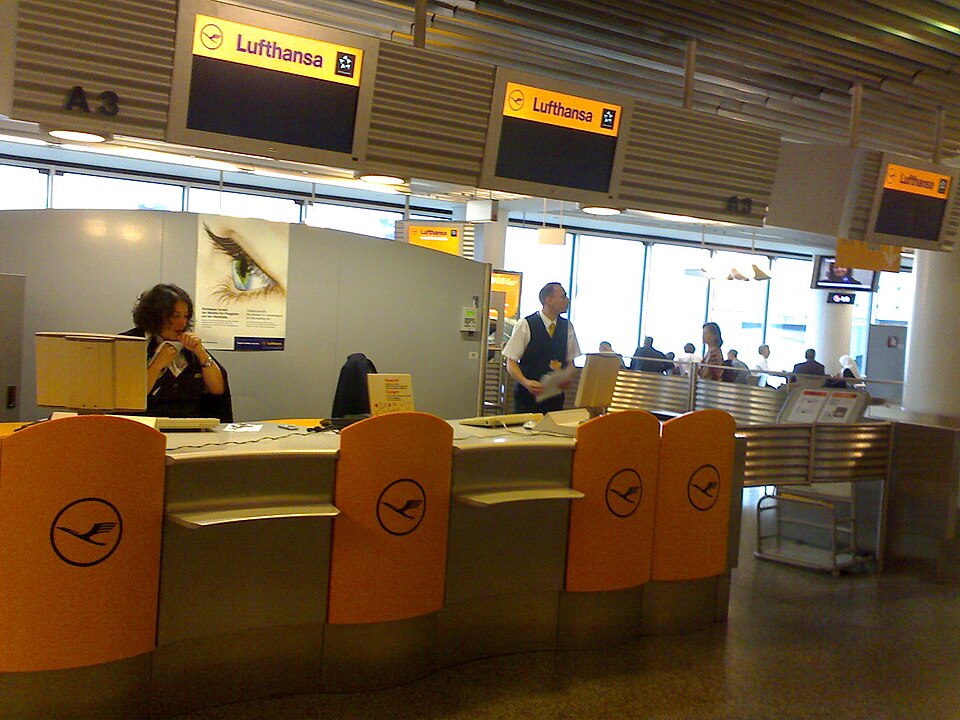 A typical airline check-in desk with self-service kiosks and agent counters. (Image: Saptarshi Pal, CC BY-SA 4.0, via Wikimedia Commons)
B. Security Screening
All passengers and carry-on baggage must pass through security checkpoints to prevent unauthorized items. The process includes:
- Metal detectors (for passengers)
- X-ray machines (for carry-on luggage)
- Liquid restrictions (containers ≤ 100ml, in a 1L transparent bag)
- Special screening for unaccompanied minors, VIPs, or high-risk passengers
C. Boarding Process
Airlines follow a structured boarding sequence to optimize aircraft loading and passenger comfort:
- Priority boarding (First/Business class, unaccompanied minors, passengers with special needs)
- Group boarding (by seat section, e.g., rows 1-10, then 11-20)
- Randomized boarding (some low-cost carriers use this for speed)
Worked Example: Kathmandu to Delhi Flight (Indigo Airlines)
- Boarding Groups:
- Group 1: First Class (rows 1-5)
- Group 2: Business Class (rows 6-10)
- Group 3: Window seats (rows 11-20)
- Group 4: Aisle seats (rows 21-30)
- Group 5: Remaining passengers
- Time Saved: Group boarding reduces congestion and speeds up aircraft turnaround.
2. In-Flight Passenger Handling
Once onboard, airlines ensure passenger comfort, safety, and service compliance.
A. Seat Assignment and Boarding
- Window/Aisle/Middle: Passengers choose seats during booking or check-in.
- Special Seating:
- Bulkhead seats (extra legroom)
- Exit rows (must be able-bodied)
- Family seating (requested for groups)
B. In-Flight Services
Airlines provide:
- Meals and beverages (varies by class; economy may get snacks only)
- Entertainment (in-flight movies, Wi-Fi, magazines)
- Special assistance (meal restrictions, medical needs, childcare)
C. Handling Special Passengers
Airlines must accommodate:
| Passenger Type | Requirements | Example (Nepal Context) |
|---|---|---|
| Unaccompanied Minors | Escort service, special boarding | Yeti Airlines assists children aged 5-12. |
| Pregnant Women | Medical clearance, priority seating | Nepal Airlines allows up to 36 weeks. |
| Passengers with Disabilities | Wheelchair access, extra time | CAAN (Civil Aviation Authority of Nepal) mandates ramps. |
| VIPs/Government Officials | Fast-track security, priority boarding | Royal Nepal Airlines handles high-profile passengers. |
3. Post-Flight Passenger Handling
After landing, airlines ensure smooth disembarkation and address passenger concerns.
A. Disembarkation Process
- Reverse boarding order (last to board, first to exit)
- Baggage claim (carousels for checked luggage)
- Lost property handling (passengers report missing items to airline staff)
B. Passenger Complaints and Feedback
Airlines use feedback forms or online portals to resolve issues like:
- Delayed flights (compensation under ICAO/IATA rules)
- Lost baggage (tracing via IATA’s Property Irregularity Report)
- Poor service (complaints escalated to CAAN in Nepal)
Worked Example: Lost Baggage at Tribhuvan International Airport (TIA)
- Step 1: Passenger reports lost baggage at the airline counter.
- Step 2: Airline issues a Property Irregularity Report (PIR).
- Step 3: CAAN and IATA trace the baggage via global databases.
- Step 4: Compensation (if delayed > 21 days) or replacement.
In the Real World
eSewa & Online Check-In (Nepal)
- Idea Used: Self-service check-in
- How: eSewa partners with airlines (e.g., Nepal Airlines, Buddha Air) to allow passengers to check in online, reducing queue times at airports like Kathmandu (TIA) and Pokhara.
Pathao’s Airport Ride-Hailing (Nepal)
- Idea Used: Efficient passenger movement
- How: Pathao provides pre-booked airport transfers, ensuring passengers reach the terminal on time, reducing missed flight risks.
Google Flights & Dynamic Pricing (Global)
- Idea Used: Passenger fare transparency
- How: Google Flights shows real-time flight prices, helping passengers compare airlines (e.g., Yeti vs. Buddha Air) and choose the best deal, directly impacting boarding and check-in decisions.
Exam Tip
- Focus on ICAO/IATA standards (e.g., check-in times, baggage rules).
- Compare airlines (e.g., full-service vs. low-cost carriers in passenger handling).
- Memorize special passenger categories (unaccompanied minors, disabilities, VIPs).
- Practice case studies (e.g., delayed flights, lost baggage scenarios).
- Diagrams are key—expect flowcharts for boarding processes or tables for passenger rights.
Visual Summary Table: Passenger Handling Phases
| Phase | Key Activities | Regulatory Body |
|---|---|---|
| Pre-Flight | Check-in, security, boarding | ICAO, IATA, CAAN |
| In-Flight | Seat assignment, meals, special needs | Airline SOP |
| Post-Flight | Disembarkation, complaints, lost property | IATA PIR, CAAN |
Based on the TU BTTM syllabus for Air Travel Operations, unit 6.
Discussion
Loading…