Research MethodologyUnit 418 min read
Measurement & Scaling: Types, Levels & Applications
Unit 4 of Research Methodology explores how to quantify data in tourism research, covering measurement scales (nominal, ordinal, interval, ratio), their applications in surveys and experiments, and scaling techniques (Likert, semantic differential, Guttman). Learn how to design valid and reliable measurement tools for
Why Measurement Matters in Tourism Research
Tourism research relies on quantifiable data to analyze trends, customer behavior, and operational efficiency. For example:
- NTC measures passenger satisfaction using Likert scales (e.g., "How likely are you to recommend NTC?").
- Daraz uses ratio scales to track delivery times (e.g., "Order processed in 2 hours").
- NEPSE applies interval scales to analyze stock price changes (e.g., "Price increased by 5% from last quarter").
Without proper measurement, data is meaningless. This unit teaches you how to classify, scale, and interpret data correctly.
1. What is Measurement in Research?
Measurement is the process of assigning numbers or labels to objects, events, or responses to describe their characteristics. In tourism research, it helps:
- Quantify customer preferences (e.g., "How satisfied are tourists with Pokhara’s hotels?").
- Track operational metrics (e.g., "How many tourists visit Chitwan National Park annually?").
- Compare performance indicators (e.g., "Which airline has the best on-time performance?").
Key Components of Measurement
| Component | Definition | Example in Tourism |
|---|---|---|
| Object | What is being measured (e.g., customer satisfaction, tourist arrival). | Measuring "satisfaction with Kathmandu traffic" |
| Attribute | The characteristic being measured (e.g., speed, quality, frequency). | "Number of complaints per day at Tribhuvan Airport" |
| Scale | The system used to assign numbers/labels (nominal, ordinal, interval, ratio). | Rating hotels on a 1-5 scale (ordinal). |
| Instrument | The tool used (questionnaire, observation, experiment). | A Likert-scale survey for tourist feedback. |
2. Levels of Measurement (Scales of Measurement)
Not all numbers are equal! The type of scale determines what statistical analysis you can perform.
Comparison Table: Four Levels of Measurement
| Scale Type | Definition | Example in Tourism | Statistical Operations Allowed | Limitations |
|---|---|---|---|---|
| Nominal | Categories with no order (labels only). | Gender (Male/Female), Nationality (Nepali/Indian). | Mode, frequency counts. | Cannot rank or calculate averages. |
| Ordinal | Categories with order but no equal intervals. | Hotel ratings (1-star to 5-star), Customer satisfaction (Poor → Excellent). | Median, rank-order correlations. | Cannot measure "how much better" one is than another. |
| Interval | Ordered categories with equal intervals but no true zero. | Temperature in °C (e.g., 20°C vs. 30°C). | Mean, standard deviation, Pearson correlation. | Zero is arbitrary (e.g., 0°C ≠ no temperature). |
| Ratio | Ordered categories with equal intervals and a true zero. | Tourist arrivals (0 = no tourists), Revenue (₹0 = no sales). | All statistical operations (mean, ratio, %). | Rare in social sciences; mostly in physical measurements. |
Visual: Levels of Measurement Hierarchy
Example Trace:
- Nominal: Classifying tourists as "Domestic" or "International."
- Ordinal: Ranking hotels as "Poor (1), Fair (2), Good (3), Excellent (4)."
- Interval: Measuring "Tourist satisfaction score" (1-100, where 50 = neutral).
- Ratio: Counting "Number of tourists visiting Annapurna Circuit" (0 = none).
3. Measurement Scales in Tourism Research
A. Nominal Scale
- Used for categorical data with no numerical meaning.
- Example: Survey question:
"What is your nationality?" ☐ Nepali | ☐ Indian | ☐ Chinese | ☐ Other
When to Use:
- Classifying groups (e.g., "Type of tourist: Business/Leisure").
- Analyzing frequency distributions (e.g., "Most tourists are Nepali").
B. Ordinal Scale
- Used when data can be ranked but not measured precisely.
- Example: Likert-scale question:
"How satisfied were you with your flight experience?" 1 (Very Dissatisfied) → 5 (Very Satisfied)
Common Ordinal Scales in Tourism:
| Scale Type | Example | Use Case |
|---|---|---|
| Likert Scale | 1 (Strongly Disagree) → 5 (Strongly Agree) | Customer satisfaction surveys (e.g., NTC). |
| Semantic Differential | Boring (1) ------------------- Exciting (7) | Measuring perception of tourist destinations. |
| Guttman Scale | Yes/No responses in cumulative order. | Ranking preferences (e.g., "Which amenity is most important?"). |
Worked Example: NTC Passenger Satisfaction Survey Suppose NTC asks:
"How would you rate your overall experience with NTC?" 1 (Poor) → 5 (Excellent)
Analysis:
- If 60% of respondents choose 4 or 5, NTC knows most passengers are satisfied.
- But we cannot say "Passengers are 20% more satisfied than last year" (since intervals are not equal).
C. Interval Scale
- Used when differences between values are meaningful, but zero is arbitrary.
- Example in Tourism:
- Temperature: "Average tourist season temperature in Pokhara is 25°C (warmer than Kathmandu’s 20°C)."
- Stock Market (NEPSE): "Hotel stocks increased by 10 points this quarter."
Key Point:
- You can calculate averages and standard deviations, but ratios are meaningless (e.g., 30°C is not twice as hot as 15°C).
D. Ratio Scale
- Gold standard for measurement—has true zero and equal intervals.
- Examples in Tourism:
- Number of tourists: "Chitwan National Park had 50,000 visitors last year (0 = no visitors)."
- Revenue: "Hotel X earned ₹5 million in 2023 (₹0 = no revenue)."
- Time: "Average wait time at Tribhuvan Airport is 30 minutes (0 = no wait)."
Why Ratio Scales Matter:
- You can say:
- "Tourist arrivals doubled from 2022 to 2023 (20,000 → 40,000)."
- "Revenue increased by 50% (₹2M → ₹3M)."
4. Scaling Techniques in Tourism Research
Scaling converts qualitative responses into quantifiable data. Common techniques:
A. Likert Scale
- Measures attitudes or opinions on a symmetrical agree-disagree scale.
- Example Question:
"The staff at Hotel Yeti were friendly." 1 (Strongly Disagree) → 5 (Strongly Agree)
How to Analyze:
- Assign numbers (1-5) and calculate mean satisfaction score.
- Interpretation:
- Mean = 4.2 → Generally satisfied.
- Mean = 2.5 → Dissatisfied.
Real-World Use:
- TripAdvisor reviews use Likert-like scales (1-5 stars).
- NTC’s customer feedback forms often use 5-point Likert scales.
B. Semantic Differential Scale
- Measures perceptions on bipolar adjectives (e.g., "Good-Bad," "Modern-Traditional").
- Example:
"How would you describe Pokhara’s tourism infrastructure?" Modern (1) 2 3 4 5 (Traditional)
Advantages:
- Captures nuanced opinions (e.g., "Is this hotel more 'luxurious' or 'budget-friendly'?").
- Useful for brand positioning (e.g., "Is Daraz perceived as 'fast' or 'slow'?").
C. Guttman Scale
- Cumulative ranking where a "Yes" to a higher-level question implies "Yes" to lower levels.
- Example:
- "Would you visit Nepal again?" (Yes/No)
- "Would you recommend Nepal to friends?" (Yes/No)
- "Would you pay extra for a guided tour?" (Yes/No)
How It Works:
- If a respondent says No to Q1, they cannot say Yes to Q2 or Q3.
- Used to rank preferences (e.g., "What amenities do tourists prioritize?").
D. Thurstone Scale
- Uses judged intervals between responses (e.g., "Slightly satisfied" vs. "Very satisfied").
- Rare in tourism but used in market research for precise attitude measurement.
5. Validity and Reliability in Measurement
Even the best scales can fail if they are invalid or unreliable.
A. Validity
- Does the scale measure what it claims to measure?
- Types of Validity:
Type Definition Example Check Face Validity Does it look valid to experts? Ask professors: "Does this survey measure tourist satisfaction?" Content Validity Does it cover all aspects of the concept? Does a "hotel satisfaction" survey include staff, cleanliness, food, location? Construct Validity Does it align with theoretical expectations? If measuring "luxury perception," does the scale include price, amenities, brand? Criterion Validity Does it correlate with other known measures? Does a "satisfaction score" match repeat bookings?
Example:
- A survey asking "Do you like Nepal?" (Yes/No) has low validity for measuring tourist satisfaction (too vague).
B. Reliability
- Does the scale produce consistent results over time?
- Tests for Reliability:
- Test-Retest Reliability: Give the same survey to the same group after a week. Are answers similar?
- Internal Consistency (Cronbach’s Alpha): Do all questions measure the same thing?
- α > 0.7 → Reliable.
- α < 0.5 → Unreliable.
- Inter-Rater Reliability: If two researchers score open-ended answers, do they agree?
Example:
- If 80% of respondents give the same rating for "Hotel cleanliness" in two surveys a month apart → Reliable.
- If ratings vary wildly → Unreliable.
6. Common Mistakes in Measurement & Scaling
| Mistake | Example | Fix |
|---|---|---|
| Using nominal data for ratio analysis | Asking "How many stars would you give this hotel?" (1-5) and treating it as ratio. | Use ordinal analysis (medians, not means). |
| Leading questions | "Don’t you agree that NTC’s delays are unacceptable?" | Rephrase as neutral: "How satisfied were you with NTC’s punctuality?" |
| Ambiguous scales | "Rate your experience: 1 (Bad) to 5 (Good)" (what’s "good" vs. "excellent"?). | Define clearly: "1 (Very Dissatisfied) to 5 (Very Satisfied)". |
| Ignoring non-response bias | Only analyzing responses from young tourists while ignoring older ones. | Ensure representative sampling. |
| Overusing Likert scales | Asking 20 Likert questions when some need open-ended answers. | Mix scales (e.g., add "What would improve your experience?"). |
In the Real World
eSewa & Khalti (Digital Payments)
- Measurement Used: Ratio scale (transaction amounts in ₹).
- How? Tracks number of transactions, average spend, and growth rate (e.g., "eSewa transactions increased by 30% in 2023").
- Scaling Technique: Interval data for user satisfaction surveys (e.g., "How easy was the payment process?" 1-5).
Pathao (Ride-Hailing App)
- Measurement Used: Ordinal (Likert) + Ratio scales.
- How?
- Ordinal: Driver ratings (1-5 stars for service).
- Ratio: Average ride time (minutes), number of daily rides, revenue per driver.
- Scaling: Uses semantic differential to measure "Pathao vs. Taxi" perceptions (e.g., "Fast (1) → Slow (7)").
NEPSE (Nepal Stock Exchange)
- Measurement Used: Interval scale for stock prices.
- How? Analyzes:
- Price changes (e.g., "Hotel stocks up by 8 points").
- Market trends (e.g., "Tourism sector grew 12% YoY").
- Scaling: Uses ratio analysis for P/E ratios (Price-to-Earnings) to compare company valuations.
NTC (Nepal Tourism Corporation)
- Measurement Used: Likert scales + Nominal data.
- How?
- Nominal: Classifies tourists by nationality, purpose (business/leisure).
- Ordinal: Surveys satisfaction with destinations (1-5 scale).
- Real Example: If 60% of tourists rate Pokhara’s hospitality as "4 or 5", NTC knows it’s a strong selling point.
Daraz (E-Commerce)
- Measurement Used: Ratio (order volume) + Ordinal (customer reviews).
- How?
- Ratio: Tracks number of orders, delivery time (hours), return rates.
- Ordinal: Uses 1-5 star reviews for product quality.
- Scaling: Guttman-like ranking for "Would you buy again?" (Yes/No → Recommend to friends?).
Exam Tip: How to Score Full Marks
Define Clearly:
- Always start with definitions (e.g., "Nominal scale is a measurement level where data is labeled but not ordered...").
- Example: "In a survey on tourist preferences, asking ‘What is your favorite destination?’ uses a nominal scale because responses (Pokhara, Chitwan, Kathmandu) are categories without order."
Use Real-World Examples:
- Examiners love examples from NTC, Daraz, NEPSE, or banks.
- Example Answer:
"NTC uses an ordinal scale in its passenger satisfaction surveys (1-5 Likert scale). If 70% of respondents rate their experience as 4 or 5, NTC can conclude high satisfaction, but cannot calculate how much better it is than last year’s score."
Compare Scales in Tables:
- A well-structured table comparing nominal, ordinal, interval, and ratio scales with tourism examples can fetch 5+ marks.
Discuss Validity & Reliability:
- Always link scaling techniques to validity/reliability.
- Example:
"A Likert scale measuring ‘hotel cleanliness’ is valid if it includes questions on rooms, bathrooms, and linens, and reliable if Cronbach’s Alpha > 0.7."
Avoid Common Pitfalls:
- Never treat ordinal data as interval/ratio (e.g., don’t calculate the mean of Likert scores without justification).
- Example Mistake:
❌ "The average satisfaction score was 3.8 out of 5." (Incorrect if not using interval data.) ✅ "The median satisfaction score was 4 out of 5." (Correct for ordinal data.)
Practical Application Questions:
- If asked: "Design a scale to measure tourist satisfaction at Chitwan National Park,"
- Use a mixed approach:
- Nominal: Nationality of tourists.
- Ordinal: Likert scale for guide knowledge, safety, facilities.
- Ratio: Number of repeat visitors.
- Use a mixed approach:
- If asked: "Design a scale to measure tourist satisfaction at Chitwan National Park,"
Worked Example: Measuring Customer Satisfaction for a Pokhara Hotel
Scenario: A 4-star hotel in Pokhara wants to measure guest satisfaction to improve services.
Step 1: Choose the Right Scale
| Aspect | Scale Type | Example Question | Analysis |
|---|---|---|---|
| Room Cleanliness | Ordinal (Likert) | "How clean was your room?" (1-5) | Median score = 4 → Generally clean. |
| Staff Friendliness | Ordinal (Likert) | "How friendly was the staff?" (1-5) | Mean = 4.2 → Very satisfied. |
| Food Quality | Ordinal (Likert) | "How would you rate the food?" (1-5) | 20% rated 3 → Room for improvement. |
| Overall Experience | Ordinal (Likert) | "Would you recommend this hotel?" (1-5) | 80% said 4 or 5 → Strong word-of-mouth. |
| Number of Complaints | Ratio | "How many issues did you face?" (0 = none, 1 = minor, 2 = major) | Mean = 0.5 → Mostly issue-free. |
Step 2: Check Validity & Reliability
- Validity:
- Does the survey cover all key areas (cleanliness, staff, food, value)?
- Yes → Content valid.
- Reliability:
- If 85% of guests give the same rating for "staff friendliness" in two surveys → Reliable.
- Cronbach’s Alpha = 0.85 → Internally consistent.
Step 3: Recommend Improvements
- Actionable Insight:
- "Food quality has a median of 3.5—train chefs on local cuisine preferences."
- "Only 10% rated cleanliness as 5—improve daily room checks."
Summary Checklist for Exams
Before submitting your answer, ensure you’ve covered: ✅ Definitions of nominal, ordinal, interval, and ratio scales. ✅ Tourism examples for each scale (NTC, Daraz, NEPSE, etc.). ✅ Scaling techniques (Likert, semantic differential, Guttman). ✅ Validity & reliability checks with real-world applications. ✅ Common mistakes and how to avoid them. ✅ A worked example (like the Pokhara hotel case).
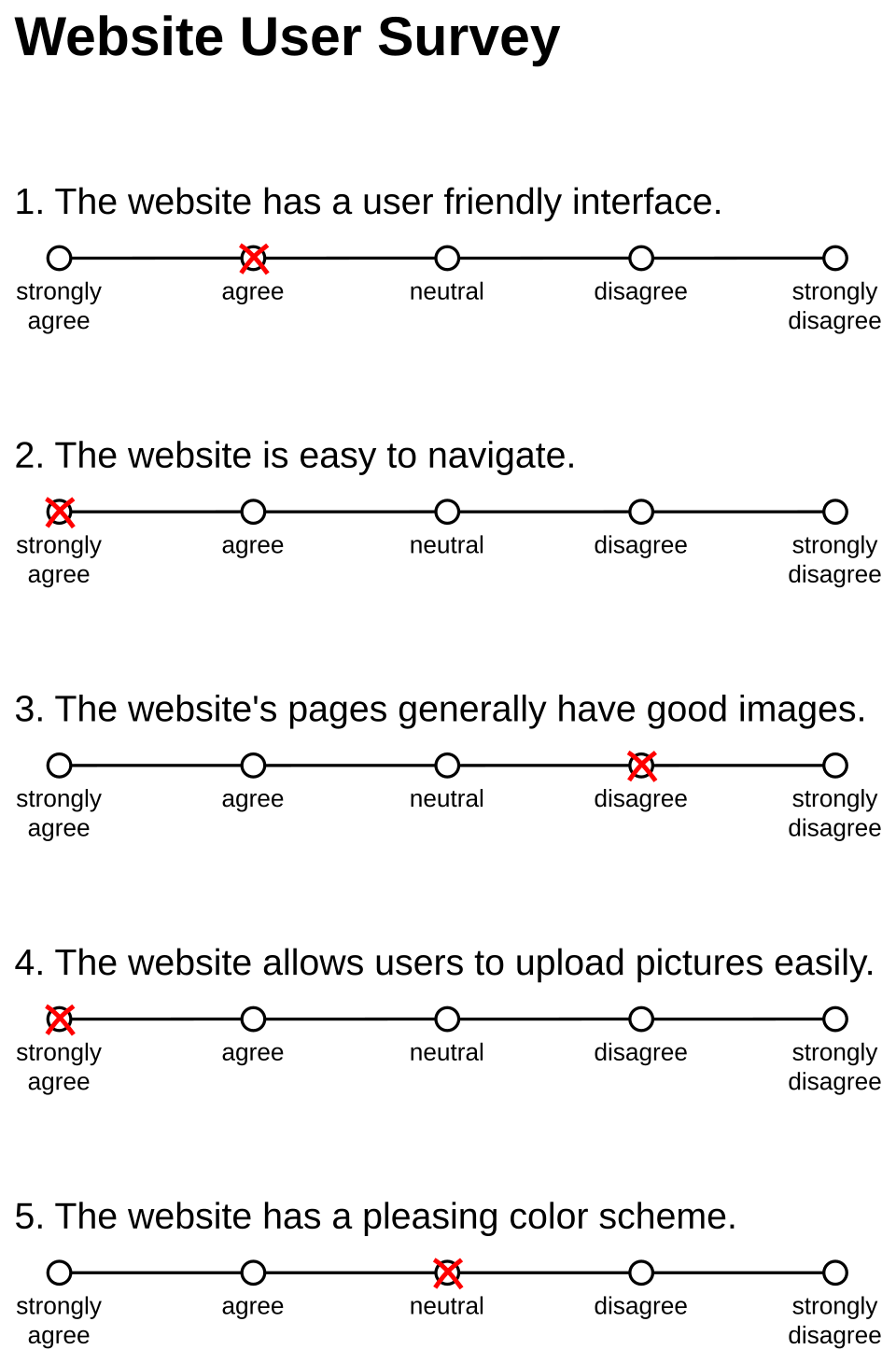 A labelled example of a 5-point Likert scale question used in customer satisfaction surveys. (Image: Nicholas Smith vectorization: Own work, CC BY-SA 3.0, via Wikimedia Commons)
Based on the TU BTTM syllabus for Research Methodology, unit 4.
Discussion
Loading…