PsychologyUnit 711 min read
Memory & Forgetting: Types, Processes, and Failures
Unit 7 of Psychology explores how we encode, store, and retrieve memories, why we forget, and the real-world impact of memory failures—with diagrams, examples, and NEB-style questions to master the topic.
TAKEAWAYS:
- Memory is a three-stage process (encoding → storage → retrieval) that explains how we remember or forget.
- Short-term memory (STM) holds 5–9 items for ~20 seconds unless rehearsed, while long-term memory (LTM) stores unlimited information for years.
- Forgetting happens due to decay, interference, or retrieval failure, not just "bad memory."
- Mnemonic techniques (like acronyms or visualization) improve memory retention.
- False memories can be created through suggestion, showing memory isn’t always accurate.
- Exam tip: Compare memory models (multi-store vs. working memory) and link theories to real-life examples (e.g., eyewitness testimony).
What is Memory?
Memory is the mental process of acquiring, storing, and retrieving information. It helps us learn, make decisions, and recognize people. Without memory, we couldn’t remember our name, a friend’s face, or how to ride a bike!
Types of Memory
Memory isn’t one thing—it’s divided into three main types, each with a different job:
graph TD
  root["Memory Types"]
  root --> STM["Short-Term Memory (STM)"]
  root --> LTM["Long-Term Memory (LTM)"]
  root --> Sensory["Sensory Memory"]
  STM --> "5–9 items, ~20 sec"
  STM --> "Example: Phone number"
  STM --> "Lost if not rehearsed"
  LTM --> "Unlimited storage"
  LTM --> "Episodic, Semantic, Procedural"
  Sensory --> "1–2 sec snapshot"
  Sensory --> "Iconic (visual), Echoic (auditory)"
Simplified memory types hierarchy with clear examples
1. The Multi-Store Model of Memory (Atkinson & Shiffrin, 1968)
This is the classic memory model that explains how information moves through three stores:
How It Works
Sensory Memory
- Duration: 1–2 seconds (like a camera flash).
- Capacity: Huge (but most info is lost).
- Example: When you see a lightning bolt, your brain briefly holds its image before it fades.
Short-Term Memory (STM)
- Duration: ~20 seconds (unless rehearsed).
- Capacity: 7 ± 2 items (Miller’s Law).
- Example: Remembering a 10-digit phone number by repeating it.
- Loss: If you don’t rehearse (repeat or think about it), the info vanishes.
Long-Term Memory (LTM)
- Duration: Years or a lifetime.
- Capacity: Unlimited (like a hard drive).
- Example: Remembering your first school or how to drive.
Processes
- Encoding: Turning sensory input into a usable form (e.g., visual → words).
- Storage: Keeping info in LTM (e.g., facts, skills).
- Retrieval: Pulling info back out (e.g., recalling a name).
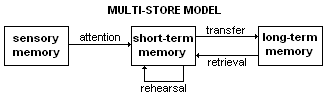 Shows sensory → STM → LTM with arrows for rehearsal and retrieval. (Image: Kurzon at English Wikipedia, Public domain, via Wikimedia Commons)
2. Working Memory Model (Baddeley & Hitch, 1974)
This updates the STM idea by saying it’s not just a single store but a workbench with different parts:
graph TD
  WM["Working Memory"]
  WM --> Phono["Phonological Loop"]
  WM --> Visuo["Visuo-Spatial Sketchpad"]
  WM --> Exec["Central Executive"]
  WM --> Episodic["Episodic Buffer"]
  Phono --> "Sound/words (e.g., poem)"
  Visuo --> "Images/spatial (e.g., map)"
  Exec --> "Controls attention (e.g., math problem)"
  Episodic --> "Time/place context (e.g., birthday)"
Baddeley & Hitch's working memory components with real examples
Why it matters:
- Explains why you can hold a conversation (phonological loop) while looking at a map (visuo-spatial sketchpad) at the same time.
3. Types of Long-Term Memory (LTM)
LTM isn’t one box—it has three subtypes:
| Type | What It Stores | Example | Brain Area |
|---|---|---|---|
| Episodic | Personal experiences (time/place) | Your 10th birthday party | Hippocampus |
| Semantic | Facts & knowledge | Capital of Nepal is Kathmandu | Temporal lobe |
| Procedural | Skills & habits | Riding a bike, typing | Cerebellum & Motor Cortex |
How Do We Forget?
Forgetting isn’t always bad—it helps us focus on what’s important. But why does it happen?
Theories of Forgetting
Decay Theory (Ebbinghaus, 1885)
- Idea: Memories fade if not used.
- Example: Forgetting a friend’s number after not calling them for years.
- Graph:
Interference Theory
- Idea: New info blocks old info (or vice versa).
- Types:
- Proactive Interference: Old info hurts new (e.g., can’t remember new password because old one keeps popping up).
- Retroactive Interference: New info hurts old (e.g., learning Spanish makes you forget French).
Retrieval Failure
- Idea: Info is in LTM but can’t be accessed (like a file saved but not found).
- Example: Walking into a room and forgetting why you went there.
- Fix: Cues (hints) help retrieval (e.g., smelling coffee reminds you of a memory).
Motivated Forgetting
- Idea: We choose to forget painful or embarrassing memories.
- Example: Not remembering a bad argument with a friend.
4. Improving Memory: Techniques & Strategies
A. Mnemonic Devices
Tricks to encode info better:
| Technique | How It Works | Example |
|---|---|---|
| Acronyms | First letters of words form a word | "ROYGBIV" for rainbow colors |
| Acrostics | First letters form a sentence | "My Very Educated Mother Just Served Us Nachos" (planets) |
| Visualization | Turning info into mental images | Imagine a "memory palace" (e.g., your house with clues in each room) |
| Chunking | Grouping info into meaningful units | Phone number: 98-12-3456 instead of 98123456 |
B. Other Tips
- Spaced Repetition: Review info over time (not cramming).
- Active Recall: Test yourself (e.g., flashcards).
- Sleep: Helps consolidate memories (why you remember dreams better after waking up).
5. False Memories & Memory Distortions
Memory isn’t 100% accurate. We can create false memories due to:
- Suggestion: Leading questions (e.g., "Did you see a broken headlight?" vs. "Did you see the headlight?").
- Imagination Inflation: Imagining an event makes it feel real.
- Source Misattribution: Mixing up where you learned something.
Example (Loftus & Palmer, 1974):
- Participants watched a car crash video.
- Asked: "How fast was the car going when it hit/smashed/collided with the other car?"
- Result: The word used changed their memory of the crash’s severity!
6. Real-Life Applications of Memory
| Field | How Memory Matters | Example |
|---|---|---|
| Education | Teaching methods (e.g., mnemonics for exams) | Using acronyms to remember historical dates |
| Law | Eyewitness testimony (but it’s unreliable!) | False memories in court cases |
| Technology | How computers store data (like LTM) | Hard drives = LTM, RAM = STM |
| Health | Memory loss in Alzheimer’s | Early sign: Forgetting recent events |
Exam Tip: How to Score Full Marks
NEB exams test concepts + applications. Here’s how to ace Unit 7:
1. Compare Memory Models
- Multi-Store vs. Working Memory:
- Multi-store: Linear (sensory → STM → LTM).
- Working memory: Active system with components (phonological loop, etc.).
- Example Answer:
"The multi-store model explains memory as a flow from sensory to LTM, while the working memory model describes STM as a multi-component system (Baddeley & Hitch). The latter better explains how we handle multiple tasks (e.g., talking while walking)."
2. Explain Forgetting with Examples
- NEB-style question:
"Why do students forget what they learned in class after a week?"
- Answer:
"Forgetting happens due to decay (not using the info) and interference (new topics blocking old ones). For example, learning Spanish after French may cause retroactive interference, making French words harder to recall."
3. Link Theories to Real Life
- Example:
"Eyewitness testimony is unreliable because of false memories (Loftus & Palmer’s study) and retrieval failure (people forget details over time). This is why police use cognitive interviews (asking open-ended questions) to improve accuracy."
4. Diagram Practice
- Draw and label:
- Multi-store model.
- Working memory components.
- Memory palace for mnemonics.
5. Common Mistakes to Avoid
- ❌ Saying "STM holds unlimited info" (it’s 7 ± 2 items).
- ❌ Confusing episodic (personal events) with semantic (facts).
- ❌ Ignoring retrieval cues in forgetting explanations.
NEB-Style Questions & Answers
Short Answer (5 marks)
Q: Explain the multi-store model of memory with examples of each stage. A: The multi-store model (Atkinson & Shiffrin) has three stages:
- Sensory Memory (1–2 sec): Brief sensory traces (e.g., seeing a flash of light).
- Short-Term Memory (STM) (~20 sec, 7 ± 2 items): Holds info like a phone number if rehearsed.
- Long-Term Memory (LTM): Unlimited storage (e.g., remembering your birthday). Processes:
- Encoding: Turning sensory input into a usable form (e.g., writing notes).
- Retrieval: Pulling info back (e.g., recalling a poem).
Long Answer (10 marks)
Q: Discuss why we forget, giving two theories with examples and one way to improve memory. A: Forgetting occurs due to:
- Decay Theory (Ebbinghaus):
- Memories fade if unused.
- Example: Forgetting a friend’s number after not calling them for years.
- Interference Theory:
- New info blocks old info (or vice versa).
- Example: Learning Spanish makes French words harder to recall (retroactive interference). Improvement:
- Mnemonic devices (e.g., acronyms like "ROYGBIV" for rainbow colors) help encode info better.
- Spaced repetition (reviewing over time) strengthens memory retention.
Quick Revision Checklist
Before the exam, ask yourself: ✅ Can I draw and label the multi-store and working memory models? ✅ Do I know the three types of LTM (episodic, semantic, procedural)? ✅ Can I explain two forgetting theories with examples? ✅ Do I remember one mnemonic technique and how it works? ✅ Can I link memory to real-life cases (e.g., eyewitness testimony)?
Final Tip: Memory is like a library—some books (memories) get lost, but others stay forever if you use them often! 📚✨
Based on the NEB +2 Humanities syllabus for Psychology (Psy), unit 7.
Discussion
Loading…