BiologyUnit 1511 min read
Human Digestive System: Organs, Enzymes, Digestion & Absorption
Unit 15 of Biology explores how humans digest food—from the mouth to the anus—covering organs, enzymes, mechanical/chemical digestion, absorption, and waste elimination, with NEB-style questions and solved examples.
TAKEAWAYS:
- The human digestive system is a tube-within-a-tube with two openings (mouth and anus) and accessory organs (liver, pancreas, gallbladder) that secrete enzymes/digestive juices.
- Digestion involves mechanical breakdown (teeth, peristalsis) and chemical breakdown (enzymes like amylase, pepsin, lipase) to convert food into absorbable nutrients.
- The small intestine is the primary site for nutrient absorption, while the large intestine absorbs water and forms feces.
- Enzymes (e.g., amylase, trypsin, lipase) are protein catalysts that speed up digestion but are not consumed in the process.
- Disorders like indigestion, constipation, and diarrhea occur when digestion or absorption is disrupted.
- NEB exams test labeling diagrams, matching organs to functions, and explaining digestion steps—practice tracing food’s journey!
1. Structure of the Human Digestive System
The digestive system is a long tube (alimentary canal) + accessory organs that work together to break down food, absorb nutrients, and eliminate waste.
1.1 The Alimentary Canal (Digestive Tube)
A muscular tube ~9 meters long, divided into 6 main parts:
flowchart TD
A["Mouth"] --> B["Pharynx"]
B --> C["Esophagus"]
C --> D["Stomach"]
D --> E["Small Intestine"]
E --> F["Large Intestine"]
F --> G["Rectum"]
G --> H["Anus"]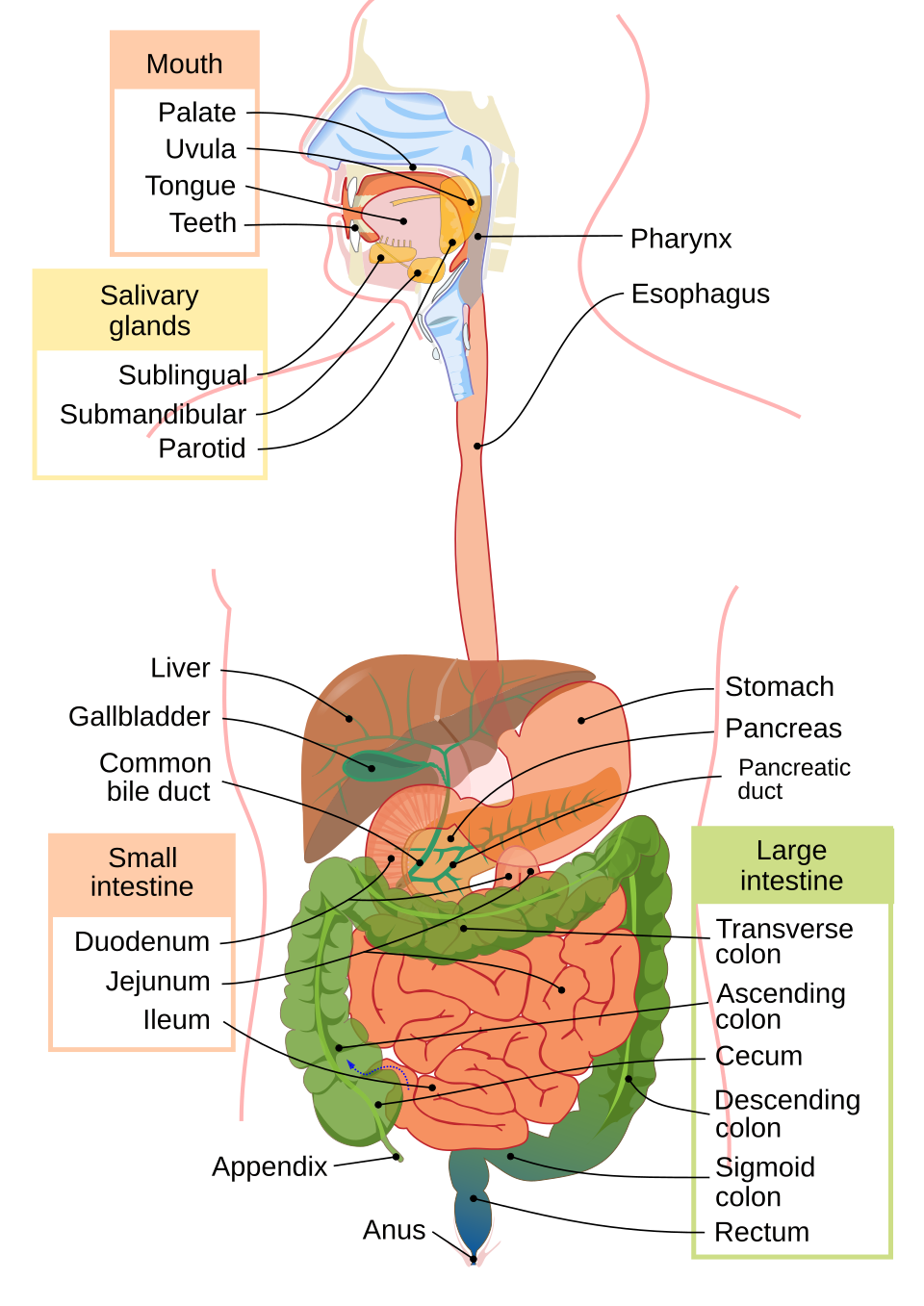 Label the organs and accessory glands. (Image: Mariana Ruiz, Jmarchn, Public domain, via Wikimedia Commons)
1.2 Accessory Organs (Not Part of the Tube but Help Digestion)
| Organ | Function |
|---|---|
| Teeth & Tongue | Mechanical breakdown + mixing with saliva. |
| Salivary Glands | Secrete saliva (contains amylase to digest starch). |
| Liver | Produces bile (emulsifies fats). |
| Gallbladder | Stores and concentrates bile. |
| Pancreas | Secretes pancreatic juice (enzymes like trypsin, lipase, amylase). |
2. Digestion: Mechanical vs. Chemical
Digestion happens in two ways:
- Mechanical Digestion – Physical breakdown of food (chewing, churning, peristalsis).
- Chemical Digestion – Enzymes break down food into smaller molecules.
2.1 Mechanical Digestion
- Mouth: Teeth cut and grind food; tongue mixes it with saliva.
- Stomach: Muscular walls churn food into a semi-liquid called chyme.
- Small Intestine: Peristalsis (wave-like muscle contractions) moves food forward.
2.2 Chemical Digestion (Enzymes Break Down Food)
| Organ | Enzyme | Substrate (Food Type) | Product |
|---|---|---|---|
| Mouth | Salivary Amylase | Starch | Maltose (simple sugar) |
| Stomach | Pepsin | Proteins | Peptides (small proteins) |
| Pancreas | Trypsin | Proteins | Amino acids |
| Pancreatic Amylase | Starch | Maltose | |
| Lipase | Fats | Fatty acids + Glycerol | |
| Small Intestine | Maltase, Sucrase, Lactase | Disaccharides (maltose, sucrose, lactose) | Glucose, Fructose, Galactose |
| Liver | Bile (no enzyme) | Fats | Emulsified fat droplets |
Why enzymes are important?
- They speed up digestion without being used up.
- They work at specific pH levels (e.g., pepsin works in acidic stomach, trypsin in alkaline small intestine).
3. Step-by-Step Digestion Journey
Let’s trace a carbohydrate-rich meal (e.g., roti) through the digestive system:
Step 1: Mouth (Ingestion & Mechanical Digestion)
- Teeth break roti into smaller pieces.
- Saliva (from salivary glands) contains amylase, which starts breaking starch → maltose.
- Bolus (chewed food) is formed and swallowed.
Step 2: Esophagus (Transport)
- Peristalsis (muscle contractions) pushes the bolus down to the stomach (~6-8 seconds).
Step 3: Stomach (Protein Digestion & Chyme Formation)
- Gastric juice (HCl + pepsin) breaks down proteins → peptides.
- Mucus protects the stomach lining from acid.
- Food turns into chyme (thick, semi-liquid paste).
Step 4: Small Intestine (Main Digestion & Absorption)
- Duodenum (first part) receives:
- Pancreatic juice (enzymes: trypsin, amylase, lipase).
- Bile (from liver, stored in gallbladder) emulsifies fats.
- Villi & Microvilli increase surface area for absorption.
- Nutrients absorbed:
- Carbohydrates → Glucose → Blood.
- Proteins → Amino acids → Blood.
- Fats → Fatty acids + glycerol → Lymph (lacteals).
Step 5: Large Intestine (Water Absorption & Feces Formation)
- Water & electrolytes (Na⁺, K⁺) are absorbed.
- Gut bacteria help digest undigested food (e.g., cellulose in vegetables).
- Feces (solid waste) is formed and stored in the rectum before elimination.
Step 6: Rectum & Anus (Egestion)
- Feces are expelled through the anus via defecation.
4. Absorption of Nutrients
The small intestine is the main absorption site due to:
- Villi (finger-like projections).
- Microvilli (tiny projections on villi).
- Large surface area (~200 m², like a tennis court!).
| Nutrient | Absorbed In | Absorbed As | Transport |
|---|---|---|---|
| Carbohydrates | Jejunum | Glucose, Fructose | Blood (via hepatic portal vein) |
| Proteins | Duodenum/Jejunum | Amino acids | Blood |
| Fats | Ileum | Fatty acids + Glycerol | Lymph (lacteals) → Blood |
| Vitamins/Minerals | Throughout small intestine | Depends on vitamin (e.g., B12 needs intrinsic factor) | Blood |
5. Common Digestive Disorders
| Disorder | Cause | Symptoms | Prevention |
|---|---|---|---|
| Indigestion | Overeating, spicy food, stress | Bloating, nausea, heartburn | Eat slowly, avoid junk food |
| Constipation | Low fiber, dehydration, lack of exercise | Hard stools, straining | Drink water, eat fruits/veggies |
| Diarrhea | Infection, food poisoning, stress | Frequent watery stools | Oral rehydration, probiotics |
| Ulcer | Helicobacter pylori bacteria, excess acid | Stomach pain, bleeding | Antibiotics, avoid smoking |
| Jaundice | Liver disease, bile duct blockage | Yellow skin/eyes, dark urine | Vaccinations, healthy liver diet |
6. Worked Example: Tracing Digestion of a Burger
Question: Where does each part of a burger (bread, beef, cheese, lettuce) get digested? Solution:
| Food Part | Digestion Site | Enzyme Involved | End Product |
|---|---|---|---|
| Bread (starch) | Mouth, Small Intestine | Salivary amylase, pancreatic amylase | Glucose |
| Beef (protein) | Stomach, Small Intestine | Pepsin, Trypsin | Amino acids |
| Cheese (fat) | Small Intestine | Lipase, Bile | Fatty acids + Glycerol |
| Lettuce (fiber) | Large Intestine (bacteria) | None (mostly undigested) | Feces |
7. NEB-Style Questions & Answers
Question 1: Label the Diagram
Diagram: Human digestive system (mouth to anus). Answer:
Mouth → Pharynx → Esophagus → Stomach → Small Intestine (Duodenum → Jejunum → Ileum) → Large Intestine (Cecum → Colon → Rectum) → Anus
Accessory Organs: Salivary glands, Liver, Gallbladder, Pancreas
Question 2: Short Answer
Q: Why is bile important in digestion? A:
- Bile is not an enzyme but emulsifies fats (breaks large fat globules into smaller droplets).
- Increases surface area for lipase to act efficiently.
- Produced in the liver, stored in the gallbladder, released into the duodenum.
Question 3: Match the Column
Match the organ to its function:
| Organ | Function |
|---|---|
| Stomach | Secretes HCl and pepsin for protein digestion |
| Liver | Produces bile for fat emulsification |
| Pancreas | Secretes digestive enzymes (amylase, lipase, trypsin) |
| Large Intestine | Absorbs water and forms feces |
Question 4: Essay Type
Q: Explain the role of enzymes in digestion with examples. A: Enzymes are biological catalysts that speed up digestion without being used up.
- Amylase (in saliva and pancreatic juice) breaks starch → maltose.
- Pepsin (in stomach) breaks proteins → peptides (works in acidic pH).
- Trypsin (from pancreas) breaks peptides → amino acids (works in alkaline pH).
- Lipase (from pancreas) breaks fats → fatty acids + glycerol. Example:
- If you eat rice (starch), amylase in saliva starts digestion in the mouth, and pancreatic amylase continues in the small intestine to produce glucose for absorption.
Exam Tip
✅ For NEB exams, focus on:
- Labeling diagrams (mouth, stomach, small intestine structure).
- Matching organs to functions (e.g., liver → bile, pancreas → enzymes).
- Explaining digestion steps (trace food from mouth to anus).
- Enzyme actions (what they digest and where they work).
- Absorption sites (small intestine for nutrients, large intestine for water).
🚫 Avoid memorizing long lists—understand how digestion happens step-by-step.
Compare the length of the small and large intestines. (Image: Mariana Ruiz, Jmarchn, Public domain, via Wikimedia Commons)
Based on the NEB +2 Science syllabus for Biology (Bio), unit 15.
Discussion
Loading…