BiologyUnit 127 min read
Excretory System: Organs, Functions & Homeostasis
Unit 12 of Biology covers the human excretory system, including kidneys, nephrons, urine formation, and homeostasis, with NEB-style questions and solved examples to master the topic.
TAKEAWAYS:
- The excretory system removes metabolic wastes (urea, uric acid, excess salts) while maintaining homeostasis (balanced internal conditions).
- The kidneys filter blood via nephrons (functional units) to produce urine, while the liver detoxifies harmful substances.
- Urine formation involves filtration, reabsorption, and secretion—three key processes in nephrons.
- The loop of Henle creates a concentration gradient for water reabsorption, crucial for urine concentration.
- Dialysis and kidney transplantation are medical solutions for kidney failure.
- NEB exams test definitions, processes (e.g., urine formation), and comparisons (e.g., kidneys vs. liver).
1. Introduction to the Excretory System
The excretory system removes metabolic wastes (like urea, uric acid, CO₂) and excess substances (water, salts) from the body. It maintains homeostasis (stable internal conditions).
Why is excretion important?
- Removes toxic waste (e.g., urea from protein breakdown).
- Regulates water and salt balance.
- Maintains pH balance in blood.
Main organs:
- Kidneys (primary excretory organs)
- Liver (detoxifies blood)
- Skin (sweat glands remove excess water and salts)
- Lungs (remove CO₂)
- Large intestine (removes undigested food as feces)
2. Kidneys: Structure and Function
A. Location and Structure
- Two bean-shaped organs located on either side of the spine.
- Outer layer (cortex) and inner layer (medulla).
- Nephrons (functional units) are present in millions in each kidney.
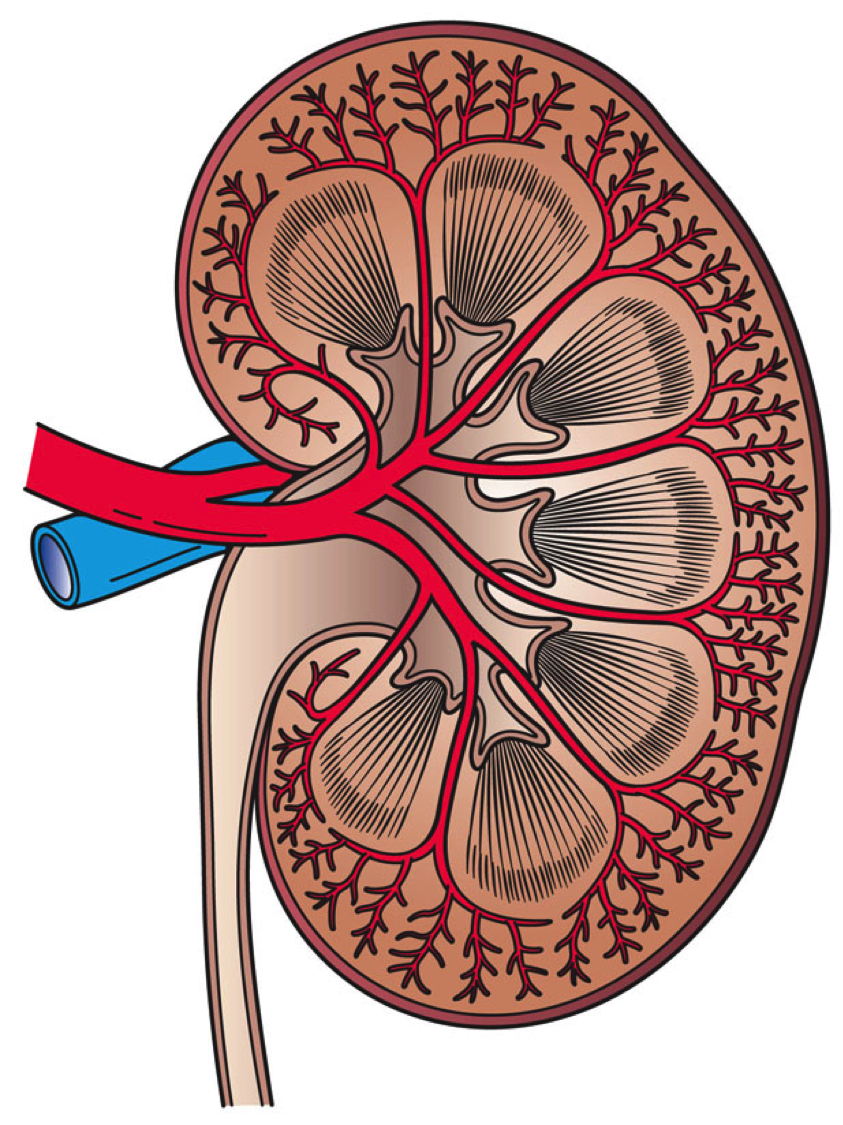 Internal structure showing cortex, medulla, and nephrons (Image: Artwork by Holly Fischer, CC BY 3.0, via Wikimedia Commons)
B. Functions of the Kidneys
- Filtration – Removes waste from blood.
- Reabsorption – Takes back useful substances (glucose, water, salts).
- Secretion – Adds extra waste (e.g., H⁺ ions) to urine.
- Regulation – Controls blood pressure and pH.
3. Nephron: The Functional Unit of the Kidney
A nephron is a tiny tube-like structure where urine formation happens.
Structure of a Nephron
graph LR
    A["Bowman's Capsule"] --> B["Proximal Convoluted Tubule"]
    B --> C["Loop of Henle"]
    C --> D["Distal Convoluted Tubule"]
    D --> E["Collecting Duct"]
    A -->|"Blood enters"| F["Glomerulus"]
    F -->|"Filtration"| A
    B -->|"Reabsorption"| G["Peritubular Capillaries"]
    D -->|"Secretion"| G
Processes in a Nephron
Filtration (Glomerulus → Bowman’s Capsule)
- Blood pressure forces water, glucose, salts, and urea into Bowman’s capsule.
- Blood cells and proteins remain in blood.
Reabsorption (Proximal Convoluted Tubule)
- 99% of water, glucose, and salts are reabsorbed back into blood.
- Selective reabsorption (e.g., glucose is fully reabsorbed; excess remains in urine).
Secretion (Distal Convoluted Tubule & Collecting Duct)
- Extra waste (H⁺, K⁺, drugs) is added to urine.
- ADH (Antidiuretic Hormone) controls water reabsorption.
4. Urine Formation: Step-by-Step
| Process | Where? | What Happens? |
|---|---|---|
| Filtration | Glomerulus → Bowman’s Capsule | Blood plasma → filtrate (water, glucose, urea, salts) |
| Reabsorption | Proximal Convoluted Tubule | Glucose, water, salts reabsorbed into blood |
| Secretion | Distal Convoluted Tubule | Extra waste (H⁺, K⁺) added to urine |
| Water Balance | Collecting Duct | ADH controls water reabsorption |
Example:
- If blood glucose is high, all glucose is reabsorbed.
- If blood glucose is very high (diabetes), excess glucose appears in urine (glucosuria).
5. Role of the Loop of Henle
The loop of Henle creates a concentration gradient for water reabsorption.
graph TD
    A["Descending Limb"] -->|"Water leaves"| B["Interstitial Fluid"]
    C["Ascending Limb"] -->|"Salts leave"| D["Interstitial Fluid"]
    B -->|"High salt concentration"| E["Water reabsorption in Collecting Duct"]
Why is this important?
- Helps kidneys concentrate urine (less water lost).
- Maintains blood volume and pressure.
6. Other Excretory Organs
| Organ | Waste Removed | How? |
|---|---|---|
| Liver | Urea, bilirubin | Detoxifies blood (ammonia → urea) |
| Skin | Water, salts | Sweat glands |
| Lungs | CO₂, water | Exhalation |
| Large Intestine | Feces | Removes undigested food |
7. Disorders of the Excretory System
| Disorder | Cause | Effect |
|---|---|---|
| Kidney Failure | Diabetes, hypertension | Toxins build up in blood |
| Kidney Stones | Calcium buildup | Painful urination |
| Uremia | Kidney failure | High urea in blood (toxic) |
| Diabetes Insipidus | ADH deficiency | Excessive urine output |
Medical Solutions:
- Dialysis (artificial kidney machine)
- Kidney Transplant (donor kidney replaces failed one)
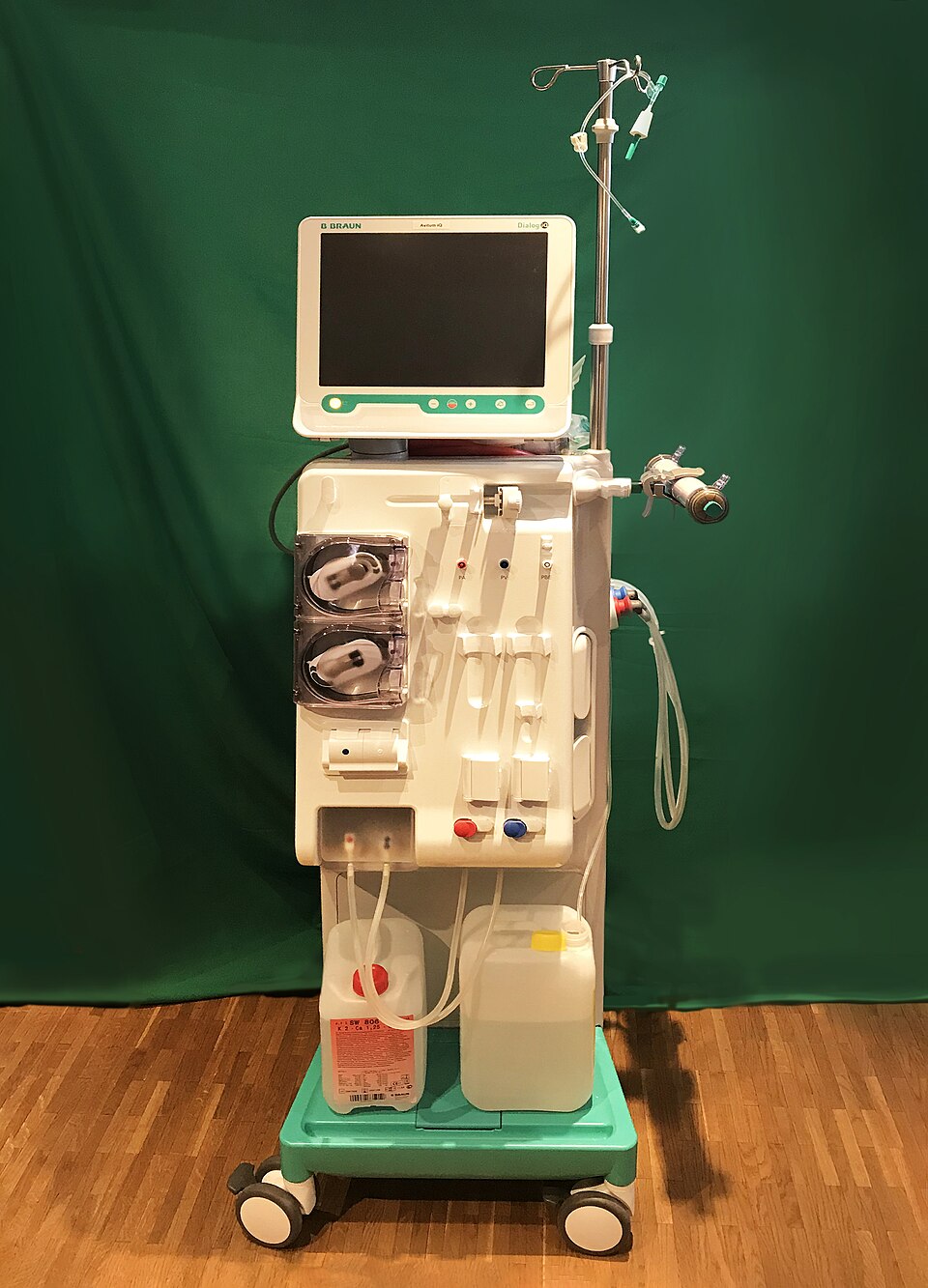 How a dialysis machine works (Image: Jonas@sodratornet.se, CC BY-SA 4.0, via Wikimedia Commons)
8. NEB-Style Questions & Solutions
Short Answer Questions
Define excretion.
- Answer: Excretion is the removal of metabolic wastes (urea, CO₂, excess salts) from the body to maintain homeostasis.
What is the role of the loop of Henle?
- Answer: It creates a salt concentration gradient that helps reabsorb water, making urine concentrated.
How does ADH affect urine output?
- Answer: ADH increases water reabsorption in the collecting duct, reducing urine volume.
Long Answer Questions
Describe the process of urine formation in a nephron.
- Answer:
- Filtration in Bowman’s capsule (blood → filtrate).
- Reabsorption in PCT (glucose, water, salts back to blood).
- Secretion in DCT (extra waste added).
- Water balance in collecting duct (ADH controls output).
- Answer:
Compare the functions of the kidneys and liver in excretion.
Kidneys Liver Removes urea, excess water, salts Detoxifies blood (ammonia → urea) Regulates blood pressure Produces bile (digestion) Produces urine Stores glycogen
Exam Tip
✅ NEB often asks:
- Definitions (e.g., excretion, nephron, dialysis).
- Processes (urine formation steps).
- Comparisons (kidneys vs. liver, filtration vs. reabsorption).
- Disorders (kidney failure, diabetes insipidus).
🔹 Key formulas to remember:
- Urine concentration depends on ADH and loop of Henle.
- Glomerular filtration rate (GFR) = Volume filtered per minute.
🔹 Diagrams are crucial! Always label:
- Nephron parts (Bowman’s capsule, loop of Henle, collecting duct).
- Blood flow in kidneys (renal artery → glomerulus → renal vein).
Final Note:
- Practice drawing nephron diagrams (NEB loves them!).
- Memorize urine formation steps (filtration → reabsorption → secretion).
- Understand ADH’s role in water balance.
Good luck! 🚀
Based on the NEB +2 Science syllabus for Biology (Bio), unit 12.
Discussion
Loading…